
If China Invades Taiwan, Which Stocks Could Win—and Which Could Crash? Explore how a potential Taiwan conflict could affect markets, sectors, and long-term investment strategies.
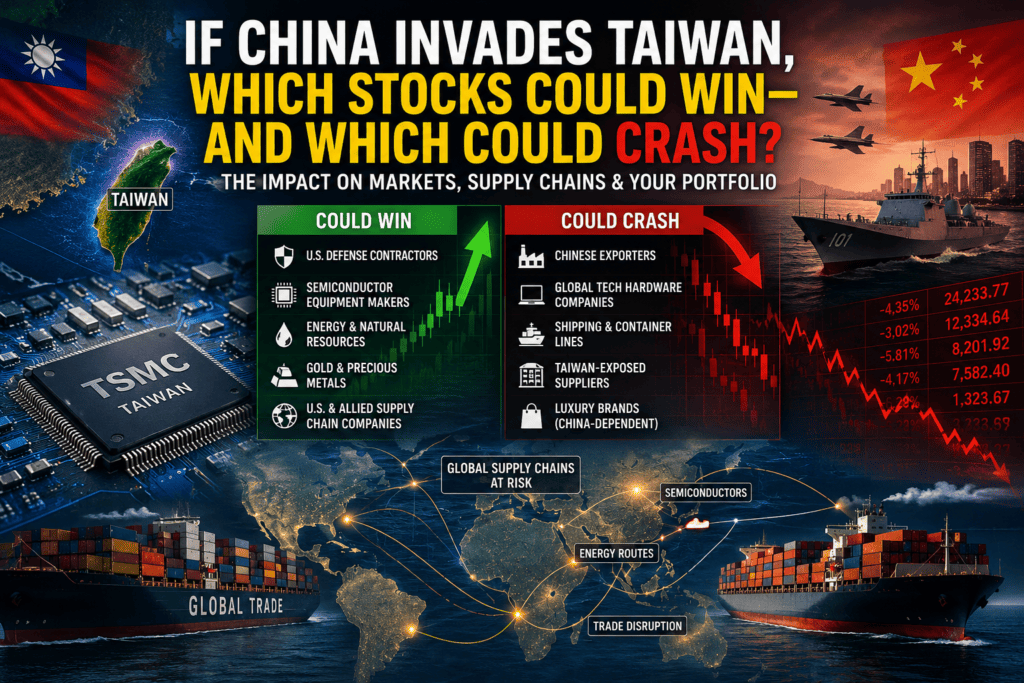
If China Invades Taiwan, Which Stocks Could Win—and Which Could Crash? illustration showing semiconductor chips, stock market charts, cargo ships, and global trade routes
Introduction
If China Invades Taiwan, Which Stocks Could Win—and Which Could Crash? This question has become increasingly common as geopolitical tensions continue to dominate financial headlines. While no one can predict future political or military events, investors often evaluate hypothetical scenarios to better understand potential risks and prepare their portfolios for uncertainty.
Taiwan plays an exceptionally important role in the global economy. In particular, it is a critical hub for semiconductor manufacturing, supplying advanced chips used in smartphones, automobiles, artificial intelligence, cloud computing, and countless other technologies. Consequently, any major disruption involving Taiwan could have far-reaching effects on global supply chains, corporate earnings, commodity prices, and financial markets.
At the same time, markets rarely respond to geopolitical headlines in a simple or predictable way. Initial reactions are often driven by fear, speculation, and rapidly changing expectations. Nevertheless, long-term investment performance usually depends on economic fundamentals rather than temporary panic.
Throughout this guide, we’ll examine how a hypothetical military conflict involving China and Taiwan could influence different sectors of the U.S. stock market. More importantly, we’ll discuss how investors can evaluate potential risks, identify industries that may benefit or face challenges, and maintain a disciplined investment strategy without relying on speculation or emotional decision-making.
Key Takeaways
- A hypothetical China–Taiwan conflict could create significant market volatility.
- Semiconductor supply chains would likely receive intense investor attention.
- Defense, cybersecurity, and some energy companies could experience increased demand under certain scenarios.
- Technology manufacturers dependent on Taiwanese chips could face operational challenges.
- Commodity prices may become more volatile.
- Diversification remains essential during geopolitical uncertainty.
- Long-term investors should focus on fundamentals rather than headlines.
- No geopolitical scenario guarantees specific investment outcomes.
Why Taiwan Matters to the Global Economy
Taiwan is much more than a small island in East Asia.
It occupies a central position in the global technology supply chain, particularly in semiconductor manufacturing. Modern economies depend on advanced computer chips for everything from smartphones and laptops to electric vehicles, industrial equipment, medical devices, and artificial intelligence systems.
Because so many industries rely on these components, disruptions to semiconductor production could affect businesses around the world.
Furthermore, multinational corporations often depend on highly integrated global supply chains that cannot be replaced overnight.
Why Investors Monitor China–Taiwan Relations
Financial markets closely watch geopolitical developments involving China and Taiwan because uncertainty influences investor expectations.
Although governments, analysts, and financial institutions monitor diplomatic and military developments continuously, no one can predict future events with certainty.
Instead, investors analyze possible scenarios to better understand potential economic consequences.
Consequently, market participants frequently evaluate factors such as:
- Global trade
- Semiconductor production
- Shipping routes
- International sanctions
- Commodity prices
- Currency markets
- Corporate earnings
Each of these variables can influence market sentiment before any measurable economic impact occurs.
How Financial Markets Typically React to Geopolitical Tensions
Markets generally dislike uncertainty.
Whenever investors face limited information about future risks, volatility often increases.
Initially, stock prices may decline as traders reduce exposure to perceived risk.
Meanwhile, investors sometimes move capital toward assets traditionally viewed as defensive, such as U.S. Treasury securities or certain sectors considered more resilient during uncertain economic conditions.
However, short-term volatility does not necessarily predict long-term market performance.
History demonstrates that markets often stabilize once uncertainty begins to decline and investors gain greater visibility into economic conditions.
Why Semiconductors Would Be Central to the Story
Semiconductors are essential to nearly every modern industry.
Unlike many manufactured products, advanced chips require highly specialized facilities, sophisticated engineering, and years of research and development.
As a result, replacing lost production capacity would be extremely difficult in the short term.
Industries potentially affected include:
- Artificial intelligence
- Cloud computing
- Consumer electronics
- Automotive manufacturing
- Aerospace
- Medical technology
- Telecommunications
- Industrial automation
Because semiconductor shortages have previously disrupted global production, investors carefully monitor companies operating throughout the chip supply chain.
Supply Chains Could Become a Major Concern
Global supply chains have become increasingly interconnected.
Many manufacturers source components from multiple countries before assembling finished products elsewhere.
Consequently, disruptions affecting one critical region can influence production across numerous industries.
For example, delays involving semiconductor availability could increase manufacturing costs while slowing product deliveries.
Likewise, shipping disruptions might affect logistics companies, retailers, and international trade.
These interconnected relationships explain why financial markets often react quickly to geopolitical developments.
Which Market Factors Would Investors Watch Most Closely?
If geopolitical tensions intensified significantly, professional investors would likely monitor several economic indicators.
Among the most important would be:
- Semiconductor production
- Global shipping activity
- Oil and natural gas prices
- Inflation expectations
- Central bank policy
- Currency movements
- Corporate earnings guidance
- Consumer confidence
Together, these indicators provide valuable insight into how businesses and financial markets are responding to evolving economic conditions.
Why Emotional Investing Can Be Dangerous
Major geopolitical headlines naturally trigger emotional reactions.
Fear, uncertainty, and sensational media coverage often encourage investors to make quick decisions.
Nevertheless, history shows that emotional investing frequently leads to buying high and selling low.
Experienced investors generally avoid making portfolio changes based solely on headlines.
Instead, they review company fundamentals, diversification, long-term objectives, and overall risk exposure before adjusting their investment strategy.
In the next section, we’ll explore which industries could potentially benefit under this hypothetical scenario, which sectors might face greater challenges, and what historical market behavior can teach investors about navigating periods of geopolitical uncertainty.
Which Industries Could Potentially Benefit?
If geopolitical tensions involving China and Taiwan were to escalate significantly, certain industries could receive increased attention from investors.
That does not guarantee these sectors would outperform. However, history suggests that some businesses may experience stronger demand under periods of geopolitical uncertainty.
Let’s examine the sectors that investors would likely monitor most closely.
Defense Companies
Defense contractors are often among the first industries investors evaluate during periods of military uncertainty.
Governments may increase defense spending when geopolitical risks rise. Consequently, companies that manufacture military aircraft, missile systems, communications equipment, radar technology, and defense software could receive additional government contracts.
Potential areas of increased demand include:
- Missile defense systems
- Military aircraft
- Naval equipment
- Intelligence technology
- Satellite communications
- Defense electronics
Nevertheless, investors should remember that government spending decisions vary significantly from one situation to another.
Cybersecurity Companies
Modern conflicts extend far beyond traditional battlefields.
Cyberattacks have become an increasingly important national security concern.
As a result, governments and private companies often increase investments in cybersecurity during periods of heightened geopolitical tension.
Organizations may seek additional protection for:
- Financial systems
- Power grids
- Hospitals
- Telecommunications
- Government networks
- Cloud infrastructure
Consequently, cybersecurity businesses could receive increased attention from long-term investors.
Energy Companies
Energy markets frequently respond to geopolitical developments.
Although Taiwan itself is not a major oil producer, broader regional instability could influence global shipping routes and investor expectations.
If energy prices were to increase, several segments of the industry might benefit.
Examples include:
- Integrated oil companies
- Exploration and production firms
- Pipeline operators
- Liquefied natural gas (LNG) businesses
- Oilfield service providers
Even so, commodity markets remain highly unpredictable.
Therefore, investors should avoid assuming that higher oil prices will automatically translate into stronger stock performance.
Domestic Semiconductor Manufacturers
Taiwan plays a central role in advanced semiconductor production.
If global supply chains experienced major disruptions, governments and businesses could accelerate efforts to expand domestic manufacturing capacity.
Consequently, companies involved in semiconductor fabrication, equipment manufacturing, chip design, and industrial automation might attract increased investor interest.
Furthermore, long-term investments in domestic production facilities could reshape portions of the global semiconductor industry over many years.
Which Industries Could Face Greater Challenges?
While some sectors might benefit, others could experience additional pressure.
Businesses that depend heavily on global supply chains may face increased operational risks.
Examples include:
Consumer Electronics
Many electronics manufacturers rely on advanced semiconductors produced in Asia.
Consequently, supply shortages could delay production while increasing costs.
Automotive Manufacturers
Modern vehicles require hundreds—or even thousands—of semiconductor components.
Therefore, production interruptions could reduce manufacturing output if chip availability declined.
Consumer Discretionary Companies
Periods of geopolitical uncertainty sometimes reduce consumer confidence.
As a result, discretionary spending on luxury goods, travel, and entertainment may weaken temporarily.
Global Shipping and Logistics
Shipping companies could experience changing trade routes, increased insurance costs, or transportation delays depending on evolving geopolitical conditions.
However, the overall impact would depend heavily on the specific circumstances.
Comparing Potential Winners and Challenges
| Sector | Possible Impact | Key Considerations |
|---|---|---|
| Defense | Potentially Positive | Government spending |
| Cybersecurity | Potentially Positive | Rising digital security demand |
| Energy | Potentially Positive | Commodity price movements |
| Domestic Semiconductors | Potentially Positive | Supply chain investment |
| Consumer Electronics | Potentially Negative | Chip shortages |
| Automotive | Potentially Negative | Semiconductor dependence |
| Consumer Discretionary | Potentially Negative | Lower consumer confidence |
| Global Logistics | Mixed | Trade route disruptions |
This comparison illustrates that market reactions often differ significantly across industries.
Why Diversification Matters More Than Ever
Periods of uncertainty remind investors why diversification remains one of the cornerstones of long-term investing.
Rather than attempting to predict exactly which sector will outperform, many experienced investors spread their assets across multiple industries.
A diversified portfolio may include:
- Broad-market ETFs
- Dividend stocks
- REITs
- Energy companies
- Technology businesses
- Bonds
- Cash reserves
This balanced approach helps reduce the impact of unexpected market events.
Inflation Could Become an Important Variable
Geopolitical tensions sometimes contribute to higher inflation.
For example, disruptions affecting global trade or energy supplies may increase production costs for businesses.
Eventually, those higher costs may be passed on to consumers.
If inflation accelerates, central banks could respond by maintaining higher interest rates or adjusting monetary policy.
Consequently, investors often monitor inflation data alongside geopolitical developments.
Market Sentiment Can Change Quickly
Investor psychology frequently changes faster than economic fundamentals.
Breaking news may trigger sharp market swings within minutes.
Nevertheless, markets also recover surprisingly quickly when uncertainty begins to fade.
Because of this dynamic, reacting emotionally to every headline can become costly.
Instead, successful investors generally evaluate whether new information materially changes long-term business prospects before making portfolio adjustments.
Preparing for Multiple Outcomes
No one can predict how geopolitical events will unfold.
Rather than focusing on one specific scenario, experienced investors often prepare for several possible outcomes.
This preparation includes:
- Reviewing portfolio diversification.
- Understanding sector exposure.
- Evaluating overall risk tolerance.
- Maintaining sufficient liquidity.
- Continuing regular investments when appropriate.
By planning ahead instead of reacting impulsively, investors place themselves in a stronger position regardless of future market developments.
In the final section, we’ll explore practical investment strategies, common mistakes to avoid during geopolitical crises, frequently asked questions, and the most important lessons long-term investors can learn from historical market behavior.
Expert Insights: Preparing Your Portfolio Without Predicting the Future
One of the most valuable lessons investors can learn is that preparing for uncertainty is usually more productive than trying to predict the next geopolitical event.
Financial markets have experienced wars, political crises, pandemics, inflation, recessions, and banking shocks throughout history. Even so, investors who maintained diversified portfolios and followed disciplined strategies often navigated these periods more successfully than those who constantly reacted to breaking news.
Although a hypothetical conflict involving China and Taiwan could create significant volatility, no one can forecast exactly how governments, businesses, or financial markets would respond. Therefore, investors should avoid making major portfolio decisions based solely on speculation.
Instead, focus on building a portfolio that can withstand a variety of economic environments.
Common Investing Mistakes During Geopolitical Crises
Periods of heightened uncertainty often encourage emotional decision-making.
Fortunately, recognizing common mistakes can help investors stay focused on long-term objectives.
Mistake 1: Selling Everything During Market Panic
Sharp declines naturally create fear.
However, history shows that many investors who sell during periods of panic struggle to buy back into the market before prices recover.
Consequently, emotional selling can permanently reduce long-term returns.
Mistake 2: Investing Based Only on Headlines
News coverage changes rapidly.
While headlines provide useful information, they rarely tell the entire investment story.
Instead of reacting immediately, evaluate whether new developments genuinely change long-term business fundamentals.
Mistake 3: Ignoring Diversification
Some investors become overly concentrated in one sector after reading optimistic forecasts.
Nevertheless, diversification remains one of the most effective ways to reduce portfolio risk.
Balancing investments across several industries helps limit the impact of unexpected events.
Mistake 4: Chasing Short-Term Performance
When one sector suddenly outperforms, many investors rush to buy after prices have already increased.
Unfortunately, chasing recent performance often results in buying near market highs.
A disciplined investment strategy generally produces better long-term outcomes.
A Practical Investment Action Plan
If geopolitical tensions become a significant market concern, consider following this step-by-step framework.
Step 1: Review Your Portfolio
Understand your current exposure to technology, energy, defense, international markets, and other major sectors.
Knowing what you already own helps you make more informed decisions.
Step 2: Maintain Diversification
Continue spreading investments across multiple asset classes.
A balanced portfolio may include:
- Broad-market ETFs
- Dividend-paying stocks
- REITs
- Bonds
- Cash reserves
- Select international investments
Diversification cannot eliminate risk.
However, it can reduce the impact of unexpected market events.
Step 3: Focus on High-Quality Companies
During uncertain periods, businesses with strong balance sheets, healthy cash flow, and experienced management teams often demonstrate greater resilience.
Consequently, quality should remain an important part of every investment decision.
Step 4: Avoid Emotional Trading
Market volatility creates opportunities as well as risks.
Rather than reacting to every headline, review your investment plan before making significant portfolio changes.
Patience frequently becomes one of an investor’s greatest advantages.
Step 5: Continue Learning
Financial markets constantly evolve.
Therefore, continue improving your understanding of:
- Global trade
- Geopolitics
- Inflation
- Interest rates
- Risk management
- Portfolio diversification
- Behavioral finance
Education remains one of the few investments that can benefit every investor regardless of market conditions.
Frequently Asked Questions
Would a conflict involving Taiwan automatically cause a stock market crash?
Not necessarily.
Although markets could experience significant volatility, historical evidence shows that investor reactions vary depending on economic conditions, policy responses, and corporate fundamentals.
Which sectors might receive increased investor attention?
Defense, cybersecurity, energy, and some domestic semiconductor companies could attract additional interest under certain hypothetical scenarios.
However, future market performance cannot be predicted with certainty.
Why is Taiwan important to global investors?
Taiwan plays a major role in advanced semiconductor manufacturing.
Because modern industries rely heavily on these components, disruptions could affect technology, automotive production, industrial manufacturing, and global supply chains.
Should long-term investors change their strategy because of geopolitical headlines?
Many financial professionals recommend reviewing portfolio risk while maintaining a disciplined long-term investment strategy rather than reacting emotionally to short-term news.
Could inflation increase during geopolitical crises?
Yes.
Supply chain disruptions, higher energy prices, and increased transportation costs may contribute to inflationary pressures under certain circumstances.
Is diversification still the best strategy?
For many investors, diversification remains one of the most effective methods of managing long-term portfolio risk.
No single sector consistently outperforms under every economic condition.
What is the most important lesson investors should remember?
Successful investing usually depends more on discipline, diversification, and patience than on predicting geopolitical events.
Final Thoughts
If China Invades Taiwan, Which Stocks Could Win—and Which Could Crash? is ultimately a question about managing uncertainty rather than predicting the future.
While geopolitical risks deserve careful attention, they should never become the sole basis for investment decisions.
History demonstrates that markets eventually adapt to changing economic conditions, even after periods of significant volatility.
Consequently, investors who focus on diversification, company fundamentals, and long-term financial goals often place themselves in a stronger position than those who react emotionally to every headline.
Instead of trying to forecast every geopolitical development, concentrate on building a resilient portfolio that can perform across a wide range of economic environments.
Over time, patience, discipline, and continuous learning remain among the most valuable advantages any investor can possess.
Internal Linking Opportunities
Strengthen your website’s SEO by linking this article to related content using anchor texts such as:
- How Wars Have Historically Affected the U.S. Stock Market
- How the Iran Conflict Could Send Oil Prices Soaring—and Which Stocks May Benefit
- Investing During Market Volatility
- Best Dividend Stocks for Long-Term Investors
- How Inflation Affects Your Investment Portfolio
- REIT Investing Guide
- Dollar-Cost Averaging Explained
- Warren Buffett’s Investment Strategy
- Building a Diversified Portfolio
- Passive Income Strategies
External Authority Sources
Readers who want to deepen their understanding of these topics can consult the following trusted organizations:
- U.S. Securities and Exchange Commission (SEC): https://www.sec.gov
- Federal Reserve: https://www.federalreserve.gov
- U.S. Department of Commerce: https://www.commerce.gov
- Congressional Research Service (CRS): https://crsreports.congress.gov
- Morningstar: https://www.morningstar.com
Final Call to Action
Geopolitical events will continue to influence financial markets from time to time.
Rather than allowing uncertainty to dictate your investment decisions, focus on building a diversified portfolio, improving your financial knowledge, and maintaining a disciplined long-term strategy.
Although no investor can eliminate risk completely, thoughtful planning and consistent decision-making can help you navigate changing market conditions with greater confidence.