

The Global Wealth Shift: Where Smart Money Is Moving Next. Discover the economic trends, industries, and investment opportunities shaping the next decade.
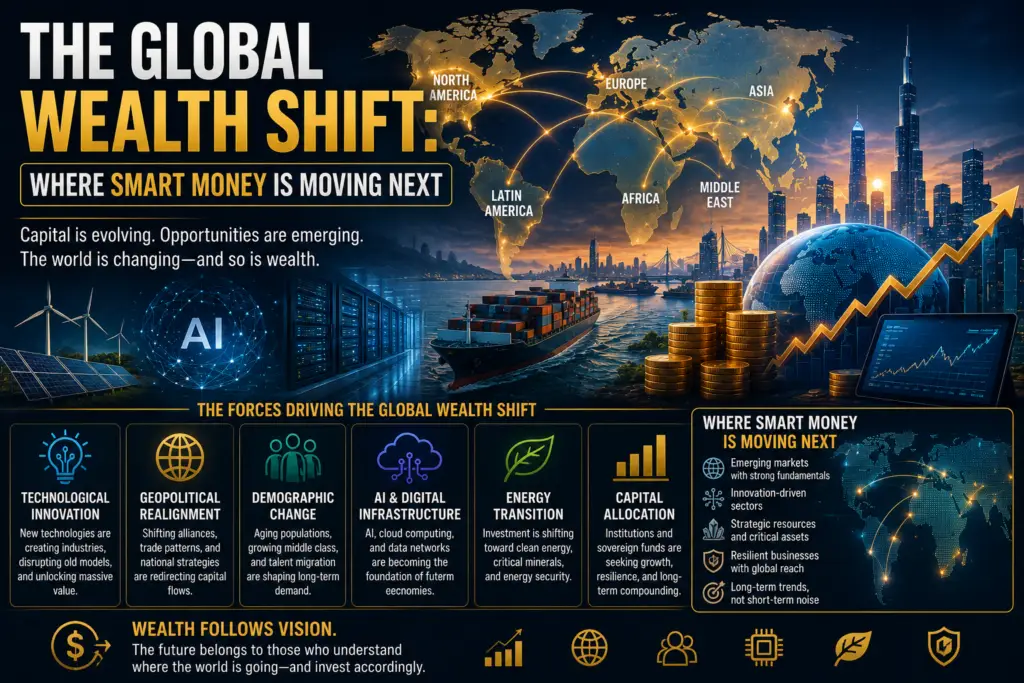
The Global Wealth Shift: Where Smart Money Is Moving Next has become one of the most important questions facing investors today. Capital is no longer flowing exactly where it did a decade ago. Instead, technological innovation, geopolitical realignment, demographic change, artificial intelligence, digital infrastructure, and energy investment are reshaping how governments, corporations, and institutional investors allocate trillions of dollars around the world.
Many individual investors continue focusing primarily on short-term market headlines. However, experienced investors often pay closer attention to structural economic changes that unfold gradually over many years. These long-term shifts frequently create investment opportunities well before they become obvious to the broader market.
At the same time, global wealth is becoming increasingly diversified across industries, regions, and technologies. Artificial intelligence is transforming productivity, semiconductor manufacturing is expanding, cybersecurity spending continues rising, and infrastructure investment remains a priority for many governments. Consequently, investors who understand these trends may be better positioned to evaluate future opportunities while maintaining realistic expectations.
This guide explores the forces driving the global wealth shift, explains where institutional capital is increasingly flowing, and highlights the industries that could play significant roles during the coming decade. You’ll also learn practical strategies for evaluating these developments within a diversified long-term investment portfolio.
Key Takeaways
- Global capital allocation is evolving rapidly.
- Artificial intelligence remains a major structural investment theme.
- Semiconductor manufacturing continues expanding worldwide.
- Digital infrastructure supports long-term economic growth.
- Energy investment includes both traditional and renewable sources.
- Demographic trends influence future investment opportunities.
- Diversification remains essential during economic transitions.
- Long-term investors should focus on structural trends rather than daily headlines.
Understanding the Global Wealth Shift
The phrase “global wealth shift” describes the gradual movement of capital toward industries, technologies, and regions expected to generate long-term economic value.
Rather than representing a single event, this process reflects continuous changes in productivity, innovation, government policy, consumer behavior, and technological development.
As a result, institutional investors frequently adjust portfolios to align with these evolving economic realities.
Why Capital Is Moving Faster Than Ever
Several powerful forces are accelerating global capital allocation.
Among the most influential are:
- Artificial intelligence
- Digital transformation
- Supply chain diversification
- Infrastructure investment
- Geopolitical realignment
- Energy modernization
- Demographic change
- Advanced manufacturing
Because these trends occur simultaneously, they create investment opportunities across multiple sectors rather than within a single industry.
Institutional Investors Think Long Term
Large institutional investors—including pension funds, insurance companies, sovereign wealth funds, and asset managers—typically invest with multi-year or multi-decade time horizons.
Instead of reacting to daily market fluctuations, many evaluate:
- Long-term productivity
- Demographic trends
- Technological leadership
- Capital expenditure
- Corporate profitability
- Competitive advantages
This disciplined approach often emphasizes business quality over short-term market sentiment.
Artificial Intelligence Is Reshaping Capital Allocation
Artificial intelligence continues attracting substantial investment from both governments and private companies.
Businesses increasingly deploy AI to improve efficiency across:
- Manufacturing
- Healthcare
- Financial services
- Logistics
- Retail
- Enterprise software
Consequently, companies providing AI infrastructure, advanced computing, and cloud services have become important participants in the evolving global economy.
Digital Infrastructure Is Becoming Essential
Modern economies rely heavily on digital infrastructure.
Growing investment continues supporting:
- Data centers
- Fiber-optic networks
- Cloud computing
- Cybersecurity
- Semiconductor production
- High-performance computing
Without these foundational technologies, many emerging innovations would struggle to scale effectively.
Governments Are Investing in Strategic Industries
Public investment plays an increasingly important role in shaping future economic growth.
Many countries continue supporting industries considered strategically important.
Examples include:
- Semiconductor manufacturing
- Artificial intelligence
- Defense technology
- Renewable energy
- Advanced manufacturing
- Critical infrastructure
Although government priorities differ across regions, these initiatives often encourage long-term private investment as well.
Demographic Changes Continue Influencing Markets
Population trends affect nearly every sector of the global economy.
Several important demographic developments include:
- Aging populations
- Urbanization
- Rising middle-class consumption
- Labor market transformation
- Healthcare demand
- Retirement planning
Companies capable of adapting to these long-term changes may strengthen their competitive positions over time.
Looking Beyond Short-Term Volatility
Financial markets naturally experience periods of uncertainty.
Nevertheless, investors who focus exclusively on daily price movements may overlook much larger structural transformations occurring throughout the global economy.
Understanding these long-term forces often provides valuable context when evaluating investment opportunities across multiple industries.
In the next section, we’ll examine where institutional capital continues flowing, compare the sectors attracting long-term investment, and discuss how diversified investors can position portfolios for the next phase of global economic growth.
Where Institutional Capital Is Moving
Professional investors rarely allocate billions of dollars based on short-term market sentiment.
Instead, pension funds, sovereign wealth funds, insurance companies, and global asset managers typically focus on structural trends capable of generating sustainable economic growth over many years.
Although investment strategies vary, several sectors continue attracting increasing levels of long-term capital.
Artificial Intelligence Continues Leading Innovation
Artificial intelligence remains one of the strongest investment themes shaping the global economy.
Companies continue increasing spending on:
- AI software
- Cloud infrastructure
- Machine learning
- Data analytics
- Enterprise automation
- High-performance computing
As AI adoption expands across nearly every industry, demand for supporting technologies may continue growing throughout the coming decade.
Semiconductor Manufacturing Has Become a Strategic Priority
Semiconductors power nearly every modern technology.
Advanced chips support:
- Artificial intelligence
- Smartphones
- Electric vehicles
- Industrial automation
- Medical equipment
- Cloud computing
- Telecommunications
Governments and private companies continue investing heavily in semiconductor production to improve supply chain resilience and technological competitiveness.
Consequently, semiconductor manufacturing remains one of the most closely watched industries among institutional investors.
Digital Infrastructure Is Expanding Rapidly
The digital economy depends on increasingly sophisticated infrastructure.
Capital continues flowing into:
- Data centers
- Fiber-optic networks
- Cloud computing
- Cybersecurity
- Enterprise software
- Networking equipment
Growing digitalization across businesses and governments supports continued investment in these foundational technologies.
Healthcare Innovation Continues Attracting Capital
Healthcare represents one of the world’s largest and most innovative industries.
Long-term growth drivers include:
- Aging populations
- Biotechnology research
- Medical devices
- Precision medicine
- Digital healthcare
- Artificial intelligence applications
Although regulatory approval processes remain complex, healthcare innovation continues creating new investment opportunities.
Energy Investment Is Becoming More Diversified
The global energy landscape continues evolving.
Instead of replacing one energy source with another overnight, investment increasingly spans multiple technologies.
Examples include:
- Oil and natural gas
- Nuclear energy
- Solar power
- Wind energy
- Battery storage
- Hydrogen
- Electricity grids
Many institutional investors evaluate how these technologies complement one another within long-term energy systems.
Advanced Manufacturing Is Growing
Manufacturing has become increasingly technology-driven.
Businesses continue investing in:
- Robotics
- Automation
- Smart factories
- Industrial software
- Supply chain optimization
- Precision manufacturing
These investments seek to improve productivity while strengthening operational resilience.
Comparing Long-Term Investment Themes
The following table summarizes several structural trends influencing global capital allocation.
| Investment Theme | Primary Growth Driver | Industries That May Benefit |
|---|---|---|
| Artificial Intelligence | Productivity | Software, Cloud Computing, Semiconductors |
| Semiconductor Manufacturing | Technology Leadership | Chipmakers, Equipment Manufacturers |
| Digital Infrastructure | Digital Economy | Data Centers, Networking, Cybersecurity |
| Healthcare Innovation | Demographic Trends | Biotechnology, Medical Devices |
| Energy Diversification | Infrastructure Investment | Utilities, Energy, Industrial Companies |
| Advanced Manufacturing | Automation | Robotics, Industrial Technology |
Each trend develops differently.
Therefore, investors should evaluate opportunities based on company fundamentals rather than assuming every sector will perform similarly.
Opportunities and Risks
Structural economic change creates both opportunities and uncertainty.
Potential opportunities include:
- Productivity growth
- Innovation
- Infrastructure expansion
- Digital transformation
- Higher operational efficiency
However, investors should also recognize several important risks:
- Elevated valuations
- Regulatory changes
- Geopolitical uncertainty
- Interest rate fluctuations
- Technology disruption
- Competitive pressure
Understanding both sides of the investment equation supports more balanced decision-making.
Diversification Remains Essential
Even when long-term trends appear compelling, diversification continues playing a central role in portfolio management.
Many experienced investors combine exposure to:
- Broad-market ETFs
- Dividend-paying companies
- Technology leaders
- Healthcare businesses
- Infrastructure investments
- REITs
- International equities
- Fixed-income securities
This diversified approach helps reduce portfolio volatility while maintaining exposure to multiple growth drivers.
Looking Beyond Headlines
Financial news changes daily.
Long-term economic transformation, however, develops over many years.
Investors who understand structural trends often focus on innovation, financial strength, competitive positioning, and business quality instead of reacting to temporary market sentiment.
In the final section, we’ll explore expert insights, common investing mistakes, a practical action plan, frequently asked questions, and the key lessons investors should remember as global wealth continues shifting toward new opportunities.
Expert Insights: Wealth Shifts Reward Investors Who Think in Decades
Every generation experiences economic transformation.
Some periods are driven by industrialization. Others are shaped by globalization or technological innovation.
Today’s global wealth shift is different because several powerful forces are unfolding simultaneously. Artificial intelligence, digital infrastructure, demographic change, supply chain diversification, energy modernization, and geopolitical realignment are all influencing where capital is being invested.
Experienced investors rarely attempt to predict every market movement.
Instead, they focus on identifying businesses capable of adapting to these structural trends while maintaining strong financial performance.
History shows that long-term wealth creation is usually driven by patience, diversification, and disciplined investing rather than by reacting to short-term headlines.
Common Mistakes Investors Should Avoid
Rapid economic change creates excitement.
Unfortunately, it can also encourage poor investment decisions.
Avoiding these common mistakes may improve long-term outcomes.
Mistake 1: Following Headlines Instead of Fundamentals
Financial news changes every day.
Strong businesses, however, often create shareholder value over many years.
Evaluate companies based on:
- Revenue growth
- Profitability
- Cash flow
- Competitive advantages
- Financial discipline
Business quality generally matters more than daily news.
Mistake 2: Chasing Every New Trend
Emerging technologies attract significant attention.
Nevertheless, not every fast-growing industry produces successful investments.
Before buying shares, understand:
- The business model
- Industry competition
- Financial health
- Valuation
- Long-term demand
Careful analysis reduces the likelihood of emotional decision-making.
Mistake 3: Ignoring Diversification
Concentrating an entire portfolio in one sector increases risk.
Even industries benefiting from structural growth experience periods of volatility.
Diversification helps investors participate in multiple long-term opportunities while reducing dependence on any single investment theme.
Mistake 4: Forgetting That Valuation Matters
Outstanding companies can become expensive.
Before investing, consider financial metrics such as:
- Price-to-Earnings (P/E)
- Free Cash Flow
- Return on Equity (ROE)
- Operating Margin
- Debt Levels
Paying reasonable prices remains an important part of successful investing.
Action Plan for Investors
Preparing for the next phase of global economic change does not require predicting the future.
Instead, focus on developing a disciplined investment process.
Step 1: Define Your Financial Goals
Determine whether your objective is:
- Long-term wealth creation
- Retirement planning
- Passive income
- Capital preservation
- Portfolio diversification
Clear goals help guide better investment decisions.
Step 2: Study Structural Trends
Continue learning about:
- Artificial intelligence
- Semiconductor manufacturing
- Digital infrastructure
- Healthcare innovation
- Energy diversification
- Advanced manufacturing
Understanding these trends provides valuable context for evaluating businesses.
Step 3: Evaluate Individual Companies
Before purchasing any stock, review:
- Revenue growth
- Earnings consistency
- Profit margins
- Cash flow
- Balance sheet strength
- Competitive positioning
Long-term investing begins with understanding the business itself.
Step 4: Build a Diversified Portfolio
Many experienced investors combine exposure to:
- Broad-market ETFs
- Dividend stocks
- Technology companies
- Healthcare businesses
- REITs
- International equities
- Treasury securities
Diversification remains one of the strongest portfolio management principles.
Step 5: Continue Monitoring Economic Change
Markets continue evolving.
Long-term investors benefit from monitoring:
- Inflation
- Interest rates
- Productivity
- Corporate earnings
- Government policy
- Technological innovation
- Demographic trends
Continuous learning supports better long-term decision-making.
Frequently Asked Questions
What is the global wealth shift?
The global wealth shift refers to the movement of capital toward industries, technologies, and regions expected to drive future economic growth.
Why are institutional investors focusing on artificial intelligence?
AI has the potential to improve productivity across numerous industries while creating demand for software, cloud computing, semiconductors, and digital infrastructure.
Does the global wealth shift guarantee investment success?
No.
Structural trends create opportunities, but no investment guarantees future returns.
Business quality, valuation, and diversification remain essential considerations.
Which industries may benefit from long-term economic transformation?
Several industries continue attracting investment, including artificial intelligence, semiconductors, cybersecurity, healthcare, digital infrastructure, advanced manufacturing, and energy.
Individual company performance, however, depends on execution and financial fundamentals.
Why is diversification still important?
Diversification reduces exposure to company-specific and sector-specific risks while allowing investors to participate in multiple long-term growth opportunities.
Should beginners focus only on growth industries?
Most financial professionals recommend diversified portfolios rather than concentrating investments in one theme.
Growth sectors may complement broader investment strategies.
What is the most important lesson for long-term investors?
Successful investing depends on patience, disciplined research, realistic expectations, and understanding business fundamentals rather than reacting to short-term market movements.
Final Thoughts
The Global Wealth Shift: Where Smart Money Is Moving Next reflects one of the defining investment themes of the modern economy.
Artificial intelligence, digital infrastructure, semiconductor manufacturing, healthcare innovation, energy diversification, and advanced manufacturing continue reshaping how governments, corporations, and investors allocate capital.
Although these structural changes create exciting opportunities, successful investing still relies on timeless principles.
Diversification, financial discipline, careful research, and long-term thinking remain more valuable than attempting to predict every economic headline.
Investors who understand these broader trends while maintaining realistic expectations may be better prepared to navigate the next decade of global economic transformation.
Internal Linking Opportunities
Strengthen your website’s SEO by linking this article to related content using anchor texts such as:
- Why the Global Economy Is Changing Faster Than Most Investors Realize
- The AI Race Between the U.S. and China: Investment Opportunities and Risks
- Could the Taiwan Crisis Disrupt the Global Semiconductor Industry?
- The U.S.–China Trade War Isn’t Over: What Investors Need to Know
- How Geopolitical Risk Could Drive Gold Prices Higher
- Why Central Banks Keep Buying Gold
- Dividend Stocks for Long-Term Investors
- REIT Investing Guide
- Passive Income Strategies
- Building a Diversified Investment Portfolio
External Authority Sources
Readers interested in learning more about global markets and long-term investing can consult these trusted organizations:
- U.S. Securities and Exchange Commission (SEC): https://www.sec.gov
- Federal Reserve: https://www.federalreserve.gov
- International Monetary Fund (IMF): https://www.imf.org
- Organisation for Economic Co-operation and Development (OECD): https://www.oecd.org
- Morningstar: https://www.morningstar.com
Final Call to Action
The world’s economic landscape is evolving rapidly, creating both opportunities and challenges for investors.
Rather than chasing every trend, focus on understanding the structural forces reshaping global markets, evaluating high-quality businesses, and maintaining a diversified portfolio aligned with your long-term goals.
Patience, continuous learning, and disciplined decision-making remain some of the most valuable assets any investor can possess as the global wealth shift continues to unfold.