
The Global Events That Could Send the Stock Market Higher — or Lower. Learn which global trends and economic events may influence markets and long-term investors.
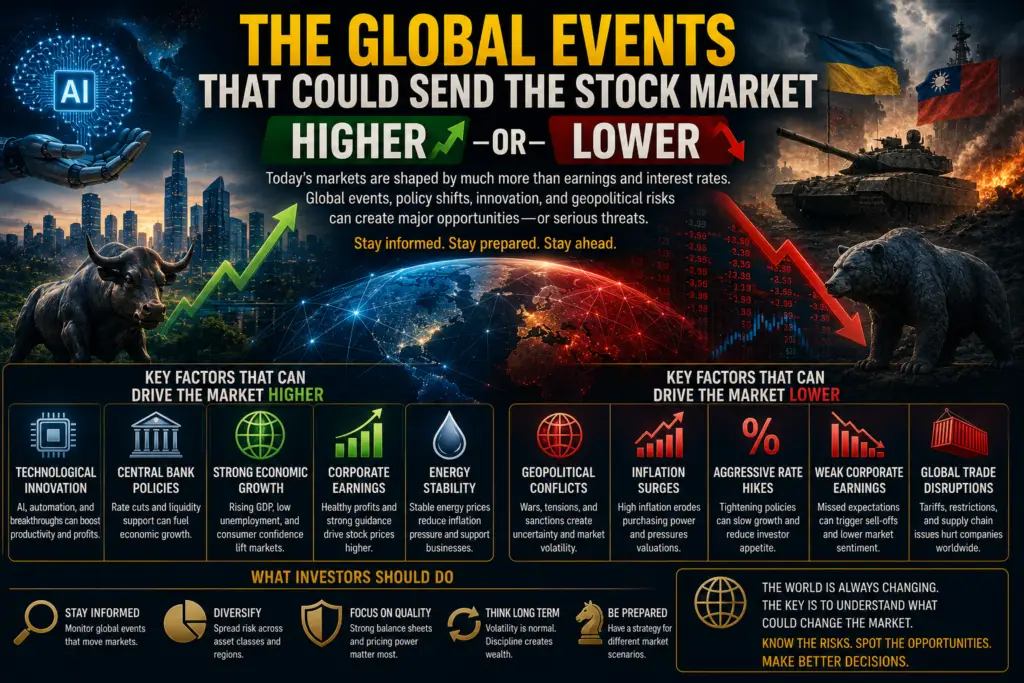
The Global Events That Could Send the Stock Market Higher—or Lower are rarely limited to corporate earnings or interest rate decisions. Today’s financial markets respond to a much broader range of influences, including geopolitical developments, artificial intelligence, central bank policies, energy markets, global trade, demographic trends, and technological innovation. As these forces interact, investors face an increasingly complex investment landscape.
Many people believe stock prices move only because companies report better or worse financial results. While earnings remain important, long-term market performance is also shaped by structural economic changes that unfold over years rather than days. Governments continue investing in infrastructure, businesses are redesigning global supply chains, and artificial intelligence is transforming productivity across multiple industries.
At the same time, uncertainty remains an unavoidable part of investing. Inflation, monetary policy, geopolitical tensions, and changing consumer behavior can all influence market sentiment. Consequently, investors who understand these broader economic forces may be better prepared to evaluate opportunities while avoiding emotional decisions driven by short-term headlines.
This guide explores the major global events capable of influencing financial markets, explains how different sectors may respond, and provides practical insights to help long-term investors build more resilient portfolios.
Key Takeaways
- Global events influence markets in multiple ways.
- Interest rates remain an important market driver.
- Artificial intelligence continues reshaping investment opportunities.
- Geopolitical developments can affect entire industries.
- Energy markets remain closely connected to economic growth.
- Supply chain changes influence corporate profitability.
- Diversification helps manage uncertainty.
- Long-term investors should focus on structural trends rather than daily headlines.
Why Global Events Matter to Investors
Financial markets reflect expectations about the future.
Consequently, investors continuously evaluate new information affecting economic growth, corporate earnings, inflation, and financial conditions.
Examples include:
- Central bank decisions
- Geopolitical developments
- Trade policy
- Technological innovation
- Consumer spending
- Employment data
- Corporate investment
Although markets may react quickly to unexpected news, long-term trends often prove more influential than temporary events.
Interest Rates Continue Influencing Financial Markets
Interest rates remain among the most closely monitored economic indicators.
When borrowing costs change, businesses and consumers often adjust spending and investment decisions.
Higher interest rates may influence:
- Corporate financing
- Mortgage activity
- Consumer demand
- Business investment
- Stock valuations
Conversely, lower borrowing costs may encourage economic activity under certain conditions.
However, market reactions depend on many additional factors beyond interest rates alone.
Artificial Intelligence Is Reshaping Market Leadership
Artificial intelligence has become one of the defining investment themes of the modern economy.
Businesses increasingly deploy AI across:
- Manufacturing
- Healthcare
- Financial services
- Logistics
- Retail
- Enterprise software
Meanwhile, demand continues growing for:
- Advanced semiconductors
- Cloud computing
- Data centers
- Networking equipment
- Enterprise infrastructure
Companies supporting this digital ecosystem have attracted considerable investor attention.
Geopolitical Developments Can Influence Entire Sectors
Political and geopolitical events sometimes affect industries differently.
For example, developments involving international trade, defense spending, energy security, or supply chains may influence specific sectors more than the broader market.
Industries frequently monitored include:
- Defense
- Energy
- Semiconductors
- Industrial manufacturing
- Transportation
- Cybersecurity
Although markets often react immediately to geopolitical headlines, long-term business fundamentals remain essential for investment analysis.
Global Trade Continues Evolving
International trade remains a major driver of economic activity.
Recent years have encouraged many companies to strengthen supply chain resilience by:
- Expanding manufacturing locations
- Diversifying suppliers
- Increasing automation
- Investing in logistics
- Building regional production networks
These changes may improve operational flexibility while creating opportunities across manufacturing and industrial technology.
Energy Markets Affect Every Economy
Energy influences transportation, manufacturing, agriculture, and consumer spending.
Consequently, investors closely monitor developments involving:
- Oil
- Natural gas
- Electricity
- Renewable energy
- Nuclear power
- Battery technology
Changes in energy markets can influence production costs, inflation, and overall economic growth.
Corporate Investment Often Signals Future Growth
Businesses continually invest in technologies that improve productivity and competitiveness.
Examples include:
- Artificial intelligence
- Robotics
- Cloud computing
- Cybersecurity
- Automation
- Research and development
Companies making disciplined long-term investments may strengthen their competitive positions over time.
Looking Beyond Market Volatility
Daily market fluctuations often receive significant media attention.
However, long-term investors frequently benefit from understanding broader economic trends rather than reacting to every headline.
Structural developments involving technology, demographics, government policy, and global trade may shape financial markets for many years.
In the next section, we’ll examine how these events can influence different sectors, compare potential investment themes, evaluate opportunities and risks, and discuss strategies for building resilient long-term portfolios.
How Different Global Events Can Affect Market Sectors
Not every global event influences the stock market in the same way.
Some developments affect nearly every industry, while others have a much greater impact on specific sectors. Understanding these differences can help investors evaluate opportunities with a broader perspective.
Although short-term price movements are often unpredictable, certain patterns tend to emerge over longer periods.
Central Bank Policy and Financial Markets
Central banks play a significant role in shaping economic conditions.
Investors closely monitor changes involving:
- Interest rates
- Inflation expectations
- Monetary policy
- Liquidity conditions
- Economic forecasts
When central banks tighten monetary policy, borrowing costs may increase for businesses and consumers.
Conversely, more accommodative policies may encourage investment and economic activity under certain circumstances.
However, market performance depends on many additional variables beyond monetary policy alone.
Artificial Intelligence Continues Creating New Opportunities
Artificial intelligence is influencing multiple industries simultaneously.
Growing investment supports companies involved in:
- Cloud computing
- Data centers
- Semiconductor manufacturing
- Enterprise software
- Cybersecurity
- Automation technologies
As businesses continue integrating AI into daily operations, supporting infrastructure may remain an important long-term investment theme.
Supply Chain Changes Create New Investment Themes
Global companies continue redesigning supply chains to improve resilience.
Common strategies include:
- Expanding regional manufacturing
- Diversifying suppliers
- Increasing automation
- Investing in logistics
- Improving inventory management
These adjustments may create opportunities across industrial equipment, transportation, manufacturing technology, and logistics services.
Energy Markets Continue Influencing Economic Growth
Energy remains one of the world’s most important economic inputs.
Investors frequently monitor developments involving:
- Oil production
- Natural gas markets
- Renewable energy
- Nuclear power
- Electricity infrastructure
- Battery technology
Rather than viewing these segments as direct competitors, many analysts recognize that multiple energy sources will likely contribute to future economic development.
Technology Infrastructure Supports Economic Expansion
Modern economies increasingly depend on digital infrastructure.
Capital continues flowing toward:
- Cloud computing
- Fiber-optic networks
- Data centers
- Enterprise software
- Networking equipment
- Cybersecurity
Growing digital demand supports continued investment across these foundational industries.
Comparing Major Global Events
The following table summarizes several events that investors frequently monitor and the sectors they may influence.
| Global Event | Potential Market Impact | Industries Commonly Affected |
|---|---|---|
| Central Bank Policy | Interest rates & liquidity | Financials, Real Estate, Growth Stocks |
| Artificial Intelligence | Productivity | Technology, Semiconductors, Cloud Computing |
| Geopolitical Developments | Market sentiment | Defense, Energy, Industrial Companies |
| Supply Chain Restructuring | Manufacturing efficiency | Logistics, Industrial Technology |
| Energy Market Changes | Production costs | Utilities, Energy, Transportation |
| Infrastructure Investment | Economic growth | Construction, Materials, Engineering |
Although these relationships are widely monitored, actual market outcomes vary depending on broader economic conditions.
Opportunities for Long-Term Investors
Periods of uncertainty often create opportunities for disciplined investors.
Rather than attempting to predict short-term market direction, many experienced investors focus on businesses with:
- Strong balance sheets
- Consistent earnings growth
- Competitive advantages
- Healthy cash flow
- Long-term innovation
These characteristics may support resilience across changing economic environments.
Risks Investors Should Understand
Every investment involves uncertainty.
Potential risks include:
- Inflation
- Interest rate volatility
- Geopolitical tensions
- Regulatory changes
- Supply chain disruptions
- Technology competition
- Economic slowdowns
Recognizing these risks helps investors develop balanced expectations and avoid emotional decision-making.
Diversification Remains One of the Strongest Strategies
Even when certain industries appear attractive, diversification continues reducing overall portfolio risk.
Many investors combine exposure to:
- Broad-market ETFs
- Dividend-paying companies
- Technology leaders
- Healthcare businesses
- Energy companies
- REITs
- International equities
- Fixed-income investments
A diversified portfolio provides exposure to multiple growth drivers while helping manage uncertainty.
Looking Beyond Daily Headlines
Financial media naturally focuses on breaking news.
Long-term investors, however, often benefit from concentrating on structural economic trends rather than temporary market reactions.
Understanding how technology, demographics, government policy, and global economic developments interact provides a stronger foundation for making informed investment decisions.
In the final section, we’ll examine expert insights, common investing mistakes, a practical action plan, frequently asked questions, and the key lessons investors should remember when navigating global financial markets.
Expert Insights: Long-Term Investors Focus on Trends, Not Predictions
Financial markets constantly respond to new information.
Some events capture headlines for only a few days, while others reshape the global economy for decades. Successful investors recognize the difference.
Rather than attempting to predict every market swing, experienced investors usually study structural forces such as technological innovation, demographic change, productivity growth, monetary policy, and corporate earnings.
Artificial intelligence, digital infrastructure, semiconductor manufacturing, cybersecurity, healthcare innovation, and energy investment are examples of long-term themes that continue influencing capital allocation worldwide.
Instead of reacting emotionally to breaking news, disciplined investors often evaluate whether an event changes a company’s long-term competitive position.
That mindset encourages better decision-making and helps reduce costly emotional mistakes.
Common Mistakes Investors Should Avoid
Periods of uncertainty often increase market volatility.
However, volatility itself is not necessarily a reason to change a long-term investment strategy.
Below are several mistakes investors should avoid.
Mistake 1: Making Decisions Based Only on Headlines
Breaking news attracts attention.
Nevertheless, markets frequently price new information quickly.
Before making investment decisions, ask:
- Has the company’s long-term outlook changed?
- Are earnings expectations materially different?
- Does this event permanently affect competitive advantages?
If the answer is no, maintaining a disciplined strategy may be more appropriate than reacting emotionally.
Mistake 2: Ignoring Business Fundamentals
Global events matter.
However, business quality remains equally important.
Evaluate factors such as:
- Revenue growth
- Profit margins
- Cash flow
- Debt management
- Return on invested capital
- Competitive positioning
Strong businesses often navigate challenging environments more successfully.
Mistake 3: Concentrating Too Much in One Sector
Some investors become overly optimistic about industries receiving significant media attention.
Although certain sectors may benefit from structural trends, excessive concentration increases portfolio risk.
Diversification continues serving as one of the most effective long-term risk management tools.
Mistake 4: Forgetting That Valuation Still Matters
Outstanding companies can become expensive investments.
Therefore, investors should analyze valuation alongside growth potential.
Common metrics include:
- Price-to-Earnings (P/E)
- Free Cash Flow
- Operating Margin
- Return on Equity (ROE)
- Debt-to-Equity
Paying reasonable prices for quality businesses remains an important investing principle.
Action Plan for Long-Term Investors
Preparing for changing global markets begins with a disciplined investment process.
Step 1: Define Your Financial Objectives
Determine whether your primary goal is:
- Wealth creation
- Retirement planning
- Passive income
- Dividend investing
- Portfolio diversification
Clear objectives support better investment decisions.
Step 2: Monitor Structural Economic Trends
Continue following developments involving:
- Artificial intelligence
- Semiconductor manufacturing
- Digital infrastructure
- Healthcare innovation
- Energy markets
- Supply chain modernization
These long-term themes may influence investment opportunities for years.
Step 3: Analyze Individual Companies
Before investing, evaluate:
- Revenue growth
- Earnings consistency
- Balance sheet strength
- Cash flow generation
- Competitive advantages
- Management execution
Understanding the business remains more valuable than predicting short-term market movements.
Step 4: Build a Diversified Portfolio
A balanced portfolio may include:
- Broad-market ETFs
- Dividend stocks
- Technology companies
- Healthcare businesses
- Infrastructure investments
- REITs
- International equities
- High-quality fixed-income assets
Diversification helps reduce concentration risk while maintaining exposure to multiple economic drivers.
Step 5: Stay Patient
Economic cycles naturally include periods of optimism and uncertainty.
Successful investors often focus on long-term business performance rather than temporary market volatility.
Patience remains one of the strongest competitive advantages available to individual investors.
Frequently Asked Questions
What types of global events usually affect the stock market?
Events involving monetary policy, inflation, geopolitical developments, corporate earnings, technological innovation, energy markets, and global trade frequently influence investor sentiment and financial markets.
Do geopolitical events always cause stock markets to fall?
No.
Some geopolitical developments increase uncertainty, while others have only temporary market effects.
Long-term outcomes depend on economic fundamentals, corporate performance, and investor expectations.
Why do investors closely monitor central banks?
Central banks influence interest rates, inflation expectations, borrowing costs, and liquidity conditions.
These factors affect both economic activity and financial asset valuations.
Can artificial intelligence continue influencing financial markets?
Artificial intelligence continues expanding across multiple industries, increasing demand for semiconductors, cloud computing, enterprise software, cybersecurity, and digital infrastructure.
Its long-term impact continues evolving.
Should investors react immediately to breaking news?
Many experienced investors first evaluate whether new information changes a company’s long-term outlook before adjusting their portfolios.
Emotional decisions often increase investment risk.
Why is diversification important during uncertain periods?
Diversification reduces dependence on individual companies, industries, or geographic regions while maintaining exposure to multiple sources of long-term growth.
What is the most important lesson investors should remember?
Successful investing depends more on disciplined research, diversification, patience, and business fundamentals than on predicting every market headline.
Final Thoughts
The Global Events That Could Send the Stock Market Higher—or Lower demonstrates how modern financial markets respond to a wide range of economic, technological, political, and corporate developments.
Artificial intelligence, central bank policy, global trade, demographic trends, digital infrastructure, energy markets, and geopolitical events all contribute to shaping long-term investment opportunities.
Although these forces can create periods of uncertainty, they also encourage innovation, productivity improvements, and economic transformation.
Rather than attempting to forecast every short-term market movement, investors may benefit from concentrating on high-quality businesses, maintaining diversified portfolios, and following disciplined investment principles.
Markets will always experience volatility.
However, long-term wealth is more often built through patience, consistent investing, and a commitment to understanding the broader forces that drive economic growth.
Internal Linking Opportunities
Strengthen your website’s SEO by linking this article to related content using anchor texts such as:
- Why the Global Economy Is Changing Faster Than Most Investors Realize
- The Global Wealth Shift: Where Smart Money Is Moving Next
- The AI Race Between the U.S. and China: Investment Opportunities and Risks
- Could the Taiwan Crisis Disrupt the Global Semiconductor Industry?
- Why Central Banks Keep Buying Gold
- How Geopolitical Risk Could Drive Gold Prices Higher
- Dividend Stocks for Long-Term Investors
- REIT Investing Guide
- Passive Income Strategies
- Building a Diversified Investment Portfolio
External Authority Sources
Readers interested in learning more about global markets and investing can explore these trusted organizations:
- U.S. Securities and Exchange Commission (SEC): https://www.sec.gov
- Federal Reserve: https://www.federalreserve.gov
- International Monetary Fund (IMF): https://www.imf.org
- Organisation for Economic Co-operation and Development (OECD): https://www.oecd.org
- Morningstar: https://www.morningstar.com
Final Call to Action
Global markets will continue evolving as technology advances, economies adapt, and new opportunities emerge.
Instead of trying to predict every market move, focus on understanding long-term economic trends, investing in fundamentally strong businesses, and maintaining a diversified portfolio aligned with your financial goals.
Over time, disciplined investing and continuous learning can become powerful advantages in building lasting wealth.