
Why the Global Economy Is Changing Faster Than Most Investors Realize. Discover the major economic trends reshaping markets and what long-term investors should watch.
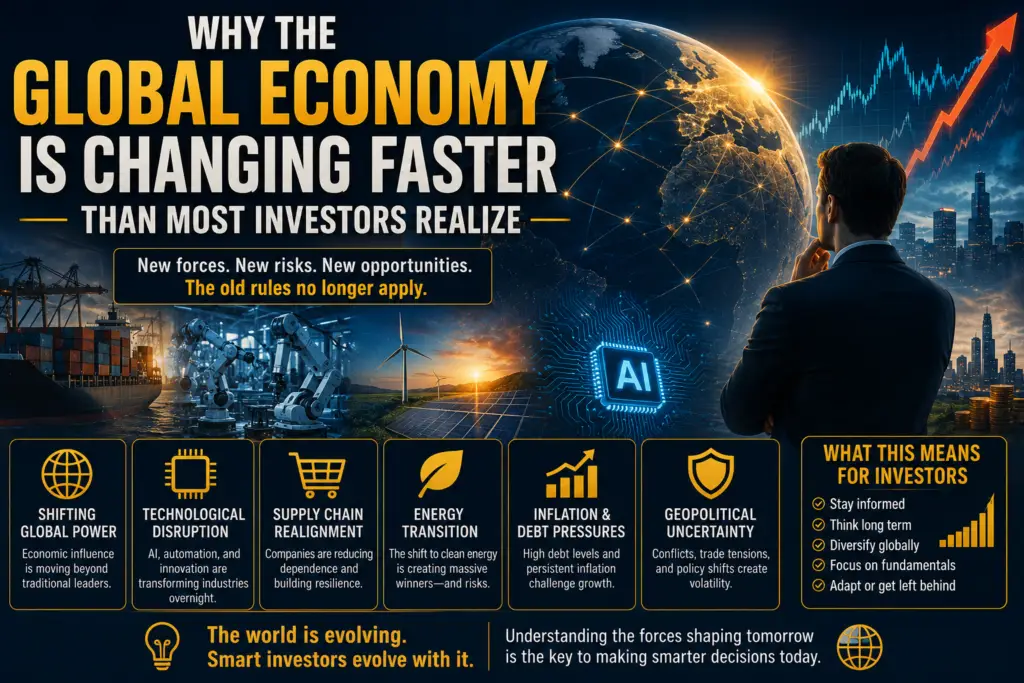
Why the Global Economy Is Changing Faster Than Most Investors Realize is a question every long-term investor should consider. Financial markets no longer respond only to interest rates or quarterly earnings. Instead, technological innovation, demographic shifts, artificial intelligence, supply chain restructuring, energy transitions, and geopolitical developments are reshaping the global economy at an unprecedented pace.
Only a decade ago, many investors viewed globalization as a relatively stable force. Today, businesses face a far more complex environment. Governments are investing heavily in semiconductor manufacturing, renewable energy, cybersecurity, and digital infrastructure. Meanwhile, corporations are redesigning supply chains, adopting artificial intelligence, and expanding automation to improve productivity and resilience.
Although daily headlines often emphasize short-term volatility, the most significant investment opportunities usually emerge from structural trends that unfold over many years. Understanding these long-term changes can help investors identify industries positioned for sustainable growth while avoiding the mistake of reacting emotionally to temporary market events.
In this guide, you’ll explore the major forces transforming the global economy, discover which industries may benefit from these shifts, and learn practical strategies for building a diversified portfolio designed to navigate an increasingly dynamic investment landscape.
Key Takeaways
- The global economy is undergoing multiple structural transformations simultaneously.
- Artificial intelligence continues reshaping productivity across industries.
- Supply chain diversification is changing international manufacturing.
- Energy markets are evolving through both traditional and renewable investments.
- Demographic trends influence labor markets and consumer demand.
- Geopolitical developments increasingly affect investment decisions.
- Diversification remains one of the most effective risk management tools.
- Long-term investors should focus on structural trends rather than short-term headlines.
The Global Economy Has Entered a New Era
Economic change has always been part of financial markets.
However, today’s transformation is broader than many previous cycles because several major trends are occurring simultaneously.
Among the most influential developments are:
- Artificial intelligence
- Digital transformation
- Geopolitical realignment
- Energy diversification
- Aging populations
- Supply chain restructuring
- Advanced manufacturing
- Cloud computing
Together, these forces are influencing corporate investment decisions, government policy, and long-term economic growth.
Artificial Intelligence Is Reshaping Productivity
Artificial intelligence has become one of the most significant technological developments of the modern economy.
Businesses increasingly integrate AI into operations such as:
- Customer service
- Manufacturing
- Healthcare
- Financial analysis
- Logistics
- Software development
- Marketing
- Scientific research
Rather than replacing every job, AI often enhances productivity by automating repetitive tasks and improving decision-making.
Consequently, companies investing successfully in AI infrastructure may strengthen their long-term competitive positions.
Supply Chains Are Becoming More Diversified
Recent global disruptions highlighted the importance of resilient supply chains.
As a result, many companies have reduced dependence on a single manufacturing location.
Businesses increasingly diversify production by:
- Expanding manufacturing facilities
- Developing regional supply networks
- Increasing inventories
- Investing in automation
- Building strategic partnerships
Although diversification requires additional investment, it may improve operational resilience over time.
Governments Are Investing in Strategic Industries
Public investment has become another important driver of economic change.
Many governments continue supporting industries viewed as strategically important, including:
- Semiconductor manufacturing
- Renewable energy
- Cybersecurity
- Artificial intelligence
- Infrastructure
- Advanced manufacturing
- Defense technology
These initiatives seek to strengthen economic competitiveness while improving national resilience.
For investors, understanding public investment priorities may provide valuable context when evaluating long-term industry trends.
The Energy Landscape Continues to Evolve
Energy markets remain essential to global economic development.
Today’s energy transition includes investments across multiple areas rather than a single source of power.
Important segments include:
- Oil and natural gas
- Nuclear energy
- Solar power
- Wind energy
- Battery storage
- Hydrogen technologies
- Electricity transmission
Consequently, investors increasingly analyze how different energy sources may complement one another during the transition toward more diversified energy systems.
Demographic Trends Are Influencing Economic Growth
Population changes affect nearly every aspect of the economy.
Many developed countries face aging populations, while other regions continue experiencing workforce expansion.
These demographic shifts influence:
- Consumer spending
- Housing demand
- Healthcare services
- Retirement planning
- Labor markets
- Productivity
- Government budgets
Businesses capable of adapting to changing demographic patterns may discover significant long-term opportunities.
Digital Infrastructure Has Become Critical
Modern economies depend on digital infrastructure more than ever before.
Growing demand continues supporting investment in:
- Data centers
- Cloud computing
- Fiber-optic networks
- Cybersecurity
- Semiconductor production
- Enterprise software
- Artificial intelligence infrastructure
As digital transformation accelerates, these industries may continue attracting significant public and private investment.
Looking Beyond Market Volatility
Financial markets will always experience periods of uncertainty.
Nevertheless, investors who focus exclusively on daily price movements often overlook much larger structural transformations.
Long-term investing requires understanding how technology, demographics, government policy, and innovation combine to shape economic growth over decades rather than weeks.
In the next section, we’ll examine the industries most likely to benefit from these structural changes, compare investment opportunities across sectors, and discuss how investors can position diversified portfolios for a rapidly evolving global economy.
Industries That Could Benefit From a Changing Global Economy
Major economic transformations rarely affect every industry equally.
Some sectors adapt quickly because they operate at the center of technological innovation, while others evolve more gradually. For long-term investors, identifying these structural trends may be more valuable than reacting to short-term market volatility.
Let’s examine several industries that could play an increasingly important role during the next decade.
Artificial Intelligence Continues Expanding Across the Economy
Artificial intelligence has moved beyond experimental applications.
Today, businesses use AI to improve productivity, automate repetitive tasks, optimize logistics, detect fraud, develop new medicines, and enhance customer experiences.
Several industries continue increasing AI investments, including:
- Cloud computing
- Healthcare
- Financial services
- Manufacturing
- Retail
- Transportation
- Defense
- Enterprise software
As adoption grows, demand for computing infrastructure, advanced software, and specialized semiconductor technologies may continue expanding.
Semiconductor Manufacturing Remains Strategically Important
Every digital economy depends on semiconductors.
Advanced chips power:
- Smartphones
- Artificial intelligence
- Electric vehicles
- Medical equipment
- Cloud computing
- Industrial automation
- Telecommunications
- Consumer electronics
Governments and private companies continue investing heavily in semiconductor production to strengthen supply chains and improve long-term resilience.
Although competition remains intense, semiconductor demand appears supported by multiple structural trends.
Cybersecurity Has Become a Permanent Priority
As businesses become increasingly digital, cybersecurity grows more important.
Organizations now invest in protecting:
- Customer information
- Financial systems
- Government infrastructure
- Healthcare records
- Cloud platforms
- Corporate networks
Because cyber threats continue evolving, demand for cybersecurity solutions may remain relatively resilient regardless of broader economic cycles.
Infrastructure Investment Supports Economic Growth
Economic modernization requires significant infrastructure spending.
Governments and private companies continue investing in:
- Transportation networks
- Electricity grids
- Broadband expansion
- Data centers
- Water systems
- Renewable energy infrastructure
These long-term projects often create opportunities across engineering, construction, industrial equipment, and materials industries.
Healthcare Innovation Continues Accelerating
Healthcare remains one of the world’s largest industries.
Several long-term factors continue supporting investment, including:
- Aging populations
- Biotechnology research
- Precision medicine
- Medical devices
- Digital healthcare
- Artificial intelligence applications
Although regulatory environments differ across countries, healthcare innovation continues driving substantial research and development.
Renewable Energy and Traditional Energy May Coexist
The global energy transition is complex.
While renewable energy investment continues growing, traditional energy sources remain essential to the modern economy.
Many experts expect multiple energy technologies to operate simultaneously, including:
- Solar
- Wind
- Natural gas
- Nuclear
- Hydroelectric power
- Battery storage
Rather than viewing energy as a winner-take-all market, investors often evaluate how different technologies complement one another.
Comparing Long-Term Structural Trends
The following table summarizes several important economic themes shaping investment opportunities.
| Trend | Primary Growth Driver | Industries Most Affected |
|---|---|---|
| Artificial Intelligence | Productivity | Software, Semiconductors, Cloud Computing |
| Supply Chain Diversification | Resilience | Manufacturing, Logistics, Industrial Equipment |
| Digital Infrastructure | Connectivity | Data Centers, Networking, Cybersecurity |
| Energy Transition | Infrastructure Investment | Utilities, Energy, Industrial Companies |
| Demographic Change | Population Trends | Healthcare, Consumer Goods, Financial Services |
| Government Investment | Strategic Priorities | Infrastructure, Defense, Technology |
Each trend develops over different time horizons.
Consequently, investors should avoid assuming that every sector will grow at the same pace.
Diversification Remains a Competitive Advantage
Economic transitions create opportunities.
However, they also introduce uncertainty.
Rather than concentrating investments in one theme, many experienced investors build diversified portfolios that include exposure to multiple sectors.
Examples include:
- Broad-market ETFs
- Dividend-paying companies
- Technology stocks
- Healthcare businesses
- Infrastructure companies
- REITs
- International equities
Diversification helps reduce portfolio volatility while maintaining participation in long-term economic growth.
What Long-Term Investors Should Monitor
Successful investing requires continuous learning.
Important indicators include:
- Corporate earnings
- Productivity growth
- Interest rates
- Inflation trends
- Capital expenditures
- Government policy
- Technological innovation
- Consumer spending
Monitoring these factors provides a broader perspective than focusing exclusively on short-term market fluctuations.
Looking Beyond Today’s Headlines
Financial news changes every day.
Structural economic transformation, however, unfolds gradually over many years.
Investors who understand long-term trends often place greater emphasis on innovation, business quality, financial discipline, and sustainable competitive advantages than on temporary market sentiment.
In the final section, we’ll explore expert insights, common investing mistakes, a practical action plan, frequently asked questions, and the key lessons investors should remember while navigating a rapidly changing global economy.
Expert Insights: Successful Investors Focus on Structural Trends, Not Headlines
The global economy has always evolved.
However, today’s transformation is unusually broad because technological innovation, demographic change, geopolitical realignment, digital infrastructure, and energy investment are all advancing simultaneously.
Experienced investors understand that wealth is rarely built by reacting to every market headline.
Instead, they concentrate on identifying businesses capable of adapting to long-term economic change.
Companies that continue investing in innovation, productivity, customer relationships, and operational efficiency often strengthen their competitive positions over time.
Rather than attempting to predict every economic cycle, investors frequently achieve better results by maintaining diversified portfolios and allowing high-quality businesses to compound value over many years.
Common Mistakes Investors Should Avoid
Periods of rapid economic change often create both opportunity and uncertainty.
Recognizing common mistakes may help investors remain disciplined.
Mistake 1: Chasing Every New Trend
New technologies receive enormous attention.
Nevertheless, not every emerging company becomes a long-term winner.
Before investing, evaluate:
- Business model
- Revenue growth
- Profitability
- Competitive advantages
- Financial strength
Innovation alone does not guarantee investment success.
Mistake 2: Ignoring Diversification
Concentrating an entire portfolio in one sector increases overall risk.
Even industries with strong long-term prospects experience periods of volatility.
Diversification remains one of the most effective methods of managing uncertainty.
Mistake 3: Focusing Only on Short-Term Market News
Daily financial headlines often create emotional reactions.
Long-term investors typically pay greater attention to:
- Earnings growth
- Productivity improvements
- Industry leadership
- Capital allocation
- Competitive positioning
These factors frequently matter more than temporary market sentiment.
Mistake 4: Forgetting That Valuation Matters
Outstanding companies can still become expensive investments.
Therefore, investors should analyze valuation alongside business quality.
Common financial metrics include:
- Price-to-Earnings (P/E)
- Free Cash Flow
- Operating Margin
- Return on Equity (ROE)
- Debt Levels
Buying exceptional businesses at reasonable prices may improve long-term outcomes.
Action Plan for Long-Term Investors
If you want to prepare your portfolio for an evolving global economy, consider following these practical steps.
Step 1: Define Your Financial Goals
Clarify whether your objective is:
- Long-term wealth creation
- Retirement investing
- Passive income
- Portfolio diversification
- Capital preservation
Clear goals provide a stronger investment framework.
Step 2: Study Long-Term Economic Trends
Focus on structural developments such as:
- Artificial intelligence
- Digital infrastructure
- Healthcare innovation
- Energy transition
- Advanced manufacturing
- Supply chain diversification
Understanding these trends helps investors evaluate opportunities beyond daily market fluctuations.
Step 3: Evaluate Business Fundamentals
Before purchasing any stock, review:
- Revenue growth
- Earnings quality
- Cash flow
- Profit margins
- Balance sheet strength
- Management execution
Strong businesses often demonstrate resilience across different economic environments.
Step 4: Maintain a Diversified Portfolio
A balanced portfolio may include:
- Broad-market ETFs
- Dividend stocks
- Technology companies
- Healthcare businesses
- Infrastructure investments
- REITs
- International equities
- Treasury securities
Diversification helps reduce concentration risk while maintaining exposure to multiple growth opportunities.
Step 5: Continue Learning
Markets evolve continuously.
Long-term investors benefit from monitoring:
- Corporate earnings
- Productivity trends
- Interest rates
- Inflation
- Technological innovation
- Government policy
- Demographic changes
Continuous education remains one of the strongest competitive advantages available to individual investors.
Frequently Asked Questions
Why is the global economy changing so quickly?
Multiple long-term forces—including technological innovation, artificial intelligence, demographic shifts, supply chain restructuring, and government investment—are reshaping industries simultaneously.
Which industries may benefit from these economic changes?
Several sectors could benefit from structural trends, including artificial intelligence, semiconductors, cybersecurity, digital infrastructure, healthcare, advanced manufacturing, and energy.
Individual company performance, however, depends on business execution and financial fundamentals.
Does economic transformation guarantee higher stock returns?
No.
Long-term trends create opportunities, but no investment guarantees future performance.
Investors should evaluate each company carefully before making investment decisions.
Why is diversification still important?
Diversification reduces exposure to risks affecting individual companies or industries while providing participation across multiple areas of economic growth.
How does artificial intelligence influence the global economy?
AI has improved productivity across numerous industries by automating processes, supporting data analysis, and enabling new products and services.
Its long-term economic impact continues evolving.
Should beginners invest only in technology companies?
Most financial professionals recommend diversified portfolios rather than concentrating investments in one sector.
Technology exposure may complement broader investment strategies.
What is the biggest lesson investors should remember?
Long-term investment success depends on disciplined research, diversification, patience, and understanding business fundamentals rather than reacting to short-term market headlines.
Final Thoughts
Why the Global Economy Is Changing Faster Than Most Investors Realize highlights one of the defining investment themes of the coming decade.
Artificial intelligence, digital infrastructure, demographic change, energy investment, advanced manufacturing, and supply chain diversification continue reshaping industries around the world.
Although these transformations create new opportunities, successful investing still depends on timeless principles.
Strong financial fundamentals, reasonable valuations, diversified portfolios, and long-term discipline remain more important than attempting to predict every economic headline.
Investors who focus on quality businesses, continuous learning, and structural economic trends may be better prepared to navigate an increasingly dynamic global economy.
Internal Linking Opportunities
Strengthen your website’s SEO by linking this article to related content using anchor texts such as:
- The AI Race Between the U.S. and China: Investment Opportunities and Risks
- Could the Taiwan Crisis Disrupt the Global Semiconductor Industry?
- Why Central Banks Keep Buying Gold
- How Geopolitical Risk Could Drive Gold Prices Higher
- The U.S.–China Trade War Isn’t Over: What Investors Need to Know
- Dividend Stocks for Long-Term Investors
- REIT Investing Guide
- Building a Diversified Investment Portfolio
- Passive Income Strategies
- Understanding Market Volatility
External Authority Sources
Readers interested in learning more about global economic trends and investing can consult these trusted organizations:
- U.S. Securities and Exchange Commission (SEC): https://www.sec.gov
- Federal Reserve: https://www.federalreserve.gov
- International Monetary Fund (IMF): https://www.imf.org
- Organisation for Economic Co-operation and Development (OECD): https://www.oecd.org
- Morningstar: https://www.morningstar.com
Final Call to Action
The global economy is changing faster than ever, but successful investing has always relied on the same foundation: knowledge, patience, diversification, and disciplined decision-making.
Instead of chasing every headline, focus on understanding long-term economic trends, evaluating high-quality businesses, and building a portfolio designed to grow through multiple market cycles.
By staying informed and maintaining a long-term perspective, you can make more confident investment decisions in an increasingly complex financial world.