

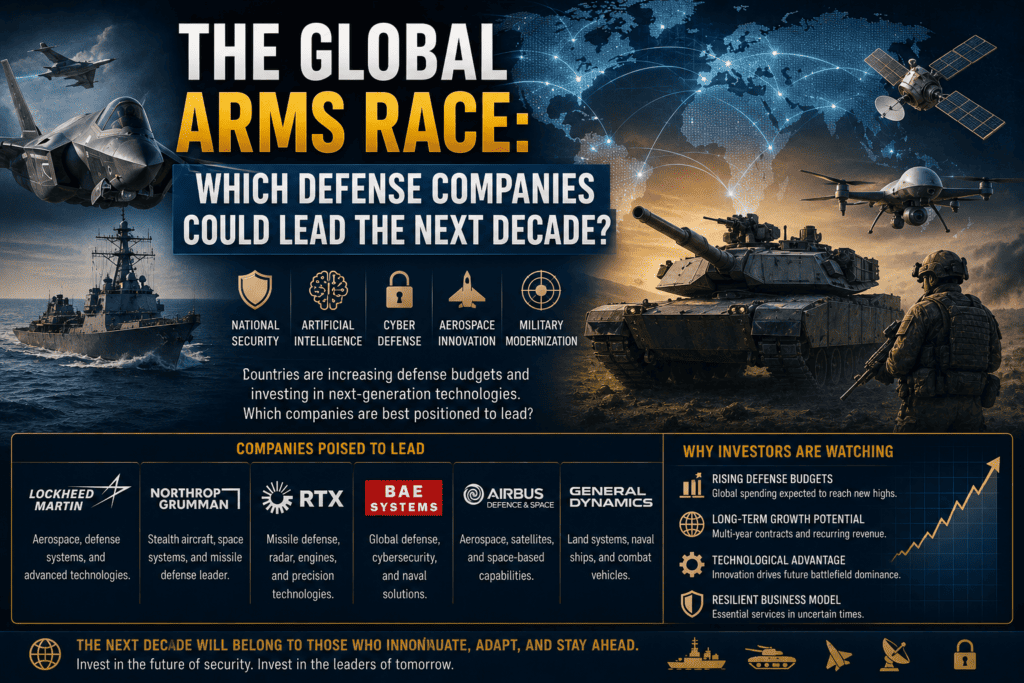
The Global Arms Race: Which Defense Companies Could Lead the Next Decade? Discover how defense spending, military technology, and innovation may shape long-term investing.
The Global Arms Race: Which Defense Companies Could Lead the Next Decade? This question has become increasingly relevant as governments around the world continue investing in national security, military modernization, cybersecurity, artificial intelligence, and advanced aerospace technologies. Although geopolitical developments frequently dominate financial headlines, long-term investors often focus on broader structural trends that can influence corporate earnings for years rather than months.
Defense spending has evolved far beyond traditional military equipment. Today, governments allocate significant resources toward satellite communications, autonomous systems, electronic warfare, missile defense, cyber resilience, and next-generation intelligence platforms. Consequently, the defense industry has become one of the most technologically advanced sectors in the global economy.
At the same time, investing in defense companies requires careful analysis. Government procurement cycles, regulatory changes, technological innovation, international competition, and valuation all influence long-term investment outcomes. Therefore, selecting companies based solely on current geopolitical events may overlook more important business fundamentals.
This guide explores the major forces shaping the global defense industry, explains why military technology continues evolving rapidly, and highlights several established defense companies that could remain strategically important during the next decade. You’ll also learn how long-term investors can evaluate opportunities while maintaining diversified portfolios and realistic expectations.
Key Takeaways
- Defense spending continues expanding in many regions of the world.
- Military modernization increasingly emphasizes advanced technologies.
- Artificial intelligence is becoming an important defense capability.
- Cybersecurity remains a strategic priority for governments.
- Long-term contracts can provide revenue stability.
- Diversification remains essential for investors.
- Strong financial fundamentals should guide investment decisions.
- Geopolitical headlines should be considered alongside business quality.
Why the Global Defense Industry Is Changing
The defense industry has experienced significant transformation during the past two decades.
While traditional military hardware remains essential, governments now prioritize technologies capable of addressing increasingly complex security challenges.
Examples include:
- Artificial intelligence
- Cybersecurity
- Space systems
- Electronic warfare
- Autonomous platforms
- Advanced communications
- Missile defense
- Intelligence software
As defense priorities evolve, companies investing in innovation may benefit from long-term procurement programs.
Long-Term Defense Spending Trends
Defense budgets rarely change overnight.
Instead, governments typically develop multi-year modernization strategies that extend across several budget cycles.
These long-term initiatives often support investments in:
- Aircraft modernization
- Naval expansion
- Missile systems
- Space capabilities
- Cybersecurity infrastructure
- Military logistics
- Research and development
Because many programs require years to complete, defense contractors often operate with substantial contract backlogs that provide greater visibility into future revenue.
Innovation Is Becoming the New Competitive Advantage
Success in today’s defense industry depends increasingly on technological leadership.
Modern military organizations require systems capable of processing enormous amounts of information while operating in highly complex environments.
Consequently, defense companies continue expanding investments in:
- Artificial intelligence
- Machine learning
- Secure communications
- Advanced radar
- Satellite technology
- Data analytics
- Autonomous systems
Innovation has become just as important as manufacturing capability.
Why Investors Pay Attention to Defense Companies
Unlike many industries driven primarily by consumer demand, defense contractors often generate revenue through long-term government contracts.
These agreements may include:
- Equipment production
- System maintenance
- Technology upgrades
- Training services
- Software support
- Logistics operations
Although procurement schedules vary, long-term contracts may provide relatively stable cash flows compared with more cyclical industries.
Company Profile 1: Lockheed Martin
Lockheed Martin remains one of the largest aerospace and defense companies in the world.
Its operations span several strategic areas, including:
- Military aircraft
- Missile defense
- Space technologies
- Integrated defense systems
- Advanced research
The company’s broad portfolio allows it to participate in multiple long-term government programs.
Investors often monitor contract backlog, research investment, and operating margins when evaluating its financial performance.
Company Profile 2: RTX Corporation
RTX combines aerospace expertise with advanced defense technologies.
Its business includes:
- Missile systems
- Radar technologies
- Military engines
- Aerospace components
- Defense electronics
Because the company serves both commercial aerospace and defense markets, it benefits from diversified revenue sources.
This balance may provide additional resilience across changing economic conditions.
Company Profile 3: Northrop Grumman
Northrop Grumman specializes in advanced defense capabilities designed for modern military operations.
Key business segments include:
- Strategic defense systems
- Military aircraft
- Space platforms
- Autonomous technologies
- Cybersecurity
- Electronic warfare
The company’s continued emphasis on research and engineering positions it within several high-priority defense programs.
Long-term investors frequently evaluate its innovation pipeline alongside financial performance.
Looking Beyond Individual Stocks
While well-known defense contractors receive significant investor attention, selecting long-term investments requires more than recognizing familiar names.
Successful investors typically compare:
- Revenue growth
- Profitability
- Free cash flow
- Contract diversification
- Research investment
- Competitive positioning
- Balance sheet strength
Evaluating these factors together often provides a more complete picture than focusing exclusively on recent geopolitical events.
In the next section, we’ll examine additional defense companies that operate across cybersecurity, naval systems, communications, and advanced military technologies. We’ll also compare their competitive strengths and discuss how investors can analyze opportunities throughout the broader defense industry.
Company Profile 4: General Dynamics
General Dynamics has developed one of the most diversified portfolios in the global defense industry.
Rather than relying on a single product category, the company operates across several strategic markets.
Its primary business segments include:
- Combat vehicles
- Naval shipbuilding
- Secure communications
- Defense information systems
- Aerospace solutions
This broad exposure allows General Dynamics to participate in multiple long-term procurement programs.
Consequently, investors often appreciate the company’s balanced revenue profile and diversified customer relationships.
Company Profile 5: L3Harris Technologies
Modern defense increasingly depends on secure communications and advanced electronic systems.
L3Harris has positioned itself within these high-priority markets.
Its business focuses on:
- Tactical communications
- Electronic warfare
- Intelligence platforms
- Space communications
- Surveillance technologies
- Advanced sensors
As military operations become more data-driven, companies specializing in communication and electronic systems may continue playing an important role.
Company Profile 6: Huntington Ingalls Industries
Naval power remains a strategic priority for many countries.
Huntington Ingalls is primarily known for designing, constructing, and maintaining advanced naval vessels.
Its portfolio includes:
- Aircraft carriers
- Nuclear-powered submarines
- Amphibious assault ships
- Fleet modernization
- Ship maintenance
Because naval construction projects often extend over many years, investors frequently monitor contract backlogs as an indicator of future revenue visibility.
Company Profile 7: Leidos Holdings
Unlike traditional defense manufacturers, Leidos focuses heavily on technology services.
Its expertise includes:
- Cybersecurity
- Artificial intelligence
- Systems integration
- Data analytics
- Defense software
- Intelligence support
As governments continue modernizing digital infrastructure, technology-focused contractors have become increasingly significant within national security programs.
Company Profile 8: BAE Systems
BAE Systems serves defense customers across numerous international markets.
Its operations include:
- Military vehicles
- Naval defense
- Aerospace systems
- Electronic warfare
- Cybersecurity
- Defense electronics
International diversification provides exposure to multiple government procurement programs rather than depending primarily on one domestic market.
Company Profile 9: Rheinmetall
European defense investment has expanded significantly in recent years.
Rheinmetall participates in several important segments, including:
- Land combat systems
- Military vehicles
- Ammunition
- Air defense technologies
- Electronic systems
Growing modernization initiatives throughout Europe have increased investor interest in companies operating within this market.
Nevertheless, investors should continue evaluating financial fundamentals alongside industry trends.
Company Profile 10: Saab AB
Saab has built a strong reputation for engineering advanced defense technologies.
Its business spans:
- Fighter aircraft
- Missile systems
- Radar technology
- Naval defense
- Electronic warfare
- Command and control systems
Innovation remains one of Saab’s defining characteristics.
Consequently, investors frequently monitor research spending, export opportunities, and long-term contract development.
Comparing Leading Defense Companies
Although every company operates differently, each contributes to the broader defense ecosystem.
The following comparison summarizes their primary areas of focus.
| Company | Primary Business | Long-Term Opportunity |
|---|---|---|
| Lockheed Martin | Aerospace & Missiles | Advanced defense programs |
| RTX | Aerospace & Missile Systems | Diversified defense portfolio |
| Northrop Grumman | Space & Strategic Defense | Technology leadership |
| General Dynamics | Naval & Land Systems | Multi-segment diversification |
| L3Harris | Communications & Electronics | Digital battlefield technologies |
| Huntington Ingalls | Naval Shipbuilding | Fleet modernization |
| Leidos | Cybersecurity & AI | Digital defense transformation |
| BAE Systems | International Defense | Global procurement programs |
| Rheinmetall | Land Defense Systems | European modernization |
| Saab | Aerospace & Electronic Warfare | Innovation-driven growth |
Each company faces unique opportunities and operational risks.
Therefore, investors should analyze them individually rather than assuming similar future performance across the sector.
Key Trends That Could Shape the Next Decade
Several structural trends continue influencing defense markets.
Among the most important are:
- Artificial intelligence integration
- Autonomous military systems
- Cybersecurity investment
- Space-based defense
- Electronic warfare
- Missile defense modernization
- Secure communications
- Defense software
- Data analytics
- Intelligence platforms
These themes extend beyond individual geopolitical events and represent broader technological transformation.
Risks Every Investor Should Consider
Despite attractive long-term opportunities, defense investing involves meaningful risks.
Potential challenges include:
- Government budget adjustments
- Procurement delays
- Contract cancellations
- Export restrictions
- Technological disruption
- Rising competition
- Elevated valuations
Accordingly, investors should avoid assuming that increased defense spending automatically translates into higher shareholder returns.
Building a Balanced Portfolio
Defense companies may complement diversified portfolios.
However, concentrating investments exclusively in one sector increases overall risk.
Many experienced investors balance defense exposure alongside:
- Broad-market ETFs
- Dividend-paying companies
- Technology stocks
- Healthcare businesses
- REITs
- Utilities
- Treasury securities
- International equities
This diversified approach helps manage uncertainty while maintaining participation in multiple long-term economic trends.
Looking Beyond Today’s Headlines
Geopolitical developments often influence market sentiment.
Nevertheless, successful long-term investing depends more on evaluating business fundamentals than reacting to daily news.
Companies with strong balance sheets, disciplined capital allocation, diversified operations, and sustainable competitive advantages may be better positioned to navigate changing market environments.
In the final section, we’ll explore expert insights, common investing mistakes, a practical action plan, frequently asked questions, and the key lessons investors should remember when evaluating defense companies for the decade ahead.
Expert Insights: Long-Term Defense Investing Is About Technology as Much as Security
Defense investing has changed significantly over the past two decades.
Although military aircraft, naval fleets, and missile systems remain essential, the industry’s future increasingly depends on technological innovation. Artificial intelligence, cybersecurity, autonomous platforms, satellite communications, quantum computing, and electronic warfare are becoming just as important as traditional defense hardware.
For long-term investors, this shift creates a broader investment landscape.
Rather than asking which country will increase military spending next year, experienced investors often focus on which companies possess durable competitive advantages, consistent research and development, diversified customer relationships, and strong financial fundamentals.
Successful investing depends on identifying businesses capable of adapting to future defense priorities instead of reacting to short-term geopolitical headlines.
Common Mistakes Investors Should Avoid
Defense companies can represent attractive long-term investments.
However, investors should avoid several common mistakes.
Mistake 1: Buying Only After Geopolitical Headlines
Defense stocks often rally following major international events.
Unfortunately, purchasing shares solely because of recent headlines may expose investors to elevated valuations.
Instead, analyze the underlying business before making investment decisions.
Mistake 2: Ignoring Valuation
Excellent companies can still become expensive.
Before investing, review metrics such as:
- Price-to-Earnings (P/E)
- Free Cash Flow
- Return on Invested Capital (ROIC)
- Operating Margin
- Debt Levels
- Revenue Growth
Paying too much for even the strongest businesses may reduce future returns.
Mistake 3: Overlooking Business Diversification
Some defense companies rely heavily on a limited number of government programs.
Others generate revenue across aerospace, cybersecurity, communications, naval systems, software, and space technologies.
Companies with diversified operations may be better positioned to navigate changing procurement priorities.
Mistake 4: Ignoring Long-Term Innovation
Military technology evolves continuously.
Businesses investing consistently in research, engineering, and next-generation technologies may strengthen their competitive positions over time.
Therefore, innovation deserves attention alongside financial performance.
Action Plan for Long-Term Investors
If you’re evaluating defense companies, consider following this structured approach.
Step 1: Define Your Investment Objective
Clarify whether you’re seeking:
- Long-term capital appreciation
- Dividend income
- Portfolio diversification
- Exposure to defense technology
- Retirement investing
Well-defined objectives support more consistent investment decisions.
Step 2: Understand the Business Model
Before investing, determine how each company generates revenue.
Questions worth asking include:
- Does the company serve multiple governments?
- Is revenue diversified?
- How large is its contract backlog?
- Which technologies drive future growth?
- How much does it invest in research and development?
Understanding these factors provides greater context than following headlines alone.
Step 3: Evaluate Financial Strength
Review key indicators such as:
- Revenue growth
- Earnings consistency
- Free cash flow
- Profit margins
- Return on invested capital
- Balance sheet quality
Strong financial discipline often supports long-term resilience.
Step 4: Maintain Diversification
Defense stocks should complement a balanced investment strategy rather than dominate it.
Many diversified portfolios also include:
- Broad-market ETFs
- Dividend-paying companies
- Technology stocks
- Healthcare companies
- REITs
- Treasury securities
- International equities
Diversification helps reduce exposure to risks affecting any single industry.
Step 5: Continue Monitoring Industry Trends
Defense priorities continue evolving.
Long-term investors should follow developments involving:
- Artificial intelligence
- Cybersecurity
- Space technologies
- Autonomous systems
- Government procurement
- Corporate earnings
- Research investment
Continuous learning remains one of the most valuable investing skills.
Frequently Asked Questions
Why are defense companies attracting investor attention?
Many governments continue investing in military modernization, cybersecurity, aerospace, and advanced technologies. These long-term programs may create opportunities for companies operating throughout the defense sector.
Are defense stocks suitable for long-term investors?
Some defense companies have historically demonstrated stable business models supported by long-term government contracts. However, every investment should be evaluated based on financial fundamentals, valuation, and risk.
Do defense companies only manufacture military equipment?
No.
Many also develop:
- Artificial intelligence systems
- Cybersecurity platforms
- Satellite technologies
- Secure communications
- Defense software
- Intelligence solutions
- Electronic warfare technologies
Modern defense increasingly depends on advanced digital capabilities.
Can defense companies pay dividends?
Several established defense contractors have historically paid dividends.
Dividend policies vary among companies and may change over time.
Investors should evaluate dividend sustainability alongside broader financial performance.
What risks affect defense stocks?
Potential risks include:
- Government budget changes
- Procurement delays
- Export restrictions
- Technology disruption
- Political uncertainty
- Contract execution challenges
Understanding these risks helps investors make more informed decisions.
Should beginners invest only in defense companies?
Most financial professionals recommend diversified portfolios rather than concentrating investments in one industry.
Defense exposure may complement broader long-term investment strategies.
What is the biggest lesson investors should remember?
Long-term investing depends more on business quality, diversification, reasonable valuations, and disciplined research than on predicting geopolitical developments.
Final Thoughts
The Global Arms Race: Which Defense Companies Could Lead the Next Decade? highlights an industry undergoing profound technological transformation.
Although defense spending remains an important investment theme, long-term success depends on identifying companies capable of adapting to changing military priorities, maintaining financial discipline, and delivering sustainable innovation.
Artificial intelligence, cybersecurity, autonomous systems, advanced communications, and space technologies are reshaping the future of national defense.
Consequently, investors should evaluate defense businesses through both financial and technological perspectives rather than relying solely on geopolitical headlines.
A diversified portfolio built around quality companies, realistic expectations, and disciplined research remains one of the strongest foundations for long-term wealth creation.
Internal Linking Opportunities
Strengthen your website’s SEO by linking this article to related content using anchor texts such as:
- The Global Arms Race: 10 Defense Stocks Built for Long-Term Growth
- Stocks That Could Benefit From Rising Military Spending
- Could the Taiwan Crisis Disrupt the Global Semiconductor Industry?
- The AI Race Between the U.S. and China: Investment Opportunities and Risks
- What Investors Should Watch During International Conflicts
- How Geopolitical Risk Could Drive Gold Prices Higher
- Gold vs. Bitcoin During Geopolitical Crises
- Dividend Stocks for Long-Term Investors
- REIT Investing Guide
- Building a Diversified Investment Portfolio
External Authority Sources
Readers interested in learning more about defense markets and long-term investing can consult these trusted organizations:
- U.S. Securities and Exchange Commission (SEC): https://www.sec.gov
- Federal Reserve: https://www.federalreserve.gov
- Stockholm International Peace Research Institute (SIPRI): https://www.sipri.org
- Aerospace Industries Association (AIA): https://www.aia-aerospace.org
- Morningstar: https://www.morningstar.com
Final Call to Action
The defense industry continues evolving as governments invest in advanced technologies, digital security, aerospace innovation, and next-generation military capabilities.
Rather than reacting to short-term geopolitical developments, focus on understanding company fundamentals, maintaining a diversified portfolio, and investing with patience.
Long-term wealth is typically built through disciplined research, thoughtful portfolio management, and a commitment to continuous learning—qualities that remain valuable in every market environment.