

The Global Arms Race: 10 Defense Stocks Built for Long-Term Growth. Explore how rising defense spending could influence aerospace and defense investments.
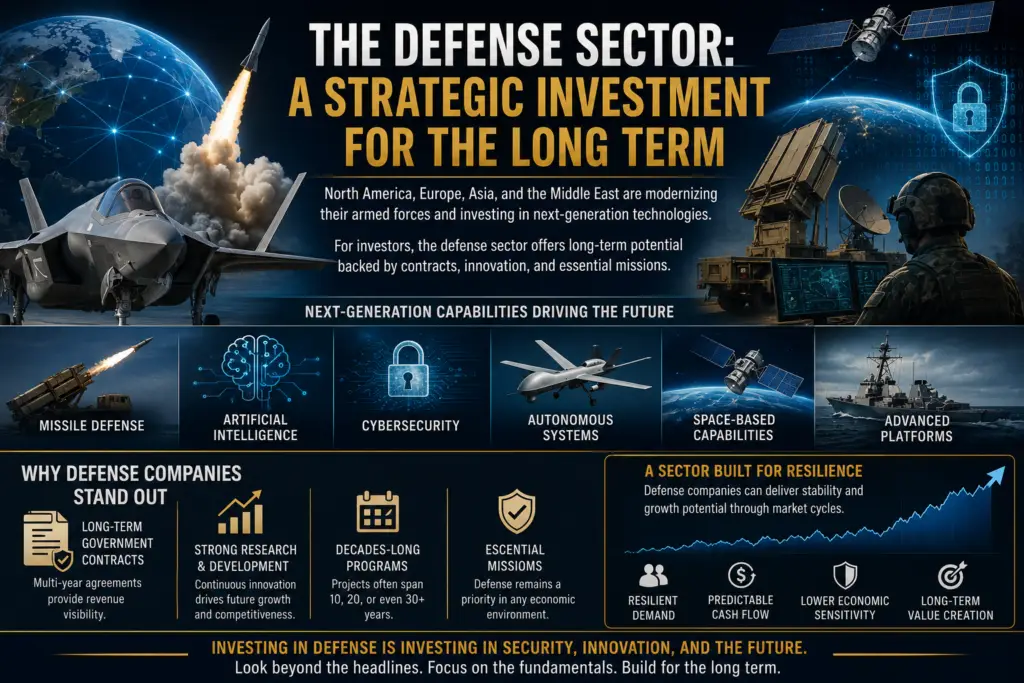
Global defense spending has entered a new phase. Governments across North America, Europe, Asia, and the Middle East continue modernizing their armed forces while investing in next-generation technologies such as missile defense, artificial intelligence, cybersecurity, autonomous systems, and space-based capabilities. Consequently, many investors are asking whether the defense sector deserves a place in a long-term investment portfolio.
Although geopolitical uncertainty often dominates the headlines, successful investing requires looking beyond daily news. Defense companies typically operate under long-term government contracts, maintain significant research and development programs, and participate in projects that may extend for decades. These characteristics can create relatively predictable revenue streams compared with industries that depend heavily on consumer spending.
At the same time, defense investing is not without risks. Government budgets, political priorities, export regulations, technological disruption, and valuation levels all influence future performance. Therefore, investors should carefully evaluate both opportunities and challenges before investing in aerospace and defense companies.
This guide examines ten well-known defense businesses that play important roles across military aviation, naval systems, missile technology, cybersecurity, communications, and defense electronics. You’ll also learn how the global defense industry works, why military spending continues attracting investor attention, and what factors long-term investors should monitor before making portfolio decisions.
Key Takeaways
- Global defense spending remains a major long-term investment theme.
- Aerospace and defense companies often benefit from multi-year government contracts.
- Military modernization extends beyond traditional weapons.
- Cybersecurity and artificial intelligence are becoming increasingly important.
- Diversification remains essential when investing in defense stocks.
- Government policy can significantly influence industry growth.
- Valuation still matters, even in growing sectors.
- Long-term investors should focus on business quality rather than headlines.
Why Defense Spending Matters to Investors
Defense is one of the few industries supported primarily by long-term government demand.
Unlike many consumer-oriented businesses, defense contractors often receive contracts lasting several years or even decades.
These agreements may involve aircraft production, naval systems, missile defense, communications equipment, cybersecurity services, maintenance, and logistics support.
Consequently, many defense companies generate relatively stable revenue compared with industries driven by short-term consumer demand.
Modern Defense Is About Much More Than Weapons
Today’s defense industry extends well beyond traditional military hardware.
Governments increasingly invest in:
- Artificial intelligence
- Cybersecurity
- Satellite communications
- Missile defense systems
- Autonomous vehicles
- Space technologies
- Advanced radar systems
- Electronic warfare
- Intelligence platforms
As military priorities evolve, companies capable of developing advanced technologies may benefit from expanding procurement programs.
What Makes a Strong Defense Company?
Long-term investors often evaluate defense companies using many of the same financial principles applied to other industries.
Important characteristics include:
- Consistent revenue growth
- Strong free cash flow
- Healthy balance sheets
- Diversified customer base
- Competitive technology
- Long-term contract backlog
- Experienced management
Although government contracts provide visibility, financial discipline remains equally important.
Defense Stocks vs. Traditional Industrial Companies
Defense contractors differ from many industrial businesses because governments represent their primary customers.
As a result, revenue often depends more on defense budgets than on consumer spending cycles.
However, political decisions, procurement delays, and budget negotiations may still influence financial performance.
Therefore, investors should monitor both company fundamentals and broader government spending trends.
Defense Stock 1: Lockheed Martin
Lockheed Martin is one of the world’s largest aerospace and defense contractors.
The company participates in numerous military programs involving advanced aircraft, missile systems, helicopters, space technologies, and integrated defense solutions.
Its business benefits from long-term government relationships and a diversified portfolio of defense technologies.
Many investors appreciate the company’s emphasis on research, engineering expertise, and shareholder returns.
Nevertheless, future performance depends on contract execution, government procurement decisions, and evolving defense priorities.
Defense Stock 2: RTX Corporation
RTX operates across several important defense and aerospace markets.
Its businesses include:
- Missile defense systems
- Military engines
- Aerospace components
- Radar technologies
- Defense electronics
Because RTX serves both commercial aerospace and defense customers, investors receive exposure to multiple industries within a single company.
This diversification may provide additional resilience during changing economic conditions.
Defense Stock 3: Northrop Grumman
Northrop Grumman focuses on advanced defense technologies.
Its operations include:
- Strategic defense systems
- Military aircraft
- Space technologies
- Cybersecurity
- Autonomous systems
The company has invested heavily in next-generation defense capabilities designed to support evolving military requirements.
As governments continue modernizing defense infrastructure, businesses specializing in advanced technology may remain strategically important.
Looking Beyond Individual Companies
Selecting defense investments involves more than recognizing familiar names.
Investors should compare:
- Financial performance
- Valuation
- Competitive advantages
- Research spending
- Government contract exposure
- International diversification
In the next section, we’ll examine seven additional defense companies, compare their strengths, analyze industry opportunities, and discuss how investors can evaluate defense stocks within a diversified long-term portfolio.
Defense Stock 4: General Dynamics
General Dynamics has built a diversified portfolio across several critical defense markets.
Its operations include:
- Combat vehicles
- Naval shipbuilding
- Secure communications
- Aerospace systems
- Information technology services
Unlike companies focused primarily on one product category, General Dynamics participates in multiple long-term defense programs.
This diversified business model may help reduce dependence on any single government contract.
Furthermore, the company has consistently invested in engineering expertise and advanced manufacturing capabilities.
Defense Stock 5: L3Harris Technologies
Modern warfare depends heavily on communication, surveillance, and electronic systems.
L3Harris specializes in technologies supporting these capabilities.
Its portfolio includes:
- Secure communications
- Electronic warfare
- Intelligence systems
- Tactical radios
- Space communications
- Sensor technologies
As military operations become increasingly data-driven, communications infrastructure continues growing in strategic importance.
Consequently, companies serving this segment remain closely connected to long-term defense modernization.
Defense Stock 6: Huntington Ingalls Industries
Naval power remains an essential component of global defense strategies.
Huntington Ingalls focuses primarily on shipbuilding and maritime defense.
Its business includes:
- Aircraft carriers
- Submarines
- Amphibious assault ships
- Fleet maintenance
- Naval engineering
Shipbuilding projects often extend across many years.
Therefore, investors frequently evaluate contract backlogs alongside revenue growth and profitability.
Defense Stock 7: Leidos Holdings
Leidos differs from traditional weapons manufacturers.
Instead, the company provides technology-driven services supporting both government and commercial organizations.
Core business areas include:
- Cybersecurity
- Data analytics
- Artificial intelligence
- Defense software
- Systems integration
- Intelligence support
Digital transformation continues reshaping national security.
As a result, technology-focused defense contractors have become increasingly important within the broader defense industry.
Defense Stock 8: BAE Systems
BAE Systems operates across multiple international markets.
Its portfolio includes:
- Military vehicles
- Naval systems
- Aerospace technologies
- Electronic warfare
- Cybersecurity
- Defense electronics
International diversification provides exposure to defense spending beyond a single country.
However, investors should also consider currency fluctuations and varying government procurement policies.
Defense Stock 9: Rheinmetall
European defense spending has increased significantly in recent years.
Rheinmetall has become an important supplier of defense equipment, military vehicles, ammunition, and advanced systems.
Its business also benefits from growing investment in modern land-based defense capabilities.
As European governments continue upgrading military infrastructure, companies operating within this market may experience expanding opportunities.
Defense Stock 10: Saab AB
Saab develops advanced defense technologies serving both domestic and international customers.
Major business segments include:
- Fighter aircraft
- Radar systems
- Missile technologies
- Naval solutions
- Electronic warfare
- Defense software
Innovation remains one of Saab’s competitive strengths.
Consequently, investors often monitor research and development alongside contract growth.
Comparing the Ten Defense Companies
Although every defense contractor operates differently, each serves important roles within the global defense ecosystem.
| Company | Primary Focus | Long-Term Growth Driver |
|---|---|---|
| Lockheed Martin | Aircraft & missile systems | Multi-year defense programs |
| RTX | Missiles & aerospace | Diversified defense portfolio |
| Northrop Grumman | Advanced defense technologies | Strategic modernization |
| General Dynamics | Naval & land systems | Broad defense exposure |
| L3Harris | Communications & electronics | Digital military transformation |
| Huntington Ingalls | Naval shipbuilding | Fleet modernization |
| Leidos | Cybersecurity & IT | Defense digitalization |
| BAE Systems | Global defense systems | International defense spending |
| Rheinmetall | Land systems | European modernization |
| Saab | Advanced defense technologies | Innovation & exports |
Each company faces unique opportunities and risks.
Therefore, investors should evaluate them individually rather than assuming all defense businesses perform similarly.
Opportunities Supporting Long-Term Defense Growth
Several structural trends continue influencing defense investment.
These include:
- Military modernization
- Artificial intelligence
- Cybersecurity
- Space technologies
- Drone systems
- Missile defense
- Electronic warfare
- Intelligence platforms
Rather than depending on one geopolitical event, many of these trends reflect long-term strategic priorities.
Risks Every Investor Should Understand
Despite attractive growth opportunities, defense investing also involves important risks.
Examples include:
- Government budget reductions
- Political changes
- Program cancellations
- Export restrictions
- Technology disruption
- Contract execution challenges
- High valuation multiples
Consequently, investors should avoid assuming continuous growth regardless of changing economic conditions.
Why Diversification Still Matters
Even investors optimistic about defense spending rarely concentrate an entire portfolio in one industry.
Instead, diversified portfolios frequently combine:
- Broad-market ETFs
- Dividend-paying companies
- Technology stocks
- Healthcare businesses
- REITs
- Utilities
- Treasury securities
- Defense companies
This balanced strategy helps reduce portfolio volatility while maintaining exposure to multiple long-term economic trends.
Investing Beyond Headlines
Defense stocks often receive increased attention during periods of geopolitical uncertainty.
However, experienced investors typically evaluate companies based on business fundamentals rather than short-term news cycles.
Financial strength, competitive positioning, contract quality, research investment, and disciplined management frequently matter more than temporary market sentiment.
In the final section, we’ll examine common investing mistakes, practical portfolio strategies, frequently asked questions, and the most important lessons long-term investors should remember when evaluating defense stocks.
Expert Insights: Defense Investing Requires Patience, Not Predictions
The defense sector has historically attracted investors during periods of heightened geopolitical uncertainty. However, experienced investors understand that successful defense investing is rarely about predicting the next global conflict.
Instead, it is about identifying companies with durable competitive advantages, strong engineering capabilities, diversified revenue sources, and disciplined capital allocation.
Many defense contractors generate revenue through multi-year government contracts, maintenance agreements, technology upgrades, and research programs that extend well beyond short-term political events.
Consequently, investors should focus on business quality rather than assuming geopolitical headlines alone will determine future stock performance.
Companies capable of adapting to changing military priorities—including cybersecurity, artificial intelligence, space technologies, autonomous systems, and advanced communications—may remain strategically important for decades.
Common Mistakes Investors Should Avoid
Although defense stocks can play an important role in diversified portfolios, investors should remain aware of several common mistakes.
Mistake 1: Buying Defense Stocks Only After Major Headlines
Many investors become interested in defense companies only after geopolitical tensions dominate the news.
Unfortunately, markets often react quickly.
Buying solely because of recent headlines may increase the risk of purchasing shares at elevated valuations.
Long-term investors generally prefer disciplined research over emotional decision-making.
Mistake 2: Ignoring Valuation
Even outstanding businesses can become expensive.
Before investing, review financial metrics such as:
- Price-to-Earnings (P/E)
- Free Cash Flow
- Operating Margin
- Return on Invested Capital (ROIC)
- Debt Levels
- Revenue Growth
Strong companies remain attractive only when purchased at reasonable valuations.
Mistake 3: Concentrating Too Much in One Industry
Defense companies represent just one sector of the economy.
A balanced portfolio usually includes exposure to:
- Technology
- Healthcare
- Consumer goods
- Financial services
- Energy
- Utilities
- Real estate
- Broad-market ETFs
Diversification helps reduce company-specific and sector-specific risk.
Mistake 4: Assuming Government Spending Always Increases
Defense budgets often grow over long periods.
Nevertheless, government priorities may change.
Budget negotiations, procurement delays, economic conditions, and political decisions can influence future contract awards.
Investors should recognize that even industries supported by government spending remain subject to uncertainty.
Action Plan for Long-Term Investors
If you’re considering adding defense stocks to your portfolio, the following framework may help.
Step 1: Define Your Investment Objective
Determine whether your goal is:
- Long-term capital appreciation
- Dividend income
- Portfolio diversification
- Retirement investing
- Exposure to defense technology
Clear objectives create better investment discipline.
Step 2: Understand Each Company’s Business Model
Rather than focusing only on well-known names, examine how each company generates revenue.
Questions to consider include:
- Does it rely on one major program?
- Is revenue diversified?
- Does it serve multiple governments?
- Does it invest heavily in innovation?
Understanding business models often provides valuable investment insight.
Step 3: Evaluate Financial Strength
Before purchasing any stock, review:
- Earnings growth
- Revenue consistency
- Cash flow generation
- Profitability
- Debt management
- Capital allocation
Business quality frequently matters more than industry popularity.
Step 4: Build a Diversified Portfolio
Defense investments should complement—not replace—a diversified strategy.
Many long-term investors combine:
- Broad-market index funds
- Dividend stocks
- Technology companies
- REITs
- Treasury securities
- International equities
- Defense contractors
This balanced approach reduces concentration risk while maintaining exposure to long-term growth opportunities.
Step 5: Continue Learning
Military technology evolves continuously.
Investors should monitor:
- Defense budgets
- Corporate earnings
- Research spending
- Artificial intelligence
- Cybersecurity
- Space technologies
- Government procurement trends
Long-term investing rewards informed decision-making rather than constant trading.
Frequently Asked Questions
Are defense stocks good long-term investments?
Some defense companies have demonstrated durable business models supported by long-term government contracts.
However, future performance depends on factors such as financial strength, execution, valuation, competition, and government spending priorities.
Why do investors follow defense spending?
Government defense budgets influence demand for military equipment, aerospace systems, cybersecurity services, communications infrastructure, and advanced technologies.
Changes in spending priorities can affect industry revenue opportunities.
Do defense companies only manufacture weapons?
No.
Many also develop:
- Cybersecurity platforms
- Satellite systems
- Space technologies
- Secure communications
- Artificial intelligence
- Radar systems
- Logistics solutions
Modern defense extends well beyond traditional military hardware.
Can defense stocks pay dividends?
Several established defense contractors have historically paid dividends.
Dividend policies vary by company and may change over time.
Investors should evaluate dividend sustainability alongside overall financial performance.
Are defense stocks affected by interest rates?
Like many equities, defense stocks may respond to changing interest rates.
Higher rates can influence valuation multiples, while government fiscal policy may also affect long-term defense budgets.
Should beginners invest only in defense companies?
Most financial professionals encourage diversified portfolios rather than concentrating investments in one sector.
Defense exposure can complement broader investment strategies.
What is the biggest lesson for investors?
Long-term investment success depends on disciplined research, diversification, reasonable valuations, and understanding business fundamentals—not simply reacting to geopolitical events.
Final Thoughts
The Global Arms Race: 10 Defense Stocks Built for Long-Term Growth highlights an industry that continues evolving alongside technological innovation and changing national security priorities.
Although rising defense spending has attracted significant investor attention, successful investing requires more than following geopolitical headlines.
Strong companies typically combine engineering expertise, financial discipline, diversified operations, and long-term customer relationships.
Meanwhile, investors should remain mindful of valuation, government policy, competitive dynamics, and company-specific execution.
Rather than attempting to predict future conflicts, focus on building a diversified portfolio supported by high-quality businesses capable of adapting to long-term economic and technological change.
Internal Linking Opportunities
Strengthen your website’s SEO by linking this article to related content using anchor texts such as:
- Stocks That Could Benefit From Rising Military Spending
- Could the Taiwan Crisis Disrupt the Global Semiconductor Industry?
- The AI Race Between the U.S. and China: Investment Opportunities and Risks
- What Investors Should Watch During International Conflicts
- The U.S.–China Trade War Isn’t Over: What Investors Need to Know
- How Geopolitical Risk Could Drive Gold Prices Higher
- Gold vs. Bitcoin During Geopolitical Crises
- Building a Diversified Investment Portfolio
- Dividend Stocks for Long-Term Investors
- REIT Investing Guide
External Authority Sources
Readers interested in learning more about defense markets and investing can consult these trusted organizations:
- U.S. Securities and Exchange Commission (SEC): https://www.sec.gov
- Federal Reserve: https://www.federalreserve.gov
- Stockholm International Peace Research Institute (SIPRI): https://www.sipri.org
- Aerospace Industries Association (AIA): https://www.aia-aerospace.org
- Morningstar: https://www.morningstar.com
Final Call to Action
The defense industry continues changing as governments invest in advanced technologies, cybersecurity, artificial intelligence, and modern military capabilities.
Rather than chasing short-term market reactions, focus on understanding business fundamentals, maintaining a diversified portfolio, and investing with a long-term mindset.
Successful investors recognize that sustainable wealth is typically built through patience, continuous learning, disciplined analysis, and consistent portfolio management—not by trying to predict tomorrow’s headlines.