

Warren Buffett’s Latest Warning Could Change How You Invest. Discover the timeless investing lessons behind Buffett’s latest moves and how to apply them wisely.
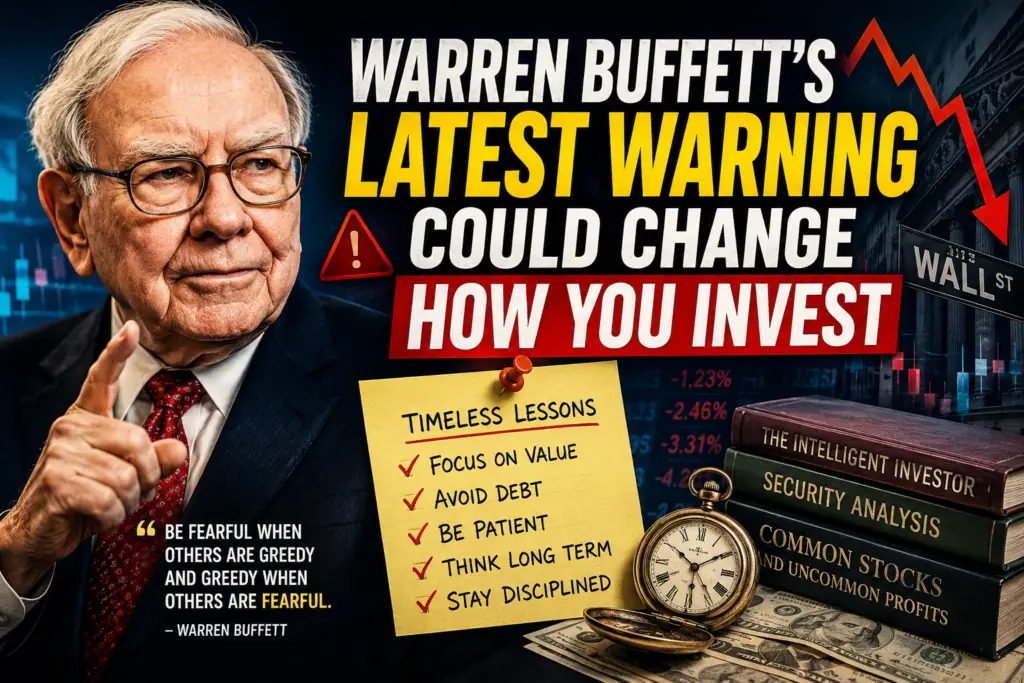
Warren Buffett’s Latest Warning Could Change How You Invest has become a popular topic among investors looking for clues about where the market may be heading next. Every time Berkshire Hathaway reports major portfolio changes or discusses capital allocation, financial headlines quickly speculate about Buffett’s intentions. Yet Buffett has consistently encouraged investors to avoid sensational predictions and focus instead on timeless investing principles.
His public letters, interviews, and decades of investment decisions reveal a remarkably consistent philosophy. Rather than trying to predict recessions or market crashes, Buffett emphasizes buying exceptional businesses, maintaining financial discipline, and keeping enough flexibility to act when opportunities appear.
Recent Berkshire Hathaway filings have renewed discussions about cash reserves, stock valuations, and long-term market expectations. Some investors interpret those developments as warnings. Others see them simply as examples of disciplined capital allocation. The more important lesson is not whether Buffett expects a correction tomorrow, but why he continues following the same principles regardless of market conditions.
This article examines what investors can reasonably learn from Buffett’s publicly available comments and Berkshire Hathaway’s investment approach. More importantly, it explains how those lessons can help beginners and experienced investors build stronger portfolios without relying on market timing or speculation.
Key Takeaways
- Warren Buffett prioritizes business quality over market forecasts.
- Cash provides strategic flexibility during uncertain periods.
- Valuation remains one of the most important investment factors.
- Long-term investing depends on patience and discipline.
- Financial strength often matters more than rapid growth.
- Emotional investing frequently destroys long-term returns.
- Market volatility can create attractive buying opportunities.
- Great businesses are not always great investments at any price.
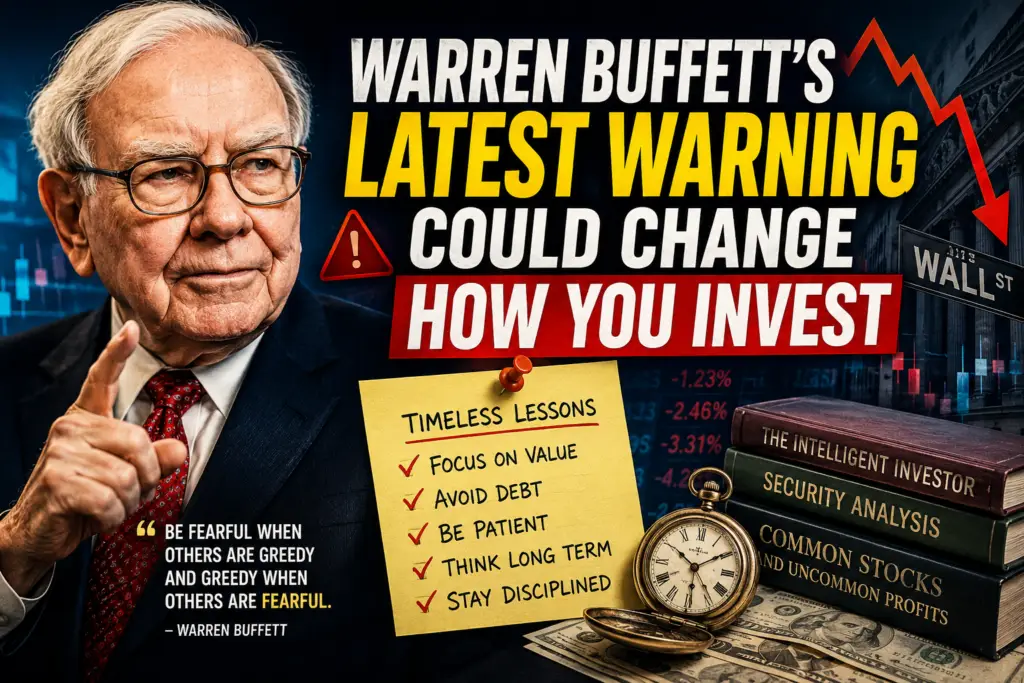
Why Investors Pay Attention to Warren Buffett
Few investors have earned the level of credibility that Warren Buffett has built over more than six decades.
His success has not come from predicting every market move. Instead, it has resulted from consistently applying a disciplined investment framework through multiple economic cycles.
Several principles define that framework:
- Buy understandable businesses.
- Focus on long-term earnings power.
- Demand a margin of safety.
- Ignore short-term market noise.
- Let compounding work over time.
These ideas have remained largely unchanged despite recessions, inflation, financial crises, and technological revolutions.
The “Warning” Isn’t a Prediction
Many headlines suggest Buffett is signaling an upcoming crash.
His own public statements tell a different story.
Throughout annual shareholder letters, Buffett has repeatedly argued that investors should avoid making decisions based on short-term forecasts. Instead, he recommends evaluating whether a business is fundamentally strong and whether its valuation makes sense.
The real warning is subtle:
Investors often lose money by abandoning discipline—not because they fail to predict the economy.
That lesson has remained consistent for decades.
Lesson 1 – Cash Is an Investment Tool
Cash is often criticized because it usually earns lower returns than stocks over long periods.
Buffett views it differently.
For Berkshire Hathaway, liquidity serves several important purposes:
- It protects against unexpected financial stress.
- It allows large investments when opportunities appear.
- It reduces dependence on external financing.
- It creates flexibility during volatile markets.
Holding cash does not necessarily indicate pessimism.
Rather, it may reflect patience and disciplined capital allocation.
Data Snapshot
| Metric | Why It Matters |
|---|---|
| Large corporate cash reserves | Provide flexibility during market stress |
| Higher interest rates | Increase the opportunity cost of borrowing |
| Market corrections | May create better long-term entry prices |
| Strong liquidity | Helps companies survive economic downturns |
Investor takeaway: Liquidity is not simply idle money. In many situations, it represents optionality.
Lesson 2 – Never Ignore Valuation
Buffett has frequently explained that purchasing an outstanding company at an excessive price can still produce disappointing investment results.
That principle becomes especially important after extended bull markets.
Professional investors often evaluate metrics such as:
- Price-to-Earnings (P/E)
- Price-to-Free Cash Flow
- Return on Equity (ROE)
- Operating Margin
- Earnings Growth
- Return on Invested Capital (ROIC)
No single ratio tells the entire story.
Instead, investors typically analyze several financial metrics together before estimating whether a company’s valuation appears reasonable.
Lesson 3 – Invest in Businesses, Not Tickers
One of Buffett’s most famous ideas is simple:
“If you wouldn’t be happy owning a business for ten years, don’t think about owning it for ten minutes.”
That mindset changes how investors evaluate stocks.
Instead of asking,
“Will this stock go up next week?”
they ask,
“Will this business create more value over the next decade?”
This shift encourages investors to focus on:
- Competitive advantages.
- Customer loyalty.
- Cash generation.
- Management quality.
- Long-term industry trends.
Berkshire Hathaway’s Long-Term Philosophy
Although Berkshire Hathaway owns publicly traded stocks, Buffett has repeatedly emphasized that he thinks like a business owner.
This perspective influences nearly every investment decision.
Rather than chasing momentum, Berkshire generally seeks companies with:
- Predictable earnings.
- Durable brands.
- Strong free cash flow.
- Conservative financial management.
- High returns on invested capital.
These characteristics may help businesses perform more consistently across changing economic environments.
Suggested Chart
Chart 1: Buffett’s Long-Term Investing Framework
| Principle | Primary Objective |
|---|---|
| Business Quality | Sustainable earnings growth |
| Margin of Safety | Reduce downside risk |
| Financial Strength | Increase resilience |
| Patience | Maximize long-term compounding |
| Rational Decision-Making | Avoid emotional investing |
Why Patience Has Become a Competitive Advantage
Modern markets move faster than ever.
News spreads instantly.
Social media amplifies fear and excitement.
Despite these changes, Buffett’s philosophy remains remarkably patient.
Instead of reacting to every headline, he focuses on whether the underlying economics of a business have changed.
That approach has helped Berkshire Hathaway navigate multiple recessions, inflationary periods, and market corrections without abandoning its long-term strategy.
In the next section, we’ll examine Berkshire Hathaway’s capital allocation decisions in greater detail, compare Buffett’s philosophy with common investor mistakes, include additional data tables, and explore how long-term investors can apply these principles in today’s market.
Berkshire Hathaway’s Capital Allocation Offers Important Clues
Berkshire Hathaway’s portfolio changes often dominate financial headlines.
However, experienced investors rarely focus on individual transactions alone. Instead, they study how Buffett allocates capital over long periods and why he chooses one opportunity over another.
Buffett has repeatedly explained that capital allocation is one of management’s most important responsibilities. Every dollar invested should have a reasonable expectation of generating attractive long-term returns.
When attractive opportunities become scarce, Berkshire has historically preferred patience over unnecessary activity.
That philosophy reflects discipline rather than market pessimism.
Why Liquidity Can Become a Competitive Advantage
Many investors feel uncomfortable holding cash because they worry about missing market gains.
Buffett has often taken the opposite view.
Liquidity allows investors to act decisively when exceptional opportunities appear.
Benefits include:
- Purchasing quality businesses during market corrections.
- Avoiding forced asset sales.
- Maintaining financial flexibility.
- Reducing portfolio stress during volatility.
Rather than asking, “Why is Buffett holding cash?”, a more useful question is:
“How can financial flexibility improve my own investment decisions?”
Data Snapshot: Buffett’s Investing Priorities
| Priority | Why It Matters |
|---|---|
| Strong balance sheets | Improve resilience during recessions |
| Consistent free cash flow | Supports long-term business growth |
| Durable competitive advantages | Protect long-term profitability |
| Conservative debt levels | Reduce financial risk |
| Attractive valuation | Improves long-term expected returns |
Investor takeaway: Buffett rarely purchases companies based solely on excitement or recent price momentum.
Lesson 4 – Quality Businesses Deserve Patience
Exceptional companies rarely become exceptional overnight.
Instead, they typically strengthen their competitive position over many years.
Characteristics Buffett frequently values include:
- Predictable earnings.
- High returns on capital.
- Pricing power.
- Strong brands.
- Loyal customers.
- Disciplined management.
These qualities often become even more valuable during difficult economic periods.
Lesson 5 – Avoid Following the Crowd
Market enthusiasm can push valuations well beyond reasonable levels.
Likewise, fear can create opportunities by driving prices below intrinsic value.
Buffett’s investment philosophy encourages independent thinking.
Rather than asking,
“What is everyone buying?”
he effectively asks,
“What is this business truly worth?”
That distinction separates investing from speculation.
Suggested Chart
Chart 2: Emotional Investing vs. Buffett’s Discipline
| Emotional Investor | Buffett’s Approach |
|---|---|
| Buys after large rallies | Buys when value exceeds price |
| Sells during panic | Focuses on business fundamentals |
| Watches headlines daily | Thinks in decades |
| Reacts emotionally | Makes rational decisions |
| Follows market sentiment | Follows intrinsic value |
Market Cycles Reward Discipline
Every market experiences periods of optimism and pessimism.
History demonstrates that neither lasts forever.
Since the mid-20th century, the U.S. stock market has experienced numerous:
- Recessions.
- Bear markets.
- Inflationary periods.
- Interest-rate cycles.
- Financial crises.
Despite these challenges, diversified long-term investors have historically benefited from economic growth and corporate innovation over extended periods.
This does not guarantee future performance, but it illustrates why Buffett consistently emphasizes patience.
Buffett’s Philosophy During Expensive Markets
When valuations become elevated, Buffett does not necessarily stop investing.
Instead, he becomes more selective.
Professional investors often evaluate:
- Expected future cash flows.
- Competitive positioning.
- Industry dynamics.
- Financial strength.
- Valuation relative to growth.
High-quality companies remain attractive only when future returns justify the purchase price.
Common Signals Buffett May Be Watching
Although no one knows exactly how Buffett evaluates every investment opportunity, his public writings suggest that he consistently pays attention to several fundamental factors.
These include:
- Corporate profitability.
- Long-term interest rates.
- Capital allocation.
- Business quality.
- Management integrity.
- Sustainable competitive advantages.
- Return on invested capital.
Notice that short-term market forecasts rarely appear on that list.
Data Snapshot: Key Business Metrics Often Used by Long-Term Investors
| Financial Metric | Purpose |
|---|---|
| Revenue Growth | Measures business expansion |
| Free Cash Flow | Indicates financial flexibility |
| Operating Margin | Evaluates efficiency |
| ROE | Measures profitability |
| ROIC | Evaluates capital allocation |
| Debt-to-Equity | Assesses leverage |
| Earnings Growth | Supports long-term valuation |
Rather than relying on one metric, experienced investors generally analyze multiple financial indicators together.
Opportunity Often Appears When Fear Increases
One of Buffett’s most quoted principles encourages investors to remain rational when others become emotional.
Periods of uncertainty often create:
- Lower valuations.
- Greater market volatility.
- Increased pessimism.
- Better long-term buying opportunities.
Of course, not every declining stock represents a bargain.
Fundamental analysis remains essential.
The goal is to distinguish temporary market fear from permanent business deterioration.
Why Buffett’s Philosophy Remains Relevant Today
Technology continues changing rapidly.
Artificial intelligence, cloud computing, cybersecurity, and digital payments are reshaping the global economy.
Yet Buffett’s core investment philosophy remains remarkably timeless.
Whether evaluating a railroad, an insurance company, or a technology business, the same questions still matter:
- Is the business understandable?
- Does it possess durable competitive advantages?
- Is management trustworthy?
- Does the valuation make sense?
- Can the company continue creating value over many years?
Those questions remain just as relevant today as they were decades ago.
In the final section, we’ll explore expert insights, common investing mistakes, a practical action plan, a comprehensive FAQ, additional authority references, and the key lessons long-term investors can apply from Warren Buffett’s enduring investment philosophy.
Expert Insights: Buffett’s Greatest Lesson Is Simpler Than Most Investors Think
Many people believe Warren Buffett’s success comes from finding secret investment opportunities.
His own writings suggest something very different.
Throughout decades of annual shareholder letters, interviews, and public appearances, Buffett has repeatedly emphasized that long-term wealth is built through discipline, rational thinking, and buying outstanding businesses at reasonable prices.
Perhaps the biggest takeaway from his philosophy is this:
Successful investing depends more on consistently making good decisions than on making brilliant predictions.
While countless investors search for the next market-moving headline, Buffett continues focusing on business fundamentals.
That mindset has remained remarkably consistent across inflationary periods, recessions, financial crises, and technological revolutions.
Common Mistakes Investors Should Avoid
Market history shows that many investment mistakes are behavioral rather than analytical.
Understanding these pitfalls may significantly improve long-term results.
Mistake 1: Chasing Market Momentum
Stocks attracting enormous attention often experience significant price appreciation.
However, rapid price gains alone do not justify an investment.
Before buying, ask yourself:
- Is revenue growing consistently?
- Does the company generate strong free cash flow?
- Is management allocating capital effectively?
- Is today’s valuation reasonable?
Outstanding businesses can still become poor investments if purchased at excessive prices.
Mistake 2: Ignoring Risk Management
Many investors spend all their time searching for returns.
Far fewer spend enough time managing risk.
Buffett has frequently emphasized protecting capital before pursuing higher returns.
Risk management may include:
- Diversification.
- Appropriate position sizing.
- Maintaining liquidity.
- Avoiding excessive leverage.
- Investing within your circle of competence.
Mistake 3: Reacting to Every Headline
Financial news never stops.
Breaking stories appear every hour.
Most of them have little impact on long-term business value.
Instead of responding emotionally, disciplined investors typically evaluate whether new information changes the original investment thesis.
If the answer is no, patience often becomes the better strategy.
Mistake 4: Forgetting the Power of Compounding
Compounding rarely attracts headlines because it works gradually.
Nevertheless, Buffett has frequently described it as one of the most powerful forces in investing.
Small improvements repeated consistently over many years often produce extraordinary long-term results.
H2: Suggested Chart
Chart 3: Buffett’s Long-Term Wealth Formula
| Principle | Long-Term Benefit |
|---|---|
| Buy Quality Businesses | Sustainable earnings growth |
| Purchase at Reasonable Prices | Better expected returns |
| Reinvest Capital | Accelerated compounding |
| Stay Invested | Benefit from economic growth |
| Avoid Emotional Decisions | Greater long-term consistency |
Action Plan for Long-Term Investors
The following framework summarizes many of Buffett’s most consistent investment principles.
Step 1: Build Financial Knowledge
Before purchasing individual stocks, understand:
- Business models.
- Financial statements.
- Competitive advantages.
- Industry dynamics.
- Basic valuation methods.
Knowledge reduces emotional decision-making.
Step 2: Focus on Business Quality
Look for companies demonstrating:
- Consistent earnings growth.
- Strong cash generation.
- Conservative debt levels.
- Durable competitive advantages.
- Shareholder-friendly management.
Quality often matters more than excitement.
Step 3: Diversify Intelligently
Many successful investors combine:
- Broad-market ETFs.
- Dividend-paying companies.
- Growth businesses.
- International exposure.
- REITs.
- Fixed-income investments.
Diversification reduces dependence on any single company or sector.
Step 4: Invest Consistently
Dollar-cost averaging allows investors to continue building wealth regardless of short-term market fluctuations.
Consistency often produces better long-term outcomes than attempting to perfectly time market cycles.
Step 5: Think in Decades
Buffett has repeatedly encouraged investors to extend their time horizon.
Businesses create value gradually.
Compounding also requires time.
The longer investors remain disciplined, the more powerful compounding can become.
Frequently Asked Questions
Did Warren Buffett issue a new market warning?
Buffett has not issued a single universally recognized “latest warning.” The article discusses the broader lessons investors can draw from his recent public comments, shareholder letters, and Berkshire Hathaway’s capital allocation decisions.
Why does Buffett sometimes keep large cash reserves?
Large cash balances provide flexibility, preserve financial strength, and allow Berkshire Hathaway to act quickly when attractive investment opportunities become available.
Does Buffett try to predict recessions?
Historically, Buffett has emphasized that predicting recessions is far less important than owning outstanding businesses capable of creating value over many years.
What is Buffett’s most important investing principle?
Many investors would point to buying high-quality businesses at reasonable valuations while maintaining a long-term investment horizon.
Is cash always a bad investment?
Not necessarily.
Although cash typically produces lower long-term returns than equities, it provides valuable flexibility during uncertain economic periods.
Should beginners copy Buffett’s portfolio?
Rather than copying individual holdings, beginners generally benefit more from understanding Buffett’s decision-making process and applying those principles to their own financial goals.
What is the biggest lesson investors should remember?
Patience, discipline, valuation awareness, diversification, and rational decision-making have consistently been among the most important drivers of long-term investment success.
Final Thoughts
Warren Buffett’s Latest Warning Could Change How You Invest is ultimately less about discovering a hidden prediction and more about embracing a proven investment philosophy.
Buffett’s long-term success demonstrates that wealth is rarely built by reacting to daily headlines or attempting to forecast every market movement.
Instead, successful investing depends on understanding businesses, maintaining financial discipline, demanding reasonable valuations, and allowing compounding to work over extended periods.
Although economic conditions will continue evolving, the principles that have guided Buffett for decades remain remarkably relevant.
Investors who focus on quality, patience, diversification, and sound decision-making are often better prepared to navigate both bull markets and periods of uncertainty.
Internal Linking Opportunities
Strengthen your website’s topical authority by linking this article to related content using anchor texts such as:
- Warren Buffett Investing Strategy
- Dividend Stocks for Long-Term Investors
- Top 10 Stocks to BUY NOW (High Growth Stocks)
- Growth vs. Value Investing
- Building a Diversified Investment Portfolio
- Passive Income Strategies
- The Warning Signs That Always Appear Before a Financial Crisis
- How Compound Interest Builds Wealth
- The Global Wealth Shift: Where Smart Money Is Moving Next
- How World Politics Could Affect Your Investment Portfolio
External Authority Sources
Readers interested in learning more about Buffett’s investing philosophy and financial markets should consult:
- Berkshire Hathaway Shareholder Letters
- U.S. Securities and Exchange Commission (SEC): https://www.sec.gov
- Federal Reserve: https://www.federalreserve.gov
- Morningstar: https://www.morningstar.com
- Charles Schwab Market Insights: https://www.schwab.com
- CFA Institute Research: https://www.cfainstitute.org
Final Call to Action
The greatest investing lessons are rarely hidden.
They are repeated consistently by investors who have demonstrated discipline over decades.
Study great businesses, focus on long-term fundamentals, invest with patience, and continue improving your financial knowledge.
Markets will always fluctuate, but thoughtful investing has remained one of the most reliable paths to building lasting wealth.
End of Part 3