

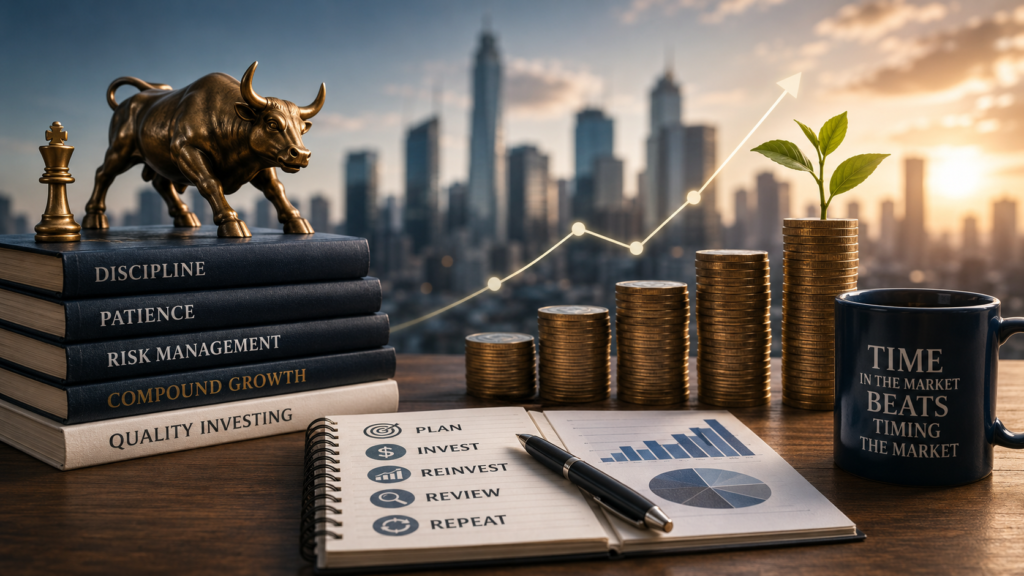
Learn the timeless principles successful stock market investors use to build wealth, manage risk, control emotions, and invest for the long term.
Every year, millions of people open brokerage accounts with the same hope:
To build a better financial future.
Some want to retire earlier.
Others want to create a reliable source of passive income.
Many simply want to stop worrying about money.
Yet only a small percentage of investors remain disciplined long enough to achieve truly meaningful results.
Why?
It is not because the stock market is reserved for financial experts.
It is not because successful investors always know which stock will rise next.
And it is certainly not because they never make mistakes.
The real difference is usually much simpler.
Successful investors follow a process.
They understand what they own.
They manage risk.
They think in years instead of days.
They avoid emotional decisions.
And, perhaps most importantly, they allow time and compound growth to work together.
That may sound less exciting than finding the next stock that doubles overnight.
But excitement is rarely what builds lasting wealth.
The market rewards patience far more consistently than prediction.
It rewards ownership more reliably than speculation.
And it rewards disciplined behavior more often than raw intelligence.
This is one of the most important lessons new investors can learn.
The financial media creates the impression that success depends on constant action.
Buy.
Sell.
Rotate sectors.
React to the latest economic report.
Predict interest rates.
Follow every market headline.
In reality, many successful investors do far less.
They buy quality assets.
They remain invested.
They review their portfolios periodically.
Then they wait.
That waiting is not passive.
It is disciplined.
It requires confidence in a well-constructed strategy.
It requires emotional control during market declines.
And it requires the ability to ignore noise when everyone else appears to be panicking.
Warren Buffett built one of the greatest fortunes in financial history by thinking like a business owner rather than a trader.
John Bogle showed that low costs, broad diversification, and long-term discipline could outperform many complicated strategies.
Peter Lynch taught that individual investors could succeed by understanding the businesses they owned.
Howard Marks emphasized that avoiding major mistakes can be just as important as finding exceptional opportunities.
Their methods were not identical.
Their principles, however, were remarkably similar.
They focused on quality.
They respected risk.
They stayed patient.
They understood that wealth compounds slowly before it compounds quickly.
That last point matters.
Many people abandon investing too early because progress feels disappointing in the beginning.
A portfolio may grow slowly for years.
Dividends may appear insignificant.
Monthly contributions may seem too small to make a difference.
Then compounding begins to accelerate.
Investment gains generate additional gains.
Reinvested dividends purchase more shares.
Those shares create even more income.
What once looked ordinary begins to become powerful.
This is why successful investing is often less about finding one extraordinary investment and more about repeating good decisions for a very long time.
The stock market can be unforgiving in the short term.
Over decades, however, ownership of productive businesses has historically been one of the most effective ways to build wealth.
That does not mean every investor succeeds.
It means success becomes more likely when investors understand the principles that actually matter.
This guide explores those principles.
It explains the mindset, habits, and practical strategies that separate disciplined long-term investors from the crowd.
There will be no promises of easy money.
No guaranteed returns.
No secret stock picks.
Instead, this article will focus on something far more valuable:
A framework for making better investment decisions through every stage of the market cycle.
Key Takeaways
- Successful investing depends more on discipline than prediction.
- Long-term thinking is one of the greatest advantages an investor can develop.
- Quality businesses tend to reward patient shareholders over time.
- Compound growth becomes increasingly powerful across long investment periods.
- Emotional control helps investors avoid buying high and selling low.
- Diversification reduces unnecessary portfolio risk.
- Regular investing is often more effective than waiting for the perfect entry point.
- Low fees and taxes can materially improve long-term outcomes.
- Successful investors focus on business fundamentals rather than daily price movements.
- Anyone can improve their investment results by following a clear process.
Why Most Investors Never Achieve Exceptional Results
The stock market has created enormous wealth.
It has also disappointed millions of investors.
That may seem contradictory.
The explanation usually lies in behavior.
Markets rise and fall.
That is normal.
What is less normal is how investors respond.
During bull markets, confidence increases.
People buy because prices are rising.
They assume recent gains will continue indefinitely.
Then markets decline.
Fear replaces optimism.
Investors sell to avoid further losses.
The result is a destructive cycle:
Buy after prices rise.
Sell after prices fall.
Repeat.
This behavior often causes investors to underperform the very assets they own.
The problem is not always the investment.
It is the timing of emotional decisions.
Successful investors approach volatility differently.
They expect it.
They build it into their plans.
They understand that corrections, bear markets, recessions, and periods of uncertainty are unavoidable.
Rather than treating every decline as a disaster, they ask whether the long-term value of the underlying business has changed.
That question creates clarity.
A falling stock price does not always mean a failing company.
Sometimes it reflects fear.
Sometimes it reflects temporary uncertainty.
Sometimes it creates an opportunity.
What Successful Investing Really Means
Many people define success as beating the market every year.
That is unrealistic.
Even the greatest investors experience periods of underperformance.
Successful investing is better understood as consistently making decisions that improve the probability of reaching long-term financial goals.
For one person, that may mean retiring at 60.
For another, it may mean generating enough dividend income to cover monthly expenses.
Someone else may simply want to build a portfolio that provides security for future generations.
The objective differs.
The process remains similar.
Successful investors:
- Set clear goals.
- Use realistic expectations.
- Invest consistently.
- Manage risk.
- Avoid unnecessary costs.
- Stay committed through market cycles.
They do not need to win every year.
They need to avoid making decisions that permanently damage their long-term progress.
Mindset Comes Before Stock Selection
Many beginners immediately ask:
Which stock should I buy?
That is understandable.
But stock selection is not the first step.
Mindset is.
An investor with the wrong mindset can lose money even while owning good assets.
For example, imagine someone purchases a diversified portfolio of high-quality companies.
The market falls 20%.
The investor panics.
They sell everything.
Months later, prices recover.
The portfolio was not necessarily the problem.
The behavior was.
This is why emotional discipline matters so much.
Mindset determines:
- Whether you stay invested during downturns.
- Whether you chase fashionable stocks.
- Whether you follow your plan.
- Whether you react to headlines.
- Whether you think like an owner or a trader.
A strong strategy cannot survive weak discipline.
The Four Pillars of Successful Investing
Although successful investors may use different methods, most of their strategies rest on four core pillars.
1. Quality
They own productive assets.
In the stock market, this often means companies with:
- Durable competitive advantages.
- Healthy balance sheets.
- Reliable cash flow.
- Strong management.
- Long-term demand.
Quality does not eliminate risk.
It improves the odds that a business can survive difficult periods.
2. Valuation
A great company can still become a poor investment if purchased at an unreasonable price.
Successful investors compare business quality with valuation.
They ask whether the expected return justifies the price paid.
3. Discipline
Markets constantly tempt investors to abandon their plans.
Discipline helps them avoid emotional reactions.
It keeps the strategy intact when fear and greed become powerful.
4. Time
Time allows earnings to grow.
It allows dividends to compound.
It allows temporary volatility to fade in importance.
Without time, even a good strategy may fail to reach its full potential.
Why Thinking Like a Business Owner Changes Everything
A share of stock is not just a ticker symbol.
It is a small ownership stake in a real company.
That company has employees.
Customers.
Products.
Revenue.
Expenses.
Debt.
Competitive advantages.
When investors think like owners, they begin asking better questions.
Instead of asking:
“Will the stock rise next week?”
They ask:
“Will this company become more valuable over the next decade?”
Instead of reacting to daily price changes, they focus on:
- Revenue growth.
- Profit margins.
- Cash generation.
- Competitive positioning.
- Capital allocation.
This mindset reduces unnecessary trading.
It also encourages patience.
A strong business may create value for years before the market fully recognizes it.
The Role of Compound Growth
Compound growth is the engine behind long-term wealth creation.
It works when returns begin generating additional returns.
Suppose an investor earns a 10% return.
The next year, the return is not earned only on the original amount.
It is earned on the original amount plus the previous gain.
Over time, the process accelerates.
The same principle applies to dividends.
Reinvested dividends purchase additional shares.
Those shares produce more dividends.
The cycle continues.
This is why starting early matters.
Time gives compounding more opportunities to work.
It is also why consistency often matters more than initial capital.
A person who invests modest amounts for thirty years may build more wealth than someone who invests a large amount but stops after a few years.
Why Boring Investing Often Wins
Successful investing is frequently boring.
There may be no dramatic trades.
No constant portfolio changes.
No daily excitement.
Instead, the process often looks like this:
Invest every month.
Own diversified assets.
Reinvest income.
Review the portfolio periodically.
Continue learning.
Stay patient.
That is not glamorous.
It is effective.
The pressure to constantly act usually comes from the financial industry, media, and social networks.
Long-term investors understand that activity and progress are not the same thing.
Sometimes the best decision is to do nothing.
The Foundation of a Long-Term Investment Plan
Before selecting individual stocks, investors should establish a structure.
That structure usually includes:
- A clear financial goal.
- A realistic time horizon.
- An emergency fund.
- A defined risk tolerance.
- A monthly contribution plan.
- A diversified portfolio.
- Rules for reviewing investments.
These elements make emotional decisions less likely.
They also help investors remain consistent during difficult periods.
A strong plan should not depend on perfect market predictions.
It should be designed to survive uncertainty.
That is the difference between investing with hope and investing with a process.
The 15 Principles Every Successful Stock Market Investor Follows
The stock market has changed dramatically over the past century.
New technologies have emerged.
Entire industries have disappeared.
Economic crises have come and gone.
Yet despite these changes, the principles followed by successful investors have remained remarkably consistent.
They are simple.
They are practical.
And, most importantly, they have stood the test of time.
Let’s explore the fifteen principles that form the foundation of long-term investing success.
1. Invest With a Clear Purpose
Every successful investment begins with a goal.
Without one, investors often make emotional decisions.
Ask yourself:
- Are you investing for retirement?
- Financial independence?
- Passive income?
- Your children’s education?
- Building generational wealth?
Your objective determines:
- Your investment horizon.
- Your risk tolerance.
- Your asset allocation.
- Your portfolio strategy.
Successful investors always know why they are investing.
2. Think Like a Business Owner
Stocks are not lottery tickets.
Every share represents ownership in a real business.
Instead of asking,
“Will this stock go up tomorrow?”
Successful investors ask,
“Will this company be stronger ten years from now?”
That simple mindset changes everything.
It shifts attention away from daily price movements and toward long-term business performance.
3. Buy Quality Companies
The greatest portfolios are usually built around exceptional businesses.
Successful investors look for companies with:
- Strong competitive advantages.
- Healthy balance sheets.
- Consistent profitability.
- Positive free cash flow.
- Excellent management teams.
- Products or services that remain relevant for decades.
Quality businesses are more likely to survive recessions and continue growing through multiple economic cycles.
4. Let Compound Interest Work
Compound growth is one of investing’s greatest advantages.
Returns begin generating additional returns.
Dividends purchase more shares.
Those shares produce additional dividends.
Earnings continue expanding.
Over long periods, relatively small investments can grow into significant wealth.
This is why millionaire investors often begin investing as early as possible.
Time matters.
5. Invest Consistently
Many investors wait for the “perfect” moment.
Successful investors understand that perfect timing rarely exists.
Instead, they invest regularly.
Every month.
Every quarter.
Every paycheck.
Consistent investing removes much of the emotion from investing while allowing investors to benefit from different market conditions over time.
6. Diversify Wisely
Diversification protects portfolios against unexpected events.
Successful investors diversify across:
- Industries.
- Company sizes.
- Countries.
- Asset classes.
- Economic sectors.
Diversification cannot eliminate losses.
It can significantly reduce unnecessary risk.
7. Reinvest Your Dividends
Dividend payments represent more than income.
They represent additional investment capital.
Reinvesting dividends accelerates compound growth because each new share purchased becomes another income-producing asset.
Many of history’s strongest long-term returns have been supported by dividend reinvestment.
8. Control Your Emotions
Markets constantly test investor psychology.
Prices rise.
Prices fall.
Economic headlines create fear.
Bull markets create overconfidence.
Successful investors understand that emotions rarely improve investment decisions.
Instead of reacting impulsively, they follow predetermined investment plans.
9. Ignore Short-Term Noise
Financial news never stops.
Every day offers another reason to worry.
Or celebrate.
Interest rates.
Inflation.
Politics.
Geopolitics.
Corporate earnings.
Professional investors certainly monitor these developments.
However, they rarely allow short-term headlines to dictate long-term investment strategies.
10. Keep Costs Low
Investment costs quietly reduce wealth.
Expense ratios.
Trading commissions.
Management fees.
Taxes.
Frequent buying and selling.
Successful investors understand that reducing unnecessary costs allows more money to remain invested and continue compounding.
11. Continue Learning
The stock market rewards curiosity.
Successful investors regularly study:
- Annual reports.
- Company financial statements.
- Economic trends.
- Industry developments.
- Shareholder letters.
- Investment books.
Knowledge compounds just as investments do.
Every lesson improves future decision-making.
12. Buy During Periods of Fear
History demonstrates an interesting pattern.
Many outstanding investment opportunities appear during periods of maximum uncertainty.
When markets decline sharply, many investors panic.
Successful investors ask a different question.
“Has the business changed—or only the stock price?”
If fundamentals remain strong, lower prices may represent opportunity rather than danger.
13. Focus on Risk Before Return
Average investors often chase high returns.
Successful investors first evaluate downside risk.
Before investing, they consider:
- Debt levels.
- Cash flow.
- Competitive threats.
- Industry disruption.
- Economic sensitivity.
- Management quality.
Protecting capital remains one of the most important aspects of long-term investing.
14. Review—Don’t Constantly Trade
Monitoring a portfolio differs from constantly changing it.
Successful investors periodically review:
- Business fundamentals.
- Portfolio allocation.
- Investment thesis.
- Risk exposure.
If nothing meaningful has changed, unnecessary trading is avoided.
Patience frequently outperforms excessive activity.
15. Let Time Become Your Greatest Ally
Perhaps no advantage is more powerful than time.
Short-term investors focus on next month.
Successful investors think about:
Five years.
Ten years.
Twenty years.
Thirty years.
Time allows:
- Earnings to grow.
- Dividends to compound.
- Businesses to mature.
- Temporary volatility to fade.
Patience transforms average investment returns into extraordinary long-term wealth.
How These Principles Work Together
Each principle is valuable individually.
Together, they become remarkably powerful.
Imagine an investor who:
- Invests every month.
- Buys outstanding businesses.
- Reinvests dividends.
- Controls emotions.
- Diversifies intelligently.
- Keeps costs low.
- Continues learning.
- Remains invested for decades.
This investor does not need to predict recessions.
They do not need to identify every winning stock.
Instead, they rely on a repeatable process.
That process steadily improves the probability of financial success.
Average Investors vs. Successful Investors
| Average Investor | Successful Investor |
|---|---|
| Chases market trends | Follows a long-term strategy |
| Buys emotionally | Buys based on fundamentals |
| Tries to time the market | Invests consistently |
| Focuses on stock prices | Focuses on business quality |
| Spends dividends | Reinvests dividends |
| Reacts to headlines | Thinks independently |
| Frequently changes strategy | Stays disciplined |
| Seeks quick profits | Builds long-term wealth |
The differences appear small.
Yet over twenty or thirty years, they often produce dramatically different financial outcomes.
Building a Portfolio That Lasts a Lifetime
A successful investment portfolio is rarely built through one extraordinary decision.
It is built through thousands of disciplined decisions repeated consistently.
Saving regularly.
Buying quality businesses.
Managing risk.
Remaining patient.
Ignoring short-term distractions.
Allowing compound growth to work.
These habits become increasingly valuable as time passes.
They also explain why many millionaire investors appear surprisingly ordinary.
Their success is not usually based on brilliance.
It is based on consistency.
The Biggest Mistakes That Prevent Investors From Building Wealth
Building wealth in the stock market is not only about making good decisions.
It is also about avoiding bad ones.
Many investors fail not because they lack intelligence or opportunity, but because they repeatedly make the same behavioral mistakes.
Fortunately, most of these mistakes are entirely avoidable.
Let’s examine the ones that cost investors the most over time.
Mistake 1: Trying to Time the Market
One of the most expensive investing habits is waiting for the “perfect” moment.
Investors often delay buying because they expect:
- A market crash.
- Lower interest rates.
- Better economic conditions.
- A cheaper entry point.
- More certainty.
The problem is that financial markets rarely offer obvious opportunities.
By the time everything feels safe, stock prices have often already recovered.
Successful investors understand a timeless lesson:
Time in the market has historically been far more valuable than timing the market.
Mistake 2: Letting Emotions Drive Decisions
Markets constantly test investor psychology.
Bull markets create excitement.
Bear markets create fear.
Both emotions can be dangerous.
Fear encourages investors to sell quality companies at low prices.
Greed encourages buying after prices have already risen significantly.
Successful investors rely on discipline rather than emotion.
They follow their investment plan regardless of temporary market sentiment.
Mistake 3: Chasing Performance
Every market cycle creates fashionable investments.
Technology.
Artificial intelligence.
Cryptocurrencies.
Electric vehicles.
The latest IPO.
Many investors assume that yesterday’s winners will continue outperforming indefinitely.
History suggests otherwise.
Successful investors evaluate business fundamentals instead of following market hype.
Mistake 4: Ignoring Risk
Many people focus only on potential returns.
Professional investors spend just as much time evaluating potential losses.
Before buying a company, they ask:
- Does it generate consistent profits?
- Is the balance sheet strong?
- Can it survive an economic recession?
- Does management allocate capital wisely?
- Does the company possess durable competitive advantages?
Managing downside risk often contributes more to long-term success than chasing extraordinary returns.
Mistake 5: Giving Up Too Early
Perhaps the greatest obstacle to wealth creation is impatience.
Many investors abandon their strategy after only a few years because progress appears slow.
Compound growth rarely looks impressive in the beginning.
It accelerates over time.
Those who remain invested often experience dramatically different outcomes from those who quit too soon.
Patience is not simply beneficial.
It is essential.
A Step-by-Step Plan for Long-Term Success
Becoming a successful investor does not require predicting the future.
It requires following a repeatable process.
Step 1: Define Your Financial Goals
Know exactly what you want your investments to accomplish.
Examples include:
- Retirement.
- Financial independence.
- Passive income.
- Wealth preservation.
- Building a legacy for future generations.
Clear goals improve decision-making.
Step 2: Create an Investment Habit
Invest regularly.
Monthly contributions often prove more effective than waiting for perfect market conditions.
Automation also reduces emotional decision-making.
Step 3: Build a Diversified Portfolio
A resilient portfolio may include exposure to:
- Large-cap companies.
- Small-cap companies.
- Dividend-paying stocks.
- Growth companies.
- International equities.
- Index funds.
Diversification helps reduce unnecessary concentration risk.
Step 4: Reinvest Your Returns
During your wealth-building years, reinvesting dividends and capital gains allows compound growth to accelerate.
This simple habit can make an enormous difference over several decades.
Step 5: Review, Don’t React
Review your portfolio periodically.
Evaluate whether:
- Your goals have changed.
- Company fundamentals remain strong.
- Asset allocation still reflects your objectives.
Avoid reacting emotionally to every market headline.
Lessons From Legendary Investors
Although the world’s greatest investors use different strategies, several common themes repeatedly emerge.
Warren Buffett
Buy outstanding businesses.
Think like an owner.
Remain patient.
Ignore short-term market noise.
Benjamin Graham
Always maintain a margin of safety.
Protect capital before seeking exceptional returns.
Value matters.
Peter Lynch
Invest in businesses you understand.
Continue learning.
Individual investors often possess more advantages than they realize.
John Bogle
Keep costs low.
Diversify broadly.
Stay invested.
Avoid unnecessary complexity.
Howard Marks
Risk management is just as important as return generation.
Successful investing often depends more on avoiding major mistakes than making spectacular decisions.
Frequently Asked Questions
Can anyone become a successful stock market investor?
Yes.
Successful investing depends primarily on discipline, consistency, education, and patience rather than exceptional intelligence.
How much money should I start with?
Start with whatever amount you can invest consistently.
Small contributions made regularly over many years can grow substantially through compound returns.
Should beginners buy individual stocks or index funds?
Both approaches can be appropriate.
Many beginners start with diversified index funds before gradually investing in carefully researched individual companies.
How often should I review my portfolio?
Most long-term investors review their portfolios periodically—often quarterly or annually—rather than daily.
The goal is to monitor progress, not constantly trade.
How long does it take to build meaningful wealth?
There is no universal timeline.
Income, savings rate, investment returns, and consistency all matter.
However, most self-made millionaire investors build wealth gradually over decades.
Final Thoughts
The stock market has created extraordinary wealth for generations of investors.
Not because it guarantees success.
But because it rewards discipline, patience, and long-term ownership of productive businesses.
The investors who consistently achieve exceptional results rarely possess secret information.
Instead, they develop habits that separate them from the crowd.
They think differently.
They manage risk carefully.
They continue investing during difficult periods.
They focus on business quality rather than market excitement.
They understand that wealth is rarely built through dramatic moments.
It is built through thousands of small, intelligent decisions repeated over many years.
The fifteen principles discussed throughout this guide provide a framework that has remained relevant through recessions, financial crises, technological revolutions, inflationary periods, and changing market environments.
Markets will continue evolving.
Human behavior will not.
Fear and greed will always influence investors.
The opportunity belongs to those who remain disciplined when others become emotional.
There is no secret shortcut to becoming a successful stock market investor.
There is only a proven process.
Invest consistently.
Own quality businesses.
Diversify intelligently.
Control your emotions.
Continue learning.
And allow time to become your greatest financial ally.
Those who follow these principles place themselves in the strongest possible position to build lasting wealth and achieve financial independence.
Internal Linking Opportunities
Strengthen your website’s topical authority by linking this article to:
- The Secret Playbook Millionaire Investors Follow to Build Lasting Wealth
- The Successful Investor’s Guide: 15 Strategies to Build Wealth in the Stock Market
- How Compound Interest Can Turn Small Investments Into Millions
- Dividend Stocks vs. Growth Stocks: Which Strategy Wins?
- Why Time in the Market Beats Timing the Market
- The Biggest Investing Mistake Almost Everyone Makes
- How to Build a Diversified Investment Portfolio
- Why Wall Street Is Quietly Buying Latin American Stocks
Recommended External Authority Sources
For readers interested in further research:
- Berkshire Hathaway Shareholder Letters
- U.S. Securities and Exchange Commission (SEC)
- Investor.gov
- Vanguard
- Fidelity Investments
- Morningstar
- CFA Institute
- FINRA
- S&P Dow Jones Indices
- Federal Reserve
Educational Disclaimer
This article is for educational and informational purposes only and should not be considered financial, investment, legal, or tax advice. Investing in stocks involves risk, including the possible loss of principal. Past performance does not guarantee future results. Always conduct your own research and consult a qualified financial advisor before making investment decisions.