

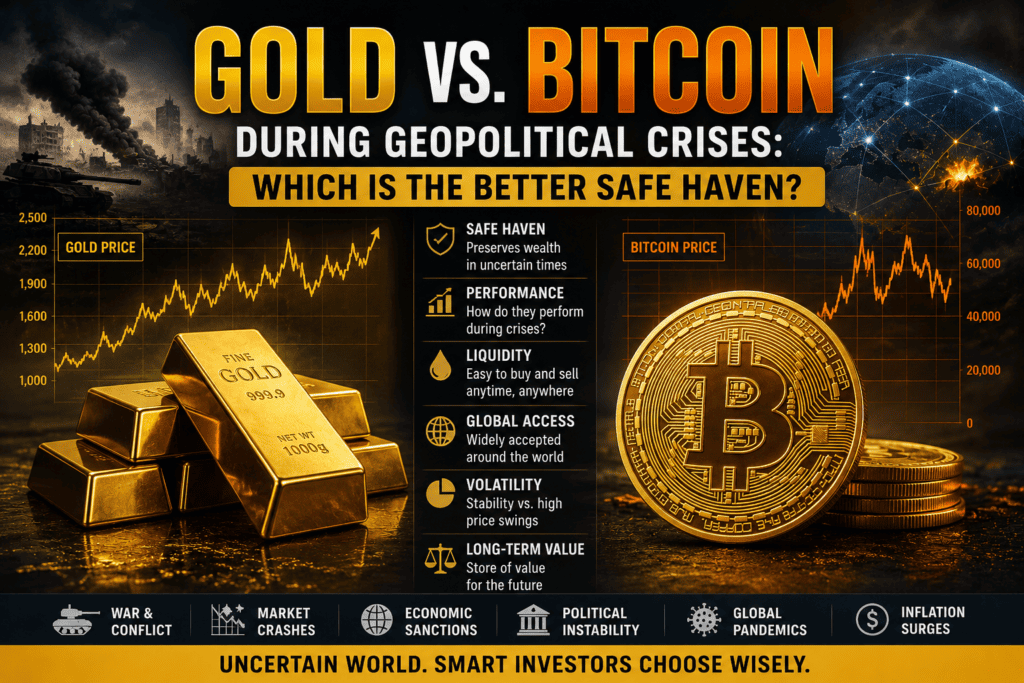
Gold vs. Bitcoin During Geopolitical Crises: Which Is the Better Safe Haven? Compare risks, historical performance, and strategies for long-term investors.
Gold vs. Bitcoin During Geopolitical Crises: Which Is the Better Safe Haven? It’s a question investors increasingly ask whenever global uncertainty dominates financial headlines. Wars, trade disputes, inflation, banking instability, and political tensions often trigger sharp market swings. Consequently, many investors begin searching for assets that may help preserve purchasing power while reducing portfolio risk.
For decades, gold has been considered one of the world’s traditional safe-haven assets. Meanwhile, Bitcoin has emerged as a newer alternative that some investors describe as “digital gold.” Although both assets attract attention during periods of uncertainty, they differ significantly in terms of volatility, historical performance, liquidity, and adoption.
Because no investment performs well under every economic condition, understanding these differences is essential. Rather than relying on social media opinions or sensational headlines, investors should evaluate each asset based on evidence, historical behavior, and long-term financial goals.
Throughout this guide, we’ll compare gold and Bitcoin during periods of geopolitical uncertainty, examine how each asset has responded to previous market shocks, and discuss the advantages and risks associated with both. More importantly, you’ll learn how these investments may fit into a diversified portfolio without relying on unrealistic expectations or speculative predictions.
Key Takeaways
- Gold has historically served as a traditional safe-haven asset.
- Bitcoin offers unique characteristics but remains more volatile.
- Geopolitical crises affect investor behavior in different ways.
- Diversification often provides better risk management than relying on one asset.
- Inflation expectations can influence demand for both gold and Bitcoin.
- Market sentiment frequently drives short-term price movements.
- Long-term investing requires discipline rather than emotional reactions.
- Understanding risk is just as important as pursuing returns.
What Makes an Asset a Safe Haven?
A safe-haven asset is generally expected to preserve value during periods of economic or geopolitical uncertainty.
However, no investment consistently performs well in every crisis.
Instead, investors evaluate safe-haven assets according to several characteristics:
- Liquidity
- Global acceptance
- Historical resilience
- Limited supply
- Market confidence
- Accessibility
- Diversification benefits
Because different crises create different economic conditions, investors often compare multiple assets before making allocation decisions.
Why Gold Has Earned Its Reputation
Gold has served as a store of value for thousands of years.
Throughout history, governments, central banks, and private investors have viewed it as a valuable asset during periods of inflation, currency instability, and geopolitical conflict.
Several characteristics contribute to gold’s reputation.
For example:
- Limited natural supply
- Global recognition
- High liquidity
- Long historical record
- Central bank ownership
- No direct dependence on corporate earnings
Consequently, many investors continue including gold in diversified portfolios as a potential risk-management tool.
Why Bitcoin Entered the Conversation
Bitcoin was introduced in 2009 following the global financial crisis.
Unlike gold, it exists entirely in digital form.
Its supply is limited by design, and transactions occur through a decentralized blockchain network.
Supporters often argue that Bitcoin shares several characteristics with gold.
These include:
- Scarcity
- Global accessibility
- Portability
- Resistance to monetary expansion
- Independence from traditional banking systems
Nevertheless, Bitcoin’s shorter history means investors have less long-term evidence regarding its performance across different economic environments.
The Biggest Difference Between Gold and Bitcoin
Although both assets attract investors seeking diversification, their behavior often differs significantly.
Gold has experienced centuries of market participation.
Bitcoin, by comparison, remains relatively young.
Furthermore, Bitcoin has historically demonstrated much higher price volatility.
Consequently, investors should understand that higher potential returns have often been accompanied by substantially larger price swings.
Risk tolerance therefore becomes an important factor when evaluating either asset.
How Investors Typically Respond During Crises
Periods of uncertainty often change investor priorities.
Rather than pursuing maximum returns, many investors shift their attention toward preserving capital.
As a result, demand sometimes increases for assets perceived as relatively defensive.
Gold has historically benefited from this behavior in many economic crises.
Meanwhile, Bitcoin’s performance has varied depending on the specific market environment.
Some periods have seen strong gains.
Others have experienced significant declines.
Therefore, understanding historical context is essential before drawing broad conclusions.
Why Inflation Matters
Inflation reduces purchasing power over time.
Consequently, investors frequently search for assets that may help preserve long-term wealth.
Gold has traditionally been viewed as a potential inflation hedge under certain circumstances.
Bitcoin supporters also argue that its fixed supply could provide similar characteristics.
However, empirical evidence remains mixed.
Because Bitcoin has existed for a much shorter period, researchers continue evaluating how consistently it performs during different inflationary environments.
Avoiding Emotional Investment Decisions
Financial headlines often create urgency.
Nevertheless, successful investing rarely depends on making immediate decisions based solely on breaking news.
Experienced investors typically evaluate:
- Portfolio diversification
- Personal risk tolerance
- Investment time horizon
- Liquidity needs
- Overall financial objectives
By focusing on long-term planning instead of short-term emotions, investors often make more consistent decisions.
In the next section, we’ll compare how gold and Bitcoin have historically behaved during major geopolitical crises, examine their strengths and weaknesses, and explore which type of investor each asset may be better suited for.
How Gold Has Historically Performed During Geopolitical Crises
Gold has earned its reputation over centuries rather than decades.
Whenever investors become concerned about war, inflation, banking instability, or currency weakness, demand for physical gold has often increased. Consequently, its price has frequently risen during periods of heightened uncertainty.
That said, gold does not move higher in every crisis.
Interest rates, inflation expectations, central bank policies, and the strength of the U.S. dollar also influence its performance. Therefore, investors should avoid assuming that every geopolitical event will automatically lead to higher gold prices.
Even so, history demonstrates that gold has repeatedly served as a portfolio diversifier during challenging economic periods.
How Bitcoin Has Responded to Market Uncertainty
Bitcoin’s history is much shorter.
As a result, investors have fewer geopolitical events available for comparison.
Since its creation in 2009, Bitcoin has experienced:
- Banking crises
- Inflationary periods
- Global pandemics
- Rising interest rates
- Regional conflicts
- Financial market volatility
During some of these events, Bitcoin appreciated significantly.
During others, it declined alongside stocks and other risk assets.
Consequently, Bitcoin has not yet demonstrated the same consistency historically associated with traditional safe-haven assets.
Volatility Is One of the Biggest Differences
One characteristic clearly separates these two assets.
Bitcoin has historically been much more volatile than gold.
Large price movements over short periods have become common throughout Bitcoin’s history.
Meanwhile, gold typically experiences smaller fluctuations.
For conservative investors, lower volatility may provide greater psychological comfort during uncertain markets.
On the other hand, investors willing to accept higher risk may view Bitcoin’s volatility as an opportunity for potentially higher long-term returns.
Liquidity and Accessibility
Both assets are highly liquid, although they operate differently.
Gold can be purchased through:
- Physical bullion
- Coins
- ETFs
- Mutual funds
- Mining company stocks
Bitcoin can be accessed through:
- Cryptocurrency exchanges
- Spot ETFs (where available)
- Digital wallets
- Certain brokerage platforms
Because both markets have expanded considerably, investors today enjoy more flexibility than ever before.
However, security considerations remain especially important for digital assets.
Institutional Adoption
Institutional participation has grown for both investments.
Central banks continue holding substantial gold reserves.
Likewise, pension funds, asset managers, and publicly traded companies have gradually increased exposure to Bitcoin in recent years.
This growing institutional interest has contributed to broader market acceptance.
Nevertheless, gold continues benefiting from a much longer history of institutional ownership.
Bitcoin, while increasingly accepted, remains an emerging asset class.
Gold vs. Bitcoin Comparison
| Feature | Gold | Bitcoin |
|---|---|---|
| History | Thousands of years | Since 2009 |
| Supply | Naturally limited | Fixed at 21 million coins |
| Volatility | Generally lower | Significantly higher |
| Liquidity | Very high | Very high |
| Inflation Hedge | Historically used by many investors | Still under evaluation |
| Physical Asset | Yes | No |
| Digital Accessibility | Through ETFs and brokers | Native digital asset |
| Central Bank Holdings | Extensive | Minimal |
This comparison highlights that both assets possess unique strengths.
Consequently, choosing between them often depends on an investor’s objectives rather than searching for a universally “better” investment.
Can Investors Own Both?
Many experienced investors avoid viewing this as an either-or decision.
Instead, they allocate small portions of their portfolios to multiple asset classes.
For example, a diversified portfolio could include:
- U.S. equities
- International stocks
- Bonds
- REITs
- Gold
- Bitcoin
- Cash reserves
This approach reduces dependence on the performance of any single investment.
Furthermore, diversification may improve long-term risk-adjusted returns.
The Role of Risk Tolerance
Every investor has a different comfort level with market volatility.
Someone approaching retirement may prioritize stability and income generation.
Conversely, younger investors with longer investment horizons may tolerate larger price fluctuations.
Consequently, asset allocation should reflect personal financial goals rather than popular market narratives.
Understanding your own risk tolerance remains one of the most important steps in building a successful portfolio.
Looking Beyond Performance Alone
Investment decisions should never rely exclusively on past returns.
Instead, consider several additional factors:
- Portfolio diversification
- Liquidity needs
- Time horizon
- Tax implications
- Overall financial plan
- Personal risk tolerance
Although historical performance provides valuable context, future outcomes will depend on changing economic conditions.
Therefore, balanced decision-making remains essential.
Why Diversification Often Wins
Financial history repeatedly demonstrates that relying on one investment rarely produces the most consistent long-term outcomes.
Markets constantly evolve.
Consequently, combining multiple asset classes often reduces overall portfolio volatility.
Gold may perform well under certain conditions.
Bitcoin may outperform during others.
Meanwhile, stocks, bonds, and real estate each contribute different characteristics.
Rather than attempting to identify a single perfect investment, many successful investors focus on building resilient portfolios capable of performing across multiple economic environments.
In the final section, we’ll examine common investing mistakes, practical portfolio strategies, frequently asked questions, and the most important lessons investors can apply when comparing gold and Bitcoin during periods of geopolitical uncertainty.
Expert Insights: Choosing Between Gold and Bitcoin
Many investors approach this comparison as if there must be a single winner.
In reality, that question oversimplifies a much more complex decision.
Gold and Bitcoin serve different purposes within a diversified portfolio. Consequently, the better choice often depends on an investor’s financial goals, risk tolerance, and investment horizon rather than on market headlines.
Gold has centuries of historical credibility and has repeatedly been used as a store of value during economic and geopolitical uncertainty. Meanwhile, Bitcoin represents a newer digital asset with unique characteristics that continue attracting institutional and retail investors alike.
Rather than asking which asset is universally superior, experienced investors typically ask a different question:
“How can each asset contribute to my overall portfolio?”
That perspective often leads to more balanced and disciplined investment decisions.
Common Mistakes Investors Make
Periods of uncertainty encourage emotional investing.
Fortunately, recognizing common mistakes can help investors avoid costly decisions.
Mistake 1: Believing There Is Only One Safe Haven
Some investors assume that every dollar should move into a single asset during market stress.
However, diversification has historically provided more consistent long-term risk management.
Owning multiple asset classes often reduces overall portfolio volatility.
Mistake 2: Chasing Recent Performance
When either gold or Bitcoin experiences a strong rally, many investors rush to buy after prices have already increased.
Unfortunately, buying solely because prices recently moved higher can expose investors to unnecessary risk.
Instead, evaluate long-term fundamentals before making allocation decisions.
Mistake 3: Ignoring Personal Risk Tolerance
Bitcoin’s volatility differs dramatically from gold’s.
Consequently, investors should honestly evaluate how much short-term price fluctuation they can comfortably tolerate.
A suitable investment for one person may be entirely inappropriate for another.
Mistake 4: Expecting Any Asset to Perform Perfectly
No investment consistently outperforms during every economic environment.
Gold has experienced extended periods of weak performance.
Likewise, Bitcoin has undergone significant drawdowns throughout its history.
Therefore, realistic expectations remain essential.
Practical Action Plan
If you’re considering adding either gold or Bitcoin to your portfolio, this framework may help guide your decision.
Step 1: Define Your Financial Objectives
Begin by identifying what you hope to achieve.
Are you seeking:
- Long-term growth?
- Inflation protection?
- Portfolio diversification?
- Capital preservation?
Your objectives should influence every investment decision.
Step 2: Evaluate Your Risk Tolerance
Consider how you typically respond during market volatility.
If large price swings create significant stress, a more conservative allocation may be appropriate.
Conversely, investors with longer time horizons may accept greater volatility in pursuit of higher potential returns.
Step 3: Build a Diversified Portfolio
Rather than relying exclusively on one investment, many financial professionals recommend combining multiple asset classes.
A diversified portfolio may include:
- Broad-market ETFs
- Dividend stocks
- Bonds
- REITs
- Gold
- Bitcoin
- Cash reserves
Diversification cannot eliminate risk.
Nevertheless, it often improves long-term portfolio resilience.
Step 4: Invest Consistently
Attempting to perfectly time geopolitical events is extremely difficult.
Instead, consistent investing over many years has historically produced more reliable long-term results than frequent trading based on headlines.
Step 5: Continue Learning
Financial markets constantly change.
Accordingly, continue improving your understanding of:
- Inflation
- Monetary policy
- Cryptocurrency
- Precious metals
- Portfolio management
- Behavioral finance
Knowledge remains one of the most valuable assets any investor can own.
Frequently Asked Questions
Is gold still considered a safe-haven asset?
Many investors continue viewing gold as a traditional safe-haven investment because of its long history as a store of value.
However, no investment guarantees protection under every market condition.
Can Bitcoin replace gold?
Bitcoin and gold possess different characteristics.
Some investors view Bitcoin as “digital gold,” while others consider it a higher-risk growth asset.
Consequently, the two investments may play different roles within diversified portfolios.
Which asset has historically been less volatile?
Gold has generally experienced significantly lower price volatility than Bitcoin.
For that reason, conservative investors often prefer gold when seeking portfolio stability.
Should investors own both gold and Bitcoin?
Some financial professionals believe modest exposure to both assets may improve diversification.
However, the appropriate allocation depends on individual financial goals and risk tolerance.
How do geopolitical crises affect these assets?
Periods of uncertainty may increase investor demand for assets perceived as stores of value.
Nevertheless, market reactions vary depending on economic conditions, inflation, interest rates, and investor sentiment.
Is Bitcoin a proven inflation hedge?
Research remains ongoing.
Although some investors believe Bitcoin’s fixed supply supports its long-term value, historical evidence remains more limited than gold’s.
What is the biggest lesson investors should remember?
Long-term financial success generally depends more on diversification, discipline, and patience than on selecting a single “perfect” investment.
Final Thoughts
Gold vs. Bitcoin During Geopolitical Crises: Which Is the Better Safe Haven? is a question without a universal answer.
Gold offers centuries of history, widespread institutional acceptance, and relatively lower volatility.
Meanwhile, Bitcoin provides a scarce digital asset with growing global adoption and the potential for higher long-term growth, albeit with substantially greater price fluctuations.
Rather than treating these investments as direct competitors, many experienced investors evaluate how each asset complements a broader, diversified portfolio.
Ultimately, successful investing is rarely about predicting the next geopolitical crisis.
Instead, it is about building a resilient financial plan that can adapt to changing economic environments while remaining aligned with your long-term goals.
Internal Linking Opportunities
Strengthen your website’s SEO by linking this article to related content using anchor texts such as:
- What Happens If You Invest $100 a Month in Bitcoin?
- Can Bitcoin Really Make You a Millionaire?
- Is It Too Late to Buy Bitcoin? Here’s What History Says
- The Biggest Bitcoin Mistakes New Investors Make
- The Simple Bitcoin Strategy That Beats Trying to Time the Market
- Building a Diversified Investment Portfolio
- Dividend Stocks for Long-Term Investors
- REIT Investing Guide
- Passive Income Strategies
- How Inflation Affects Your Investments
External Authority Sources
Readers who want to deepen their knowledge should consult trusted organizations such as:
- U.S. Securities and Exchange Commission (SEC): https://www.sec.gov
- Federal Reserve: https://www.federalreserve.gov
- World Gold Council: https://www.gold.org
- Morningstar: https://www.morningstar.com
- CFA Institute: https://www.cfainstitute.org
Final Call to Action
Economic uncertainty will continue to shape financial markets for years to come.
Instead of searching for a single perfect safe-haven investment, focus on creating a diversified portfolio that reflects your financial objectives, your tolerance for risk, and your long-term investment strategy.
Whether you choose gold, Bitcoin, or a combination of both, disciplined investing, continuous learning, and patience remain some of the most reliable foundations for building lasting wealth.