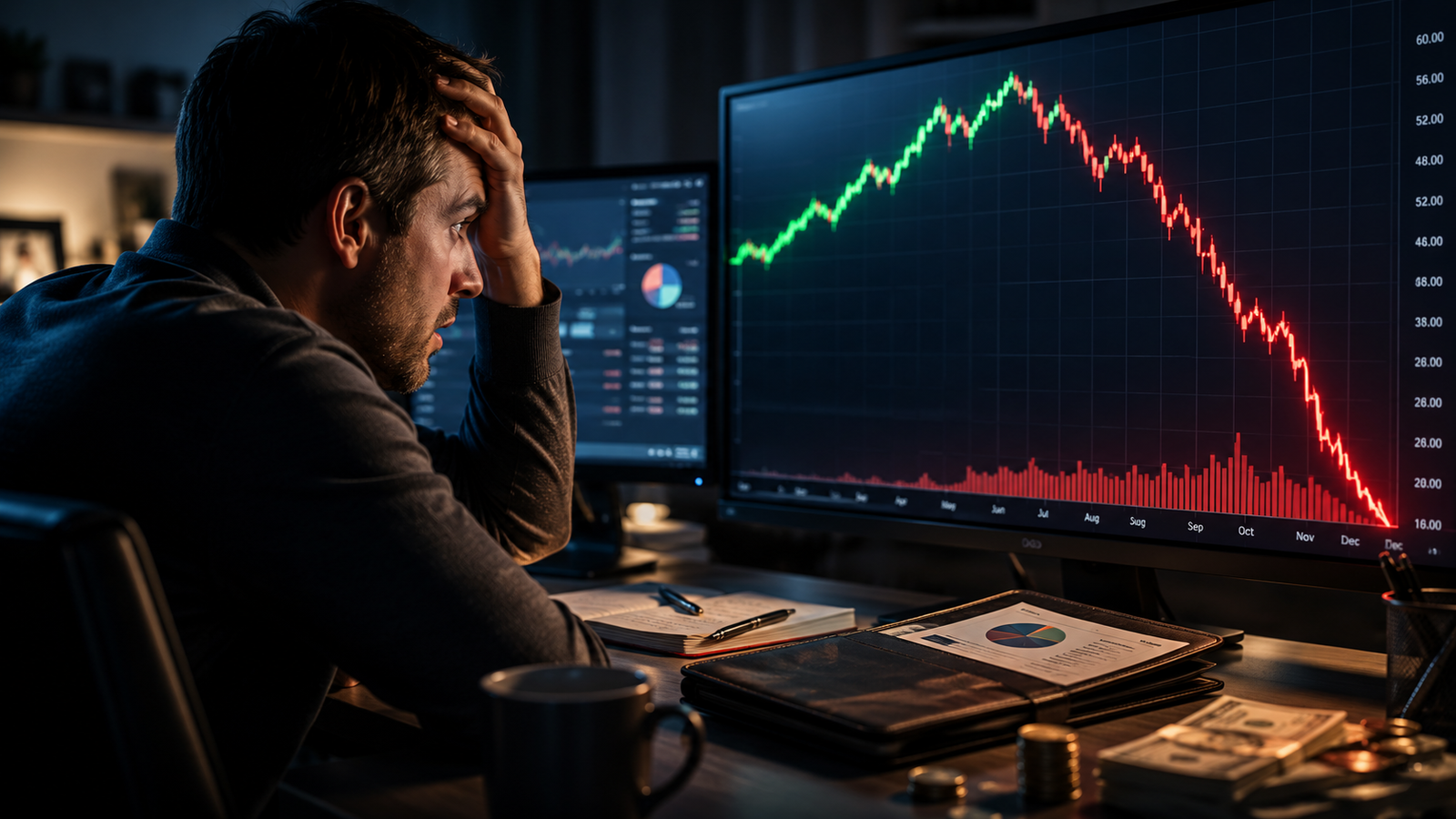

Discover what every stock market crash has in common and learn the timeless lessons smart investors use to protect wealth and stay invested.
Article Category
Investing • Stock Market • Long-Term Wealth Building
Every generation of investors believes it is living through the most frightening market crash in history.
One decade brings a banking crisis. The next delivers a technology bubble. Later, a global pandemic shakes financial markets, followed by inflation concerns, rising interest rates, or geopolitical conflict.
At first, each crisis feels unique. Financial news fills with alarming headlines, experts debate what comes next, and investors begin wondering whether “this time is different.”
However, history tells a remarkably consistent story.
Although the causes of market crashes vary, the underlying patterns are surprisingly similar. Fear spreads quickly, stock prices fall sharply, and uncertainty dominates investor sentiment. Meanwhile, businesses continue adapting, economies gradually adjust, and financial markets eventually begin recovering—even when that outcome seems impossible during the darkest moments.
Understanding what every stock market crash has in common can dramatically change the way you invest. Instead of reacting emotionally to temporary volatility, you’ll learn to recognize recurring patterns that have appeared throughout more than a century of market history.
This perspective doesn’t eliminate risk, nor does it guarantee positive returns. Rather, it helps investors replace panic with preparation and short-term emotions with long-term thinking.
Throughout this guide, we’ll examine the common characteristics shared by every major market crash, explore the psychological traps that hurt investors the most, and uncover practical lessons that can help you build a stronger portfolio before the next downturn inevitably arrives.
Key Takeaways
✔ Every stock market crash has been triggered by different events but has followed remarkably similar psychological patterns.
✔ Fear and uncertainty often spread faster than economic fundamentals change.
✔ Market recoveries usually begin while investor sentiment remains deeply pessimistic.
✔ Emotional investing has historically destroyed more wealth than market crashes themselves.
✔ Diversification and long-term thinking help reduce panic during periods of extreme volatility.
✔ Successful investors prepare for market crashes before they happen—not during them.
✔ History cannot predict the future, but it provides valuable lessons for managing uncertainty.
Why Every Market Crash Feels Different
One reason investors struggle during market downturns is that every crisis appears unprecedented.
In 1987, investors feared computerized trading would permanently destabilize financial markets.
During the late 1990s, technology stocks reached extraordinary valuations before the dot-com bubble burst.
A few years later, the Global Financial Crisis exposed deep weaknesses in the housing and banking sectors.
More recently, the COVID-19 pandemic created one of the fastest market declines in modern history.
Each event had its own causes.
Each generated different headlines.
Each produced unique economic challenges.
Nevertheless, the emotional response followed a familiar pattern.
Investors questioned whether markets would ever recover.
Financial commentators debated worst-case scenarios.
Many individuals sold investments to avoid additional losses.
Looking back, those reactions are understandable.
Unfortunately, they were often costly.
History demonstrates that markets rarely move in straight lines.
Periods of rapid optimism are frequently followed by sharp corrections.
Likewise, moments of extreme pessimism have often created opportunities for disciplined long-term investors.
Recognizing this cycle is the first step toward becoming a more resilient investor.
The First Thing Every Crash Creates: Uncertainty
Every major market decline begins with uncertainty.
Sometimes investors fear rising interest rates.
At other times, concerns focus on inflation, recession, banking failures, geopolitical conflicts, or unexpected economic shocks.
The specific catalyst changes.
The emotional response rarely does.
Human beings naturally dislike uncertainty.
When future outcomes become difficult to predict, many people assume the worst.
Financial markets reflect this behavior almost immediately.
As uncertainty increases, investors demand higher compensation for taking risk.
Consequently, stock prices often fall long before economists fully understand the situation.
This explains why markets sometimes decline even when economic data appears relatively stable.
Prices respond not only to current conditions but also to expectations about the future.
Because expectations can change rapidly, market volatility often rises dramatically during periods of crisis.
For long-term investors, this distinction is essential.
Temporary uncertainty does not automatically mean permanent damage.
Many companies continue serving customers, generating revenue, and investing for future growth despite challenging economic conditions.
That is one reason patient investors frequently avoid making major portfolio changes during periods of panic.
Fear Spreads Faster Than Facts
Modern financial markets move at incredible speed.
News travels instantly.
Social media amplifies emotional reactions.
Television networks provide continuous market coverage.
As a result, fear often spreads much faster than verified information.
This creates a dangerous environment for investors.
Imagine reading several headlines predicting a severe recession before the opening bell.
By midday, markets have fallen sharply.
Later that afternoon, social media is filled with forecasts of an even larger collapse.
Although very little may have changed fundamentally in a single day, investor psychology has shifted dramatically.
Behavioral finance explains why this happens.
People tend to pay greater attention to negative information than positive developments.
Psychologists refer to this tendency as negativity bias.
From an evolutionary perspective, quickly recognizing potential threats improved human survival.
In financial markets, however, the same instinct can encourage emotional decision-making.
Successful investors understand this psychological challenge.
Instead of reacting immediately to alarming headlines, they pause and ask whether new information has fundamentally changed the long-term value of the businesses they own.
Very often, the answer is far less dramatic than the headlines suggest.
Investor Psychology Always Follows a Familiar Pattern
Although every market crash has a different trigger, investor behavior tends to follow the same emotional cycle.
Initially, many investors dismiss the first signs of trouble.
Soon afterward, concern replaces confidence.
As prices continue falling, fear becomes the dominant emotion.
Eventually, panic reaches its peak.
At that stage, many investors begin selling simply because others are doing the same.
Behavioral finance has studied this pattern for decades.
Researchers have consistently found that emotions—not facts—often drive the most damaging investment decisions during severe market declines.
Instead of evaluating long-term business fundamentals, frightened investors focus almost entirely on recent price movements.
Consequently, temporary losses begin to feel permanent.
That emotional shift explains why many investors sell near market bottoms instead of remaining invested for the eventual recovery.
The Emotional Cycle of Every Market Crash
Understanding this emotional pattern can help investors recognize it before making costly decisions.
The cycle often unfolds like this:
| Market Phase | Common Investor Emotion | Typical Behavior |
|---|---|---|
| Strong Bull Market | Confidence | Increased risk-taking |
| Early Decline | Doubt | Watching headlines more closely |
| Sharp Correction | Fear | Delaying new investments |
| Panic Selling | Capitulation | Selling quality assets |
| Stabilization | Uncertainty | Waiting for “better conditions” |
| Early Recovery | Skepticism | Missing the first stage of the rebound |
| Sustained Recovery | Optimism | Gradually returning to the market |
One observation stands out.
Most investors feel safest after markets have already recovered.
Ironically, that is often when prices are significantly higher.
Meanwhile, periods of maximum fear frequently coincide with the most attractive long-term buying opportunities.
Liquidity Becomes Everyone’s Favorite Asset
During prosperous times, investors rarely think about liquidity.
Cash appears unproductive when markets continue reaching new highs.
However, priorities change quickly during market crashes.
Suddenly, liquidity becomes extremely valuable.
Investors appreciate having cash because it provides flexibility.
Emergency expenses can be covered without selling investments at depressed prices.
Furthermore, available cash allows disciplined investors to purchase high-quality assets when prices become more attractive.
This explains why experienced investors frequently maintain emergency savings alongside their investment portfolios.
An adequate emergency fund reduces the likelihood of making emotional investment decisions during difficult periods.
Preparation, rather than prediction, creates confidence.
Market Crashes Reveal Weak Strategies
Bull markets can make almost any investment strategy appear successful.
Rising prices often hide poor decision-making.
Eventually, however, market declines expose weaknesses.
For example:
- Excessive borrowing becomes difficult to manage.
- Concentrated portfolios become more volatile.
- Speculative investments often experience larger declines.
- Investors without clear plans become more emotional.
Although crashes are painful, they also provide valuable feedback.
They reveal whether a portfolio was built for long-term resilience or short-term optimism.
Successful investors treat these periods as opportunities to evaluate risk management rather than reasons to abandon investing altogether.
Great Businesses Continue Operating
One mistake investors frequently make during market crashes is assuming that falling stock prices automatically mean businesses have permanently deteriorated.
In reality, many outstanding companies continue operating successfully throughout recessions and financial crises.
Employees continue working.
Customers continue purchasing products.
Management teams continue investing in future growth.
Research and development projects move forward.
Innovation does not stop simply because stock prices decline.
Naturally, some businesses struggle during economic downturns.
Others emerge even stronger.
The important distinction is that temporary market prices do not always reflect long-term business value.
Experienced investors understand this difference.
Instead of asking why a stock price fell today, they ask whether the company’s competitive position has fundamentally changed.
That question often leads to much better investment decisions.
Every Recovery Begins Before Confidence Returns
Perhaps the most surprising lesson from market history is that recoveries rarely wait for good news.
Instead, markets often begin recovering while headlines remain overwhelmingly negative.
At first, this seems counterintuitive.
Why would investors buy when uncertainty remains high?
The answer lies in expectations.
Financial markets are forward-looking.
Prices reflect expectations about future conditions rather than current headlines alone.
By the time economic data begins improving, markets have often already advanced significantly.
Consequently, investors waiting for complete certainty frequently miss a meaningful portion of the recovery.
History repeatedly demonstrates that perfect clarity usually arrives after attractive investment opportunities have already passed.
The Investors Who Benefit Most Think Differently
During every major market decline, two groups of investors emerge.
The first group focuses almost exclusively on losses.
They monitor financial news constantly.
They refresh portfolio values throughout the day.
Eventually, many sell because they believe conditions will continue deteriorating.
The second group behaves differently.
These investors acknowledge uncertainty without allowing fear to control their decisions.
Instead, they review their investment plans.
They examine business fundamentals.
They continue making regular contributions.
Most importantly, they recognize that volatility is an expected part of long-term investing.
This mindset does not eliminate risk.
However, it dramatically reduces the likelihood of making emotionally driven decisions that permanently damage long-term returns.
History Rewards Preparation, Not Prediction
Countless investors spend years trying to predict the next market crash.
Very few succeed consistently.
Even professional economists disagree about the timing of recessions and bear markets.
Fortunately, successful investing does not require perfect forecasting.
Instead, it requires preparation.
Preparation includes:
- Maintaining diversification.
- Keeping an emergency fund.
- Following a written investment plan.
- Managing risk appropriately.
- Investing consistently through different market environments.
These habits remain valuable regardless of when the next downturn occurs.
Rather than asking, “When will the next crash happen?”, disciplined investors ask a far more productive question:
“Is my portfolio prepared if it happens tomorrow?”
That shift in thinking changes everything.
Instead of fearing uncertainty, investors begin building financial systems capable of surviving it.
What History Teaches About Every Major Market Crash
Although each market crash has its own story, history reveals several lessons that appear repeatedly.
Different decades have produced different catalysts.
Nevertheless, investor behavior has remained surprisingly consistent.
The table below summarizes several of the most significant market downturns.
| Market Event | Primary Trigger | Investor Sentiment | Long-Term Lesson |
|---|---|---|---|
| 1929 Stock Market Crash | Excessive speculation and leverage | Panic | Valuations matter, but markets eventually recover. |
| 1987 Black Monday | Program trading and panic selling | Fear | Liquidity can disappear quickly during periods of uncertainty. |
| Dot-Com Crash (2000–2002) | Technology bubble | Extreme pessimism | Strong businesses ultimately outperform speculation. |
| Global Financial Crisis (2008–2009) | Housing and banking crisis | Capitulation | Diversification helps investors survive severe downturns. |
| COVID-19 Crash (2020) | Global pandemic | Uncertainty | Markets often recover before economic headlines improve. |
Although the causes varied significantly, every crash reminded investors that uncertainty is temporary while disciplined investing can last a lifetime.
Why Bear Markets Eventually End
When markets are falling, it often feels as though prices will never recover.
History suggests otherwise.
Bear markets eventually come to an end because businesses adapt.
Companies reduce costs.
Consumers adjust spending habits.
Governments introduce economic policies.
Central banks respond to changing financial conditions.
Meanwhile, entrepreneurs continue creating new products and services.
Economic activity gradually resumes.
Markets anticipate these improvements before they become obvious in economic data.
Consequently, recoveries often begin while public sentiment remains overwhelmingly negative.
This explains why waiting for “good news” frequently causes investors to miss the strongest phase of a market rebound.
Volatility Is the Price of Higher Returns
Many investors hope to achieve strong long-term returns without experiencing significant market declines.
Unfortunately, history offers little evidence that this is possible.
Volatility is not a market defect.
Rather, it is one of the costs associated with investing in productive businesses.
Consider the alternatives.
Keeping all wealth in cash may reduce short-term price fluctuations.
However, inflation gradually erodes purchasing power.
High-quality businesses, by contrast, experience periods of volatility while also providing opportunities for long-term growth.
Successful investors accept this trade-off.
Instead of trying to eliminate volatility, they prepare for it.
That preparation often becomes a competitive advantage during periods of widespread panic.
Every Crash Separates Investors Into Two Groups
Market declines reveal how investors truly think.
One group reacts emotionally.
The other follows a disciplined process.
The differences become obvious during periods of extreme uncertainty.
| Reactive Investors | Disciplined Investors |
|---|---|
| Focus on daily losses | Focus on long-term goals |
| Follow alarming headlines | Review business fundamentals |
| Sell during panic | Continue investing systematically |
| Attempt to predict market bottoms | Accept that timing is impossible |
| Frequently change strategies | Follow a written investment plan |
| Concentrate on short-term news | Think in years instead of days |
| Allow fear to drive decisions | Allow evidence to guide decisions |
Interestingly, neither group has access to different information.
The difference lies in how that information is interpreted.
Why Dollar-Cost Averaging Becomes More Powerful During Downturns
One strategy that has historically helped investors manage volatility is dollar-cost averaging.
Instead of attempting to predict market bottoms, investors contribute a fixed amount at regular intervals.
This approach offers several advantages.
During rising markets, contributions purchase fewer shares because prices are higher.
During falling markets, the same contribution purchases more shares.
Over long periods, this process reduces the pressure to predict short-term market movements.
More importantly, it encourages consistent investing regardless of market sentiment.
Although dollar-cost averaging cannot eliminate investment risk, it helps reduce the emotional stress associated with deciding when to invest.
The Biggest Mistake Isn’t the Crash—It’s the Reaction
Many investors assume market crashes are the primary reason people lose money.
Behavioral finance suggests a different explanation.
Poor decisions made during crashes often create greater long-term damage than the downturn itself.
Common examples include:
- Selling diversified investments after large declines.
- Waiting for complete certainty before reinvesting.
- Chasing investments that recently performed well.
- Abandoning carefully designed financial plans.
- Attempting to predict short-term market movements.
Each decision feels reasonable in the moment.
Unfortunately, many of these actions interrupt the compounding process that long-term investing depends upon.
Recognizing this pattern helps investors avoid repeating it.
Five Characteristics Shared by Every Market Recovery
Although recoveries never look identical, they often share several important characteristics.
1. They Begin Unexpectedly
Most investors remain pessimistic when recoveries first begin.
As a result, many miss the strongest early gains.
2. Leadership Changes
Industries that struggled before a downturn may become future market leaders.
Consequently, diversification becomes increasingly valuable.
3. Confidence Returns Slowly
Economic headlines usually remain negative long after markets have begun recovering.
Patient investors understand this delay.
4. Quality Businesses Adapt
Well-managed companies frequently emerge stronger after difficult economic periods.
Strong balance sheets, disciplined management, and competitive advantages become increasingly important.
5. Long-Term Investors Are Rewarded
History consistently shows that investors who remained diversified and continued investing during difficult periods often benefited from the eventual recovery.
Although future outcomes can never be guaranteed, disciplined investing has repeatedly demonstrated its value across many different market environments.
Action Plan: Prepare for the Next Crash Before It Happens
Rather than trying to predict future market declines, focus on building a portfolio designed to withstand them.
Step 1
Create a written investment plan.
Clearly define your objectives, risk tolerance, and investment horizon.
Step 2
Build an emergency fund covering several months of essential expenses.
Financial flexibility reduces emotional decision-making.
Step 3
Diversify across industries, asset classes, and investment styles.
Avoid concentrating too much capital in a single investment.
Step 4
Automate your investment contributions.
Consistency removes much of the emotion from investing.
Step 5
Review your portfolio periodically instead of reacting to daily headlines.
Long-term investors generally benefit more from thoughtful reviews than constant monitoring.
Crash Preparedness Checklist
Before the next market downturn arrives, ask yourself these questions:
- Do I understand why I own each investment?
- Is my portfolio diversified?
- Do I have an adequate emergency fund?
- Have I written down my investment strategy?
- Can I remain invested during a significant market decline?
- Am I relying on evidence rather than headlines?
- Does my investment horizon match my financial goals?
If you can confidently answer “yes” to most of these questions, your portfolio is likely better prepared than that of the average investor.
Expert Insights
After studying more than a century of market history, one lesson becomes remarkably clear:
Every stock market crash has looked permanent while it was happening.
Investors living through the 1929 crash couldn’t foresee the decades of economic expansion that followed.
Likewise, many people believed the 2008 Global Financial Crisis would permanently damage financial markets.
More recently, the COVID-19 crash created extraordinary uncertainty. Yet markets began recovering long before the global economy had fully stabilized.
The lesson is not that markets always recover quickly.
Instead, it is that financial markets are forward-looking.
Stock prices typically begin reflecting future expectations before economic headlines become optimistic again.
Experienced investors understand this principle.
Rather than trying to predict the exact bottom of every market decline, they prepare portfolios capable of surviving uncertainty.
That mindset transforms market crashes from unpredictable disasters into expected phases of the investing journey.
The Most Expensive Mistakes Investors Make During Crashes
Market crashes rarely destroy wealth on their own.
More often, wealth is lost because investors make emotional decisions under pressure.
Understanding these mistakes before the next downturn can dramatically improve long-term investment outcomes.
1. Selling Quality Investments Out of Fear
Temporary declines often convince investors that permanent losses are inevitable.
Unfortunately, selling strong businesses during periods of panic frequently locks in losses that may have recovered over time.
2. Waiting for “Perfect Certainty”
Many investors promise themselves they’ll return once markets feel safe again.
The problem is that markets often recover before confidence returns.
As a result, those investors frequently buy back at significantly higher prices.
3. Ignoring Asset Allocation
Bull markets can gradually push portfolios away from their intended allocation.
Without periodic rebalancing, investors may unknowingly assume more risk than they intended.
4. Following the Crowd
Fear spreads rapidly during market declines.
Consequently, many investors simply copy the actions of others instead of following a disciplined investment plan.
History repeatedly shows that crowd behavior often reaches its most extreme levels near major market bottoms.
5. Forgetting Their Investment Time Horizon
Someone investing for retirement twenty or thirty years from now should not evaluate success based on today’s market performance.
Long-term goals require long-term thinking.
Realistic Expectations for Long-Term Investors
Successful investing is not about avoiding market crashes.
Rather, it is about learning how to navigate them.
Every investor should expect:
- Periodic corrections.
- Bear markets.
- Economic recessions.
- Unexpected geopolitical events.
- Temporary portfolio declines.
- Years of below-average market performance.
These experiences are uncomfortable.
However, they are also normal.
Building wealth requires accepting uncertainty instead of attempting to eliminate it.
Although no strategy guarantees positive returns, disciplined investing has historically rewarded patience over long periods.
A Crash-Resistant Investing Framework
If you want to improve your resilience before the next market downturn, consider following this framework.
Step 1: Build an Emergency Fund
Cash reserves reduce the need to sell investments during periods of market stress.
For many households, maintaining several months of essential living expenses provides valuable financial flexibility.
Step 2: Diversify Intelligently
Avoid concentrating too much of your portfolio in one company, sector, or asset class.
Diversification cannot eliminate losses.
Nevertheless, it helps reduce the impact of any single investment.
Step 3: Invest Automatically
Automatic contributions encourage consistency regardless of market conditions.
Over time, this disciplined approach reduces emotional decision-making.
Step 4: Review Your Portfolio, Not the Headlines
Instead of checking financial news every hour, evaluate your portfolio periodically.
Focus on:
- Business fundamentals.
- Asset allocation.
- Long-term objectives.
- Risk tolerance.
These factors matter far more than daily market commentary.
Step 5: Continue Learning
Market crashes are excellent teachers.
Study financial history.
Read annual shareholder letters.
Learn about behavioral finance.
The more knowledge you accumulate, the less intimidating future downturns become.
Frequently Asked Questions
Do all stock market crashes eventually recover?
Many broad stock market indexes have historically recovered from major declines over long investment horizons.
However, recovery times vary, and individual companies may never regain previous valuations.
Diversification remains an important risk-management tool.
What usually causes stock market crashes?
Crashes can result from many different factors, including excessive speculation, financial crises, economic recessions, geopolitical events, rising interest rates, or unexpected global shocks.
Although the triggers change, investor psychology often follows similar patterns.
Should I keep investing during a market crash?
For investors with long-term goals and an appropriate risk tolerance, continuing a disciplined investment plan may help maintain consistency.
Investment decisions should always reflect individual circumstances.
How much cash should investors keep?
The appropriate amount depends on personal expenses, income stability, and financial goals.
Many financial professionals recommend maintaining an emergency fund before investing aggressively.
Can diversification prevent losses?
No.
Diversification reduces concentration risk but cannot eliminate market risk.
Even diversified portfolios may decline during broad market sell-offs.
Why do markets recover before the economy?
Financial markets are forward-looking.
Investors price assets based on expectations about future earnings and economic conditions rather than current headlines alone.
What is the biggest lesson from every market crash?
Perhaps the most important lesson is that emotional decisions frequently create greater long-term damage than temporary market declines themselves.
Preparation consistently outperforms panic.
Final Thoughts
Every stock market crash has its own story.
Some begin with excessive speculation.
Others emerge from banking crises, geopolitical conflicts, inflation, or unexpected global events.
Despite those differences, history reveals a remarkably consistent pattern.
Fear spreads rapidly.
Headlines become increasingly negative.
Many investors believe recovery is impossible.
Then, gradually, conditions begin improving.
Markets adapt.
Businesses innovate.
Economic activity resumes.
Patient investors who remained disciplined often find themselves in a stronger financial position than those who reacted emotionally.
This does not mean market crashes should be ignored.
Instead, they should be expected.
Volatility is part of investing.
Uncertainty is unavoidable.
Preparation, however, is entirely within your control.
If you remember one idea from this article, let it be this:
The cause of every market crash may be different, but the principles of successful investing remain remarkably consistent.
Stay diversified.
Keep investing according to your plan.
Think in decades instead of days.
Most importantly, never allow temporary fear to determine lifelong financial decisions.
Internal Linking Opportunities
Strengthen your investing knowledge by reading these related guides:
- Why Smart Investors Ignore Breaking News
- Why Most Millionaires Never Check Their Portfolio Every Day
- The $10 Financial Habit That Quietly Creates Millionaires
- How Compound Interest Builds Wealth Over Time
- Dividend Stocks vs. Index Funds: Which Builds More Wealth?
- How to Build a Dividend Portfolio That Pays You Every Month
- Financial Independence Score Calculator
- Passive Income Score Calculator
- Wealth Acceleration Calculator
- The Psychology of Successful Investors
Trusted External Resources
To deepen your understanding of market history and investing, explore these authoritative resources:
- U.S. Securities and Exchange Commission (SEC) – Investor Education
https://www.investor.gov/ - Federal Reserve – Monetary Policy and Economic Research
https://www.federalreserve.gov/ - Morningstar – Investment Research and Education
https://www.morningstar.com/ - Charles Schwab – Market Insights
https://www.schwab.com/learn - Vanguard – Investor Education Center
https://investor.vanguard.com/
Educational Disclaimer
This article is intended solely for educational and informational purposes. It does not constitute financial, investment, tax, or legal advice.
Investing involves risk, including the possible loss of principal. Past performance should never be interpreted as a guarantee of future results.
Before making investment decisions, consider your financial objectives, investment horizon, and tolerance for risk. When appropriate, consult a qualified financial advisor who can provide guidance based on your individual circumstances.