

Could the Taiwan Crisis Disrupt the Global Semiconductor Industry? Discover how geopolitical tensions may affect chip supply chains, technology stocks, and long-term investors.
Could the Taiwan Crisis Disrupt the Global Semiconductor Industry? This question has become increasingly important as geopolitical tensions continue shaping global financial markets. Modern economies depend on semiconductors for nearly every advanced technology, from smartphones and automobiles to cloud computing, artificial intelligence, medical equipment, and defense systems. Consequently, any disruption affecting chip production could influence businesses, consumers, and investors worldwide.
Taiwan occupies a uniquely important position within the semiconductor ecosystem. The island has developed one of the world’s most advanced manufacturing capabilities, supplying cutting-edge chips used by technology companies across multiple industries. As global demand for computing power continues growing, investors have become more aware of how geopolitical developments could affect supply chains and corporate earnings.
Although headlines often focus on potential conflict scenarios, successful investing requires a broader perspective. Market outcomes depend on many factors, including government policies, international trade, corporate diversification, inventory management, and technological innovation. Therefore, investors should evaluate both opportunities and risks without relying on speculation.
In this guide, you’ll learn why Taiwan plays such a central role in the semiconductor industry, how global supply chains operate, which sectors may be most sensitive to disruptions, and what long-term investors can do to manage uncertainty while maintaining a disciplined investment strategy.
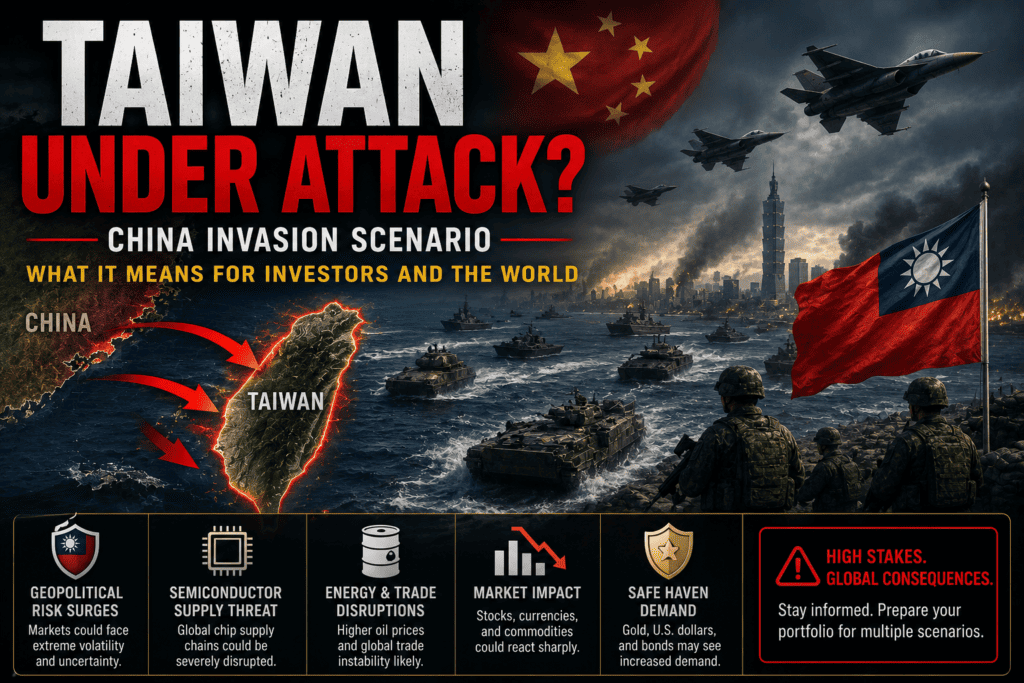
Key Takeaways
- Taiwan plays a critical role in the global semiconductor supply chain.
- Advanced chips support industries ranging from AI to automotive manufacturing.
- Supply chain diversification has become a strategic priority.
- Geopolitical tensions may increase market volatility.
- Semiconductor demand continues expanding across multiple sectors.
- Investors should distinguish short-term headlines from long-term trends.
- Diversification remains essential during periods of uncertainty.
- Strong business fundamentals matter more than speculation.
Why Taiwan Is So Important to the Semiconductor Industry
Semiconductors power nearly every modern electronic device.
Without advanced chips, industries such as artificial intelligence, telecommunications, healthcare, transportation, and cloud computing would struggle to operate efficiently.
Taiwan has become one of the world’s leading semiconductor manufacturing centers through decades of investment in engineering, research, and advanced fabrication technologies.
Consequently, technology companies around the globe depend on Taiwanese manufacturing capacity.
This dependence explains why investors closely monitor geopolitical developments involving the region.
Semiconductors Power the Modern Economy
The importance of semiconductors extends far beyond consumer electronics.
Advanced chips support:
- Artificial intelligence
- Data centers
- Smartphones
- Electric vehicles
- Medical equipment
- Industrial automation
- Aerospace systems
- Financial technology
- Telecommunications infrastructure
Because semiconductors serve as the foundation of digital innovation, their availability influences economic activity across numerous industries.
Global Supply Chains Are Highly Interconnected
Semiconductor production involves an extensive international network.
Research may occur in one country, chip design in another, manufacturing in Taiwan, packaging elsewhere, and final assembly in entirely different regions.
This interconnected system creates remarkable efficiency.
However, it also means disruptions at one stage may influence production throughout the global economy.
For investors, understanding these supply chains provides valuable context when evaluating technology companies.
Why Governments Care About Semiconductor Production
Semiconductors are increasingly viewed as strategic national assets.
Governments recognize that advanced chips influence:
- Economic competitiveness
- National security
- Artificial intelligence development
- Telecommunications
- Defense technologies
- Industrial productivity
As a result, many countries have introduced initiatives designed to expand domestic semiconductor manufacturing capacity and reduce supply chain concentration.
Artificial Intelligence Has Increased Chip Demand
Artificial intelligence represents one of the strongest long-term drivers of semiconductor demand.
Training advanced AI models requires extraordinary computing power.
Consequently, demand continues rising for:
- High-performance processors
- Graphics processing units (GPUs)
- Advanced memory
- Networking hardware
- AI accelerators
This structural trend extends well beyond temporary market cycles and supports continued investment throughout the semiconductor ecosystem.
Supply Chain Diversification Has Become a Priority
Following recent global supply chain disruptions, many technology companies have begun diversifying manufacturing locations.
Rather than relying exclusively on one region, businesses increasingly evaluate opportunities to expand production across multiple countries.
Although diversification requires significant investment, it may improve long-term resilience while reducing operational risk.
Consequently, investors often monitor capital expenditure plans alongside geopolitical developments.
Headlines Can Create Short-Term Volatility
Financial markets frequently react quickly to geopolitical news.
Nevertheless, short-term price movements do not always reflect long-term business fundamentals.
Experienced investors typically evaluate:
- Revenue growth
- Earnings quality
- Free cash flow
- Competitive advantages
- Supply chain flexibility
- Management execution
This disciplined approach often provides greater perspective than reacting immediately to breaking news.
Looking Beyond Uncertainty
Geopolitical developments naturally attract significant media attention.
However, successful investing requires balancing current events with long-term economic trends.
Semiconductor demand continues expanding because digital transformation, artificial intelligence, cloud computing, and automation remain powerful structural drivers of global growth.
In the next section, we’ll explore how different industries could respond to semiconductor supply disruptions, examine the opportunities and risks investors should consider, and compare the sectors most closely connected to the global chip ecosystem.
How a Semiconductor Supply Disruption Could Affect Global Industries
Modern economies depend on a constant supply of advanced semiconductors.
When chip availability changes, the effects often spread far beyond technology companies.
Manufacturers, healthcare providers, financial institutions, transportation networks, and industrial businesses all rely on sophisticated processors to support daily operations.
Consequently, even localized supply disruptions can create ripple effects across multiple sectors of the global economy.
However, the impact is rarely uniform.
Some industries are more dependent on cutting-edge chips than others.
Artificial Intelligence Could Face Infrastructure Challenges
Artificial intelligence requires enormous computing resources.
Large language models, cloud-based AI platforms, and enterprise automation systems all depend on advanced semiconductor technology.
If production capacity became constrained, companies developing AI infrastructure could experience higher equipment costs or longer delivery times.
Nevertheless, long-term demand for AI is driven by structural digital transformation rather than temporary geopolitical events.
Therefore, investors should distinguish between short-term operational challenges and long-term industry growth.
Consumer Electronics Depend on Advanced Chips
Many consumer products contain dozens or even hundreds of semiconductor components.
Examples include:
- Smartphones
- Tablets
- Laptop computers
- Gaming consoles
- Smart televisions
- Wearable devices
- Smart home equipment
Manufacturers often manage inventories carefully.
Even so, prolonged supply disruptions could influence production schedules and product availability.
Companies with diversified supplier relationships may demonstrate greater operational flexibility.
Automotive Manufacturers Continue Increasing Chip Usage
Modern vehicles contain significantly more semiconductor content than previous generations.
Electric vehicles, advanced driver assistance systems, battery management, navigation, and onboard connectivity all rely on sophisticated electronic components.
Consequently, automotive companies closely monitor semiconductor supply conditions.
Although manufacturers have expanded sourcing strategies in recent years, semiconductor availability remains an important consideration for production planning.
Cloud Computing and Data Centers
Cloud infrastructure represents another major source of semiconductor demand.
Large technology companies continue investing billions of dollars in:
- Data centers
- AI servers
- Networking equipment
- High-performance storage
- Cloud computing platforms
Because these facilities support enterprise software and artificial intelligence, continued semiconductor availability remains essential for future expansion.
However, many companies plan infrastructure investments years in advance, providing some operational flexibility.
Industrial Automation and Manufacturing
Factories increasingly rely on advanced electronics to improve productivity.
Industrial robots, automated production lines, sensors, and quality control systems all require semiconductor technology.
As manufacturing becomes more digital, reliable chip supplies support efficiency improvements across global industries.
Businesses with diversified procurement strategies may be better positioned to manage temporary disruptions.
Comparing Industries Most Exposed to Semiconductor Supply Chains
Different sectors exhibit varying levels of semiconductor dependence.
The following comparison highlights several examples.
| Industry | Dependence on Advanced Chips | Primary Consideration |
|---|---|---|
| Artificial Intelligence | Very High | Computing power |
| Cloud Computing | Very High | Data center expansion |
| Consumer Electronics | High | Product manufacturing |
| Automotive | High | Vehicle production |
| Telecommunications | High | Network infrastructure |
| Healthcare Technology | Moderate to High | Medical equipment |
| Industrial Manufacturing | Moderate | Automation systems |
Although exposure differs among industries, diversification remains an important competitive advantage.
Opportunities Created by Supply Chain Diversification
Growing awareness of supply chain concentration has encouraged many governments and corporations to invest in additional semiconductor manufacturing capacity.
Potential areas of investment include:
- Domestic fabrication facilities
- Advanced packaging technologies
- Semiconductor equipment
- Electronic design software
- Materials manufacturing
- Research and development
These investments aim to strengthen long-term resilience while supporting future technological growth.
Risks Investors Should Monitor
Investors should evaluate several factors before making decisions related to semiconductor companies.
Important considerations include:
- Geopolitical developments
- Export regulations
- Capital expenditure requirements
- Industry competition
- Technology cycles
- Corporate earnings
- Valuation levels
No single variable determines long-term investment performance.
Instead, successful investors analyze the broader business environment before adjusting portfolios.
Long-Term Trends Remain More Important Than Daily Headlines
Breaking news often creates temporary market volatility.
Nevertheless, experienced investors typically focus on structural growth drivers such as:
- Artificial intelligence
- Digital transformation
- Cloud computing
- Advanced manufacturing
- Automation
- Connectivity
- Enterprise software
These long-term trends continue influencing semiconductor demand regardless of short-term market fluctuations.
In the final section, we’ll examine common investing mistakes, practical portfolio strategies, frequently asked questions, and the most important lessons investors should remember when evaluating semiconductor investments during periods of geopolitical uncertainty.
Expert Insights: Focus on Resilience Instead of Predictions
Investors naturally pay close attention to geopolitical developments involving Taiwan because the island plays a critical role in advanced semiconductor manufacturing.
However, experienced investors understand that predicting geopolitical events with precision is extremely difficult.
Instead of attempting to forecast political outcomes, they evaluate how well companies prepare for uncertainty.
Businesses with diversified manufacturing, strong balance sheets, healthy cash flow, and disciplined management often demonstrate greater resilience during periods of market volatility.
Consequently, investors may benefit more from studying business fundamentals than from reacting to every geopolitical headline.
Successful long-term investing has historically depended on patience, diversification, and careful research rather than speculation.
Common Mistakes Investors Should Avoid
Periods of geopolitical uncertainty often encourage emotional decision-making.
Recognizing common mistakes may help investors remain focused on long-term financial goals.
Mistake 1: Assuming Every Headline Will Create a Market Crisis
News coverage often emphasizes worst-case scenarios.
Nevertheless, financial markets constantly reassess probabilities as new information becomes available.
Long-term investors usually avoid making immediate portfolio changes based solely on breaking news.
Mistake 2: Ignoring Company Fundamentals
Supply chain concerns matter.
Even so, financial strength remains equally important.
Before investing, review:
- Revenue growth
- Profit margins
- Free cash flow
- Debt levels
- Competitive advantages
- Management execution
Strong businesses are generally better positioned to adapt to changing conditions.
Mistake 3: Concentrating Investments in One Industry
Semiconductors represent an important long-term industry.
However, concentrating an entire portfolio in one sector increases overall risk.
Diversified portfolios typically provide greater stability across different market environments.
Mistake 4: Forgetting Long-Term Technology Trends
Geopolitical events may influence markets temporarily.
Meanwhile, structural trends such as artificial intelligence, automation, cloud computing, and digital infrastructure continue shaping semiconductor demand over many years.
Long-term investors often benefit from separating temporary uncertainty from lasting economic transformation.
Action Plan for Investors
If you’re evaluating semiconductor investments, the following framework may help organize your research.
Step 1: Review Your Financial Objectives
Determine whether your primary goal is:
- Long-term growth
- Retirement investing
- Dividend income
- Portfolio diversification
- Capital preservation
Clear objectives support better investment decisions.
Step 2: Study the Semiconductor Value Chain
Rather than focusing on one manufacturer, understand the broader ecosystem.
Important segments include:
- Chip designers
- Semiconductor manufacturers
- Equipment suppliers
- Memory producers
- Electronic design software
- Advanced packaging companies
This broader perspective often reveals additional investment opportunities.
Step 3: Analyze Financial Fundamentals
Evaluate each company using traditional financial metrics.
Important indicators include:
- Revenue growth
- Earnings consistency
- Free cash flow
- Return on invested capital
- Operating margins
- Balance sheet strength
Financial quality remains essential regardless of industry trends.
Step 4: Maintain Portfolio Diversification
Technology represents only one component of a balanced investment strategy.
Many long-term portfolios combine:
- Broad-market ETFs
- Dividend-paying companies
- Technology stocks
- Healthcare businesses
- REITs
- Treasury securities
- International investments
Diversification helps reduce exposure to unexpected events affecting any single industry.
Step 5: Continue Monitoring Long-Term Developments
Successful investors remain informed about:
- Semiconductor demand
- Artificial intelligence adoption
- Corporate earnings
- Capital expenditures
- Global trade
- Supply chain investment
- Monetary policy
Continuous learning strengthens long-term decision-making.
Frequently Asked Questions
Why is Taiwan important to the semiconductor industry?
Taiwan is home to some of the world’s most advanced semiconductor manufacturing capabilities, supplying chips used in artificial intelligence, smartphones, cloud computing, automobiles, industrial equipment, and many other technologies.
Would supply chain disruptions affect only technology companies?
No.
Many industries depend on semiconductors, including automotive manufacturing, healthcare, telecommunications, financial technology, industrial automation, and consumer electronics.
Does geopolitical uncertainty automatically make semiconductor stocks poor investments?
Not necessarily.
Investment decisions should consider company fundamentals, valuation, competitive positioning, financial strength, and long-term industry trends alongside geopolitical developments.
Why are semiconductors so important for artificial intelligence?
AI systems require extremely powerful processors capable of handling massive computational workloads.
Advanced semiconductor technology enables the training and operation of modern artificial intelligence models.
Should investors avoid semiconductor companies because of geopolitical risks?
Every investment involves risk.
Rather than avoiding an entire industry, investors should evaluate individual businesses while maintaining diversified portfolios aligned with their financial objectives.
How are companies reducing supply chain risk?
Many businesses continue expanding manufacturing capacity, diversifying suppliers, increasing inventories, and investing in additional production facilities across multiple regions.
What is the biggest lesson investors should remember?
Long-term investment success depends more on diversification, disciplined research, strong business fundamentals, and patience than on attempting to predict geopolitical outcomes.
Final Thoughts
Could the Taiwan Crisis Disrupt the Global Semiconductor Industry? is an important question because semiconductors have become essential to the global economy.
Although geopolitical developments deserve careful attention, successful investing requires balancing current events with long-term economic trends.
Artificial intelligence, cloud computing, automation, digital infrastructure, and advanced manufacturing continue supporting long-term semiconductor demand.
At the same time, investors should remain aware of supply chain risks, regulatory developments, valuation levels, and company-specific fundamentals.
Rather than making decisions based on uncertainty alone, focus on building a diversified portfolio supported by quality businesses, thoughtful research, and realistic expectations.
Internal Linking Opportunities
Strengthen your website’s SEO by linking this article to related content using anchor texts such as:
- The AI Race Between the U.S. and China: Investment Opportunities and Risks
- If China Invades Taiwan, Which Stocks Could Win—and Which Could Crash?
- The U.S.–China Trade War Isn’t Over: What Investors Need to Know
- What Investors Should Watch During International Conflicts
- Stocks That Could Benefit From Rising Military Spending
- Building a Diversified Investment Portfolio
- Dividend Stocks for Long-Term Investors
- REIT Investing Guide
- Passive Income Strategies
- Understanding Market Volatility
External Authority Sources
Readers interested in learning more about semiconductors and global markets can consult these trusted organizations:
- U.S. Securities and Exchange Commission (SEC): https://www.sec.gov
- Federal Reserve: https://www.federalreserve.gov
- Semiconductor Industry Association (SIA): https://www.semiconductors.org
- National Institute of Standards and Technology (NIST): https://www.nist.gov
- Morningstar: https://www.morningstar.com
Final Call to Action
Semiconductors are at the heart of today’s digital economy, powering everything from artificial intelligence and cloud computing to electric vehicles and advanced manufacturing.
Rather than trying to predict geopolitical events, concentrate on understanding industry fundamentals, maintaining a diversified portfolio, and investing with a long-term perspective.
Markets will continue evolving, but investors who combine patience, discipline, and continuous learning are often better prepared to navigate uncertainty while pursuing sustainable wealth creation.