

Can dividend investing replace your paycheck? Learn how passive income works, what it takes to build sustainable cash flow, and the risks involved.
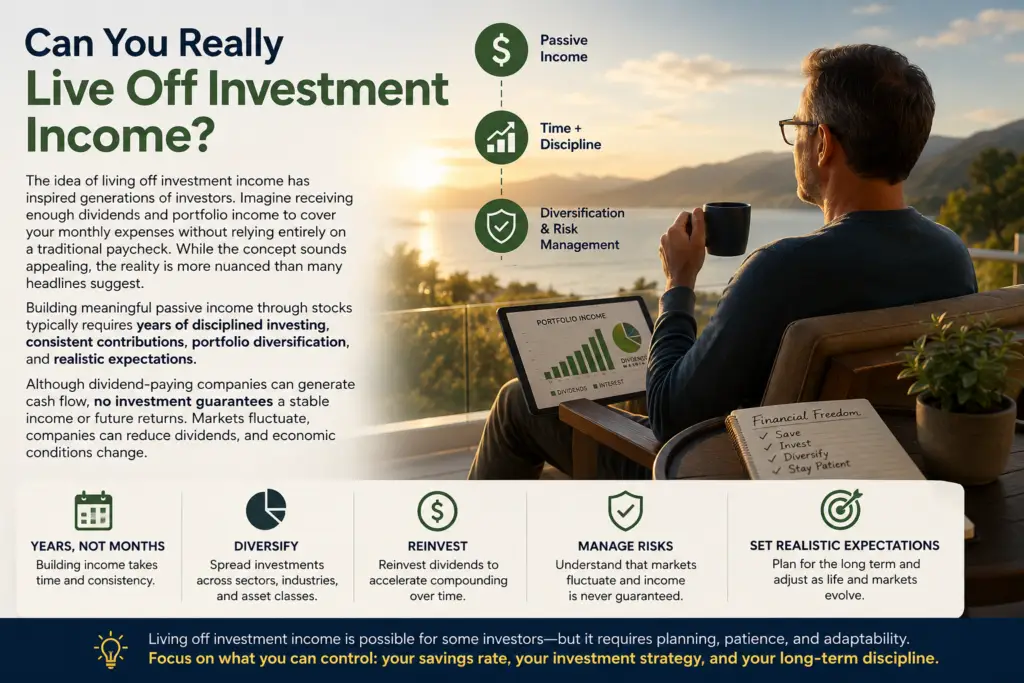
The idea of living off investment income has inspired generations of investors. Imagine receiving enough dividends and portfolio income to cover your monthly expenses without relying entirely on a traditional paycheck. While the concept sounds appealing, the reality is more nuanced than many headlines suggest.
Building meaningful passive income through stocks typically requires years of disciplined investing, consistent contributions, portfolio diversification, and realistic expectations. Although dividend-paying companies can generate cash flow, no investment guarantees a stable income or future returns. Markets fluctuate, companies can reduce dividends, and economic conditions change over time.
Instead of searching for shortcuts, successful long-term investors often focus on developing a diversified portfolio capable of producing growing income while preserving capital. This approach combines patience with careful research and an understanding of business fundamentals.
In this guide, you’ll learn how dividend investing works, why some companies distribute profits to shareholders, what level of portfolio income may be realistic, and which financial metrics experienced investors commonly analyze before investing. By understanding both the opportunities and the risks, you’ll be better equipped to evaluate whether dividend investing fits your long-term financial goals.
Key Takeaways
- Dividend investing can provide passive income over time.
- Replacing employment income usually requires substantial invested capital.
- Dividend payments are never guaranteed.
- Diversification helps manage portfolio risk.
- Reinvesting dividends may accelerate long-term wealth creation.
- Business quality often matters more than dividend yield alone.
- Sustainable income requires patience and realistic expectations.
- Long-term planning is essential for financial independence.
What Does It Mean to Replace Your Paycheck?
Replacing employment income means generating enough cash flow from investments and other assets to cover your living expenses.
Possible sources include:
- Dividend income
- Bond interest
- Rental income
- Business ownership
- Retirement accounts
- Other passive income streams
Most investors combine several income sources rather than relying on a single investment.
How Dividend Stocks Generate Income
Some publicly traded companies share part of their profits with shareholders through dividends.
Dividend payments are generally influenced by factors such as:
- Corporate profitability
- Cash flow
- Capital allocation priorities
- Balance sheet strength
- Economic conditions
Companies may increase, maintain, reduce, or suspend dividends depending on business performance.
Data Snapshot
Long-term investors often evaluate more than dividend yield alone.
| Financial Metric | Why It Matters |
|---|---|
| Dividend Yield | Current income level |
| Payout Ratio | Dividend sustainability |
| Free Cash Flow | Ability to support future payments |
| Revenue Growth | Business expansion |
| Earnings Growth | Long-term income potential |
| Debt Levels | Financial flexibility |
Investor Insight: A very high dividend yield does not automatically indicate a better investment. Sustainability is often more important than headline yield.
Why Some Companies Pay Dividends
Businesses distribute dividends for different reasons.
Mature companies with stable cash flows often return excess capital to shareholders instead of reinvesting every dollar into expansion.
Common sectors that historically include many dividend-paying companies include:
- Utilities
- Consumer staples
- Financial services
- Energy
- Healthcare
- Telecommunications
Growth-oriented businesses, by contrast, may choose to reinvest profits to expand operations rather than pay dividends.
Income Investing vs. Growth Investing
Investors often compare two broad approaches.
| Income Investing | Growth Investing |
|---|---|
| Focuses on cash flow | Focuses on capital appreciation |
| Often emphasizes dividends | Often emphasizes earnings growth |
| May provide regular income | May produce little or no current income |
| Typically favors mature companies | Often favors expanding companies |
Many long-term investors combine both strategies to balance income and growth.
Suggested Chart
Chart 1 – Building Passive Income Over Time
| Stage | Primary Objective |
|---|---|
| Early Career | Build savings and invest consistently |
| Growth Phase | Reinvest dividends and increase contributions |
| Wealth Accumulation | Expand diversified portfolio |
| Income Phase | Generate sustainable portfolio cash flow |
A timeline infographic illustrating these stages can help readers visualize how passive income develops over many years.
Setting Realistic Expectations
One of the biggest misconceptions about dividend investing is that a relatively small amount of capital can quickly replace a full-time salary.
In practice, the amount of income a portfolio generates depends on several variables, including:
- Portfolio size
- Dividend yield
- Investment returns
- Dividend growth
- Reinvestment strategy
- Taxes
- Inflation
Because these factors vary, there is no universal amount of capital or timeframe that works for every investor.
In the next section, we’ll explore how experienced investors evaluate dividend sustainability, discuss common portfolio-building approaches, compare different income strategies, and examine the trade-offs between yield, growth, and risk.
How Experienced Investors Evaluate Dividend Sustainability
A generous dividend can look attractive at first glance.
However, experienced investors rarely focus on yield alone. Instead, they evaluate whether a company’s dividend appears sustainable through different market conditions.
Several financial indicators are commonly reviewed:
- Revenue growth
- Earnings per share (EPS)
- Free cash flow
- Dividend payout ratio
- Debt levels
- Return on equity (ROE)
- Interest coverage
Looking at these metrics together provides a more complete picture than relying on a single number.
Dividend Yield Isn’t Everything
A higher dividend yield does not automatically mean a better investment.
Sometimes, an unusually high yield reflects a declining share price caused by concerns about the company’s future prospects.
Conversely, companies with lower yields may increase their dividends consistently for many years.
Comparing Different Dividend Profiles
| Characteristic | Higher Yield Company | Dividend Growth Company |
|---|---|---|
| Current Income | Higher | Lower |
| Dividend Growth Potential | Moderate | Often Higher |
| Share Price Growth | Varies | Often Stronger |
| Business Maturity | Usually Mature | Often Expanding |
| Risk Profile | Depends on Fundamentals | Depends on Growth Execution |
Investor Insight: Sustainable dividend growth can be just as valuable as a high starting yield over long investment horizons.
Why Diversification Matters for Income Investors
Even well-established companies can reduce or suspend dividends during challenging economic periods.
Diversification helps reduce the impact of unexpected events affecting any single business or sector.
Many long-term investors spread their investments across multiple industries such as:
- Financial services
- Healthcare
- Consumer staples
- Utilities
- Industrials
- Energy
- Technology
Some also diversify internationally and include different asset classes alongside equities.
Data Snapshot
Historically, companies have adjusted dividend policies in response to changing business conditions, interest rates, recessions, and industry-specific challenges.
Factors that may influence future dividend payments include:
| Factor | Possible Impact |
|---|---|
| Earnings Growth | Supports dividend increases |
| Strong Cash Flow | Improves payment sustainability |
| Rising Debt | May limit future distributions |
| Economic Slowdown | Can pressure corporate profits |
| Higher Interest Rates | May affect financing costs |
Investor Insight: Stable cash generation often plays a more important role than dividend yield when evaluating long-term income potential.
Dividend Reinvestment Can Accelerate Wealth Building
Many investors choose to reinvest their dividend payments instead of spending them immediately.
Reinvestment allows additional shares to be purchased, which may generate more dividends in the future.
This process illustrates the power of compounding.
For example:
- Portfolio generates dividends.
- Dividends purchase additional shares.
- Additional shares may generate more dividends.
- The cycle continues over time.
Although future results are never guaranteed, reinvestment has historically been an important contributor to long-term total returns.
Balancing Income and Growth
Investors often face a trade-off between maximizing current income and pursuing long-term growth.
Some companies prioritize paying regular dividends.
Others retain earnings to finance expansion, product development, or acquisitions.
A balanced portfolio may include exposure to both approaches.
| Income-Oriented Investments | Growth-Oriented Investments |
|---|---|
| Established dividend payers | Expanding businesses |
| More predictable cash flow | Higher potential earnings growth |
| May offer lower volatility | May experience greater price fluctuations |
| Often attractive to retirees | Often attractive to long-term accumulators |
The appropriate mix depends on an investor’s objectives, investment horizon, and tolerance for risk.
Common Risks Income Investors Should Understand
Generating passive income through investments involves risks.
Some of the most important include:
Dividend Reductions
Companies can reduce or eliminate dividend payments if financial conditions deteriorate.
Inflation
Even steady dividend income may lose purchasing power if inflation rises faster than income growth.
Market Volatility
Stock prices can fluctuate significantly, even when companies continue paying dividends.
Interest Rate Changes
Higher interest rates may influence investor demand for dividend-paying stocks and affect borrowing costs for companies.
Company-Specific Risks
Changes in competition, regulation, management decisions, or consumer demand may affect long-term business performance.
Suggested Chart
Chart 2 – The Dividend Growth Cycle
| Stage | Potential Outcome |
|---|---|
| Invest Capital | Purchase quality businesses |
| Receive Dividends | Generate portfolio cash flow |
| Reinvest Dividends | Increase share ownership |
| Compound Growth | Potentially expand future income |
| Long-Term Wealth | Build larger investment portfolio |
A circular infographic illustrating this process can help readers visualize how reinvestment contributes to long-term wealth creation.
Building an Income Strategy That Fits Your Goals
Every investor’s financial situation is different.
Someone in their twenties may prioritize long-term growth and reinvestment.
Meanwhile, an investor approaching retirement may focus more on generating dependable portfolio income.
Rather than copying another person’s strategy, many financial professionals encourage investors to develop an investment plan based on:
- Personal financial goals.
- Time horizon.
- Risk tolerance.
- Expected expenses.
- Tax considerations.
- Diversification needs.
A thoughtful plan can make investment decisions more consistent over time.
In the final section, we’ll cover expert insights, common mistakes to avoid, a practical action plan, frequently asked questions, internal linking opportunities, trusted external resources, and the key lessons readers should remember when building a long-term dividend investing strategy.
Expert Insights: Passive Income Is Built, Not Found
One of the biggest misconceptions in investing is that a relatively small portfolio can quickly replace a full-time salary.
In reality, sustainable passive income is usually the result of years—or even decades—of disciplined investing, consistent contributions, and the power of compounding.
Successful income investors generally focus on three priorities:
- Owning financially strong businesses.
- Maintaining a diversified portfolio.
- Allowing investments time to grow.
Rather than searching for shortcuts, experienced investors often emphasize building a resilient portfolio capable of generating income through different market environments.
Common Mistakes Dividend Investors Should Avoid
Mistake 1: Chasing High Dividend Yields
A double-digit dividend yield may seem attractive.
However, unusually high yields sometimes reflect declining share prices or financial challenges.
Always evaluate whether the dividend appears sustainable.
Mistake 2: Ignoring Business Fundamentals
Dividend payments come from profitable businesses.
Before investing, many analysts examine:
- Revenue growth
- Earnings stability
- Free cash flow
- Debt levels
- Competitive advantages
- Management quality
Strong businesses are generally better positioned to maintain dividends over time.
Mistake 3: Failing to Diversify
Concentrating too much money in one company or industry increases risk.
Diversification across sectors, industries, and asset classes may improve portfolio resilience.
Mistake 4: Expecting Immediate Results
Passive income rarely grows overnight.
Consistent investing, dividend reinvestment, and patience often play a larger role than attempting to predict short-term market movements.
Suggested Chart
Chart 3 – The Long-Term Income-Building Process
| Stage | Primary Objective |
|---|---|
| Save Regularly | Build investment capital |
| Invest Consistently | Increase portfolio size |
| Reinvest Dividends | Accelerate compounding |
| Diversify | Manage long-term risk |
| Generate Income | Support future financial goals |
A timeline infographic based on this framework helps readers understand how long-term income investing develops over time.
Action Plan
Building dividend income becomes more manageable when broken into practical steps.
Step 1: Define Your Income Goal
Estimate your future monthly expenses and determine how investment income could contribute to those needs.
Step 2: Build an Emergency Fund
Maintaining cash reserves may reduce the likelihood of selling investments during market downturns.
Step 3: Invest Consistently
Regular contributions, regardless of market conditions, can help build wealth over time.
Many investors use dollar-cost averaging to maintain discipline.
Step 4: Diversify Your Portfolio
Consider diversification across:
- Industries
- Company sizes
- Geographic regions
- Asset classes
Diversification cannot eliminate risk, but it may reduce exposure to any single investment.
Step 5: Review Your Portfolio Periodically
Monitor whether your investments continue aligning with your financial goals, risk tolerance, and investment horizon.
Adjustments should be based on long-term strategy rather than short-term market noise.
Frequently Asked Questions
Can dividend investing replace employment income?
It can contribute to long-term passive income, but replacing a paycheck typically requires substantial invested assets, consistent investing, and realistic expectations. There is no guaranteed portfolio size or timeline that works for everyone.
Are dividends guaranteed?
No.
Companies may increase, reduce, suspend, or eliminate dividend payments depending on business performance and financial conditions.
Is dividend yield the most important metric?
Not necessarily.
Many investors also evaluate free cash flow, payout ratio, earnings growth, debt levels, and business quality.
Should beginners focus only on dividend stocks?
Not always.
Many investors combine dividend-paying companies with growth investments and diversified funds to pursue both income and long-term appreciation.
Why do some companies pay no dividends?
Many growing businesses choose to reinvest profits into expansion, research, acquisitions, or new products instead of distributing cash to shareholders.
Does reinvesting dividends make a difference?
Dividend reinvestment may increase long-term portfolio growth because additional shares can generate future dividend payments, illustrating the effects of compounding.
What role does diversification play?
Diversification helps reduce dependence on a single company, industry, or asset class and may improve a portfolio’s resilience during changing market conditions.
Final Thoughts
The idea of replacing employment income through investments is appealing, but it requires planning, patience, and disciplined execution.
Dividend investing can become one component of a broader wealth-building strategy, especially when combined with consistent saving, diversification, and long-term thinking.
Rather than focusing exclusively on current yield, successful investors often prioritize business quality, sustainable cash flow, reasonable valuations, and portfolio balance.
Markets will continue changing, interest rates will rise and fall, and companies will evolve. Investors who remain focused on fundamentals and maintain realistic expectations are generally better positioned to pursue long-term financial goals.
The journey toward financial independence rarely depends on finding a single perfect investment. More often, it reflects thousands of thoughtful financial decisions made consistently over many years.
Internal Linking Opportunities
Strengthen your website’s topical authority by linking this article to related content using anchor texts such as:
- Dividend Stocks for Long-Term Investors
- Building a Diversified Investment Portfolio
- Passive Income Strategies
- Growth vs. Value Investing
- How Compound Interest Builds Wealth
- Warren Buffett Investing Strategy
- Retirement Planning Basics
- The Global Wealth Shift: Where Smart Money Is Moving Next
- How World Politics Could Affect Your Investment Portfolio
- The Warning Signs That Always Appear Before a Financial Crisis
External Authority Sources
Readers who want to learn more about dividend investing and long-term wealth building should consult trusted resources such as:
- U.S. Securities and Exchange Commission (SEC)
- Federal Reserve
- Internal Revenue Service (IRS)
- Vanguard Investor Education
- Morningstar
- Charles Schwab Market Insights
- Fidelity Learning Center
Final Call to Action
Building meaningful passive income is a long-term process, not a race.
Continue learning about investing, evaluate businesses carefully, diversify thoughtfully, and review your financial plan regularly. Over time, disciplined investing and realistic expectations can help create a portfolio designed to support your long-term financial goals while adapting to changing market conditions.