

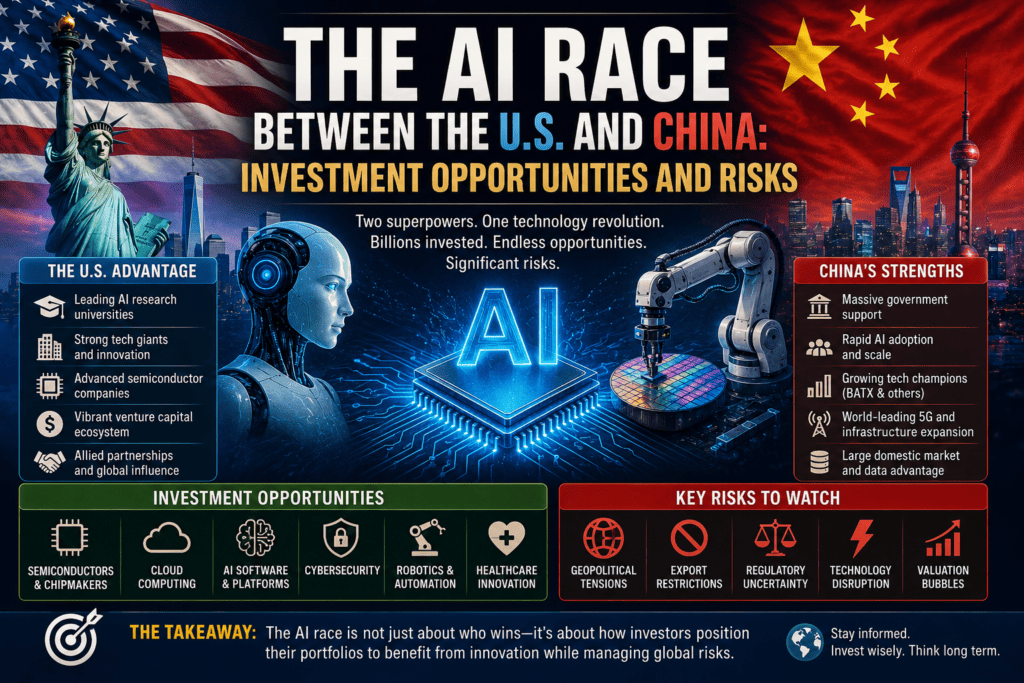
The AI Race Between the U.S. and China: Investment Opportunities and Risks. Discover how AI competition could reshape industries, markets, and long-term investing.
The AI Race Between the U.S. and China: Investment Opportunities and Risks has become one of the defining investment themes of the decade. Artificial intelligence is transforming industries ranging from healthcare and finance to manufacturing, transportation, and cybersecurity. At the same time, the United States and China are investing heavily in AI research, semiconductor technology, cloud computing, and advanced infrastructure to strengthen their competitive positions.
As governments and private companies commit billions of dollars to AI development, investors naturally wonder which sectors could benefit, where the greatest risks exist, and how this technological competition might influence long-term portfolios. Although headlines often emphasize rivalry between the world’s two largest economies, the investment landscape is far more complex than choosing one country over the other.
Fortunately, investors do not need to predict which nation will ultimately lead the AI race to identify attractive opportunities. Instead, understanding the industries, supply chains, and business models driving AI innovation can provide a stronger foundation for long-term decision-making.
In this guide, you’ll learn how the U.S.–China AI competition affects financial markets, why semiconductors have become strategically important, which industries stand to benefit from continued AI investment, and what risks every investor should carefully evaluate before adding AI-related companies to a diversified portfolio.
Key Takeaways
- Artificial intelligence has become a major long-term investment theme.
- The U.S. and China continue investing heavily in AI infrastructure.
- Semiconductor companies play a critical role in AI development.
- Cloud computing supports the rapid expansion of AI applications.
- Geopolitical tensions may influence technology supply chains.
- Diversification remains essential despite AI’s growth potential.
- Strong financial fundamentals still matter more than headlines.
- Long-term investors should focus on sustainable business models.
Why the AI Race Matters to Investors
Artificial intelligence is no longer an experimental technology.
Instead, it has become a strategic priority for governments, corporations, universities, and technology firms worldwide.
Consequently, capital investment continues flowing into AI research, computing infrastructure, and advanced manufacturing.
For investors, this trend represents more than a technology story.
AI has the potential to reshape productivity, corporate profitability, labor markets, and economic growth over many years.
Understanding these structural changes helps investors evaluate opportunities with a longer-term perspective.
Why the United States and China Lead AI Investment
The United States and China account for a significant share of global AI research and investment.
Both countries possess extensive technology ecosystems supported by universities, private capital, and large technology companies.
However, each follows a different approach.
The United States benefits from deep capital markets, established technology firms, and a vibrant startup ecosystem.
China, meanwhile, combines large-scale industrial capabilities, growing AI adoption, and substantial investment in advanced technologies.
As a result, competition extends well beyond software development.
Semiconductors Have Become the Foundation of AI
Modern artificial intelligence depends on extraordinary computing power.
That capability relies heavily on advanced semiconductor chips capable of processing enormous volumes of data efficiently.
Consequently, semiconductor manufacturers have become central participants in the AI economy.
Key areas include:
- AI accelerators
- Graphics processing units (GPUs)
- Advanced memory
- Chip manufacturing equipment
- Electronic design software
- High-performance processors
Without continued advances in semiconductor technology, AI innovation would slow significantly.
Data Centers Continue Expanding
Training sophisticated AI models requires enormous computing resources.
Therefore, demand for modern data centers continues increasing.
These facilities provide:
- High-performance computing
- Cloud infrastructure
- Massive data storage
- Networking capabilities
- AI model deployment
As AI adoption grows, companies investing in digital infrastructure may experience sustained demand.
Nevertheless, expansion requires substantial capital investment and reliable energy supplies.
Cloud Computing Powers AI Growth
Cloud computing has become one of AI’s most important enabling technologies.
Businesses increasingly rely on cloud platforms to develop, train, and deploy artificial intelligence applications.
Consequently, cloud service providers continue investing in:
- Server infrastructure
- AI software platforms
- Cybersecurity
- Networking equipment
- Enterprise AI services
This trend extends beyond large technology companies and supports digital transformation across many industries.
AI Adoption Reaches Every Industry
Although technology companies receive the most attention, AI is influencing many sectors of the economy.
Examples include:
- Healthcare
- Financial services
- Manufacturing
- Transportation
- Logistics
- Agriculture
- Retail
- Energy
- Education
Because AI applications continue expanding, investment opportunities may emerge well beyond traditional software businesses.
Geopolitical Competition Creates Both Opportunities and Risks
Competition between major economies has increased attention on technology supply chains.
Export controls, trade policies, semiconductor manufacturing, and research collaboration all influence the AI ecosystem.
Consequently, investors should monitor broader economic developments alongside company fundamentals.
However, successful investing requires more than following geopolitical headlines.
Financial strength, innovation, competitive positioning, and management quality remain equally important when evaluating AI-related businesses.
Looking Beyond Short-Term Excitement
Artificial intelligence has generated enormous investor enthusiasm.
Even so, long-term investment success depends on disciplined analysis rather than speculation.
Experienced investors evaluate valuation, earnings growth, cash flow, competitive advantages, and sustainable business models before making investment decisions.
In the next section, we’ll explore the industries positioned to benefit most from AI investment, compare different segments of the AI value chain, and examine the financial risks investors should consider before investing in this rapidly evolving sector.
Understanding the AI Investment Ecosystem
Artificial intelligence is far more than software.
Behind every AI application lies an ecosystem of companies responsible for designing chips, manufacturing hardware, building cloud infrastructure, developing algorithms, securing networks, and supplying enormous amounts of electricity.
Consequently, investors who understand the entire value chain often identify opportunities beyond the most recognizable technology companies.
Rather than focusing on a single business, many experienced investors analyze how different industries work together to support AI innovation.
Semiconductors Remain the Foundation of AI
Advanced semiconductors sit at the center of modern artificial intelligence.
Training large language models, processing massive datasets, and operating complex AI systems require highly specialized processors capable of performing trillions of calculations every second.
As demand for AI continues expanding, several parts of the semiconductor industry may benefit, including:
- Graphics processing units (GPUs)
- AI accelerators
- Memory manufacturers
- Chip fabrication equipment
- Semiconductor design software
- Advanced packaging technologies
Although long-term demand appears strong, semiconductor businesses remain cyclical and capital intensive.
Therefore, investors should evaluate both industry trends and company fundamentals.
Data Centers Are Becoming Strategic Infrastructure
Artificial intelligence requires enormous computing capacity.
Consequently, technology companies continue investing billions of dollars in modern data centers capable of supporting AI workloads.
These facilities rely on:
- High-performance servers
- Cooling systems
- Fiber-optic networking
- Power infrastructure
- Cloud computing platforms
Growing AI adoption may support long-term demand for companies involved in digital infrastructure.
However, rapid expansion also increases capital expenditure requirements.
Cloud Computing Continues to Expand
Cloud platforms have become essential for businesses implementing artificial intelligence.
Instead of building expensive computing infrastructure internally, many organizations access AI tools through cloud providers.
This approach offers greater flexibility while reducing upfront costs.
As adoption increases, cloud providers may benefit from higher demand for:
- AI development platforms
- Enterprise software
- Data storage
- Computing capacity
- Security services
Nevertheless, competition within cloud computing remains intense.
Cybersecurity Has Become More Important Than Ever
As AI systems become more sophisticated, cybersecurity grows increasingly critical.
Organizations handling sensitive information must protect:
- Customer data
- Intellectual property
- Financial records
- AI models
- Cloud infrastructure
Consequently, cybersecurity companies continue investing heavily in advanced threat detection and automated security solutions.
For investors, cybersecurity represents another industry closely connected to long-term AI growth.
Electricity and Power Infrastructure May Benefit
Artificial intelligence requires enormous amounts of electricity.
Large-scale data centers consume significant energy while operating continuously.
As a result, investors increasingly monitor businesses involved in:
- Electric utilities
- Grid modernization
- Power equipment
- Energy infrastructure
- Cooling technologies
Although these companies may not be classified as AI businesses, they often support the infrastructure that enables AI expansion.
Comparing Major AI Investment Areas
The AI ecosystem extends across multiple industries.
Each segment offers different growth opportunities and investment risks.
| AI Segment | Potential Growth Driver | Key Risk |
|---|---|---|
| Semiconductors | AI chip demand | Industry cyclicality |
| Cloud Computing | Enterprise AI adoption | Competitive pricing |
| Cybersecurity | Digital security needs | Rapid technological change |
| Data Centers | Computing infrastructure | High capital expenditures |
| Utilities & Power | Electricity demand | Regulatory uncertainty |
Understanding these relationships helps investors build a more balanced perspective on AI-related opportunities.
Risks Investors Should Consider
Artificial intelligence represents an exciting long-term theme.
However, no investment trend is without risk.
Important considerations include:
- Elevated valuations
- Regulatory changes
- Export restrictions
- Technology competition
- Supply chain disruptions
- Slower-than-expected AI adoption
- High infrastructure costs
Consequently, investors should avoid assuming that every AI-related company will automatically become a long-term winner.
Diversification Remains the Best Defense
Even investors who strongly believe in AI’s future rarely allocate their entire portfolios to one sector.
Instead, they combine multiple investment categories.
Examples include:
- Broad-market ETFs
- Dividend-paying companies
- Technology stocks
- Healthcare businesses
- REITs
- Treasury securities
- International equities
This diversified approach reduces dependence on the performance of any single industry while maintaining exposure to long-term innovation.
Focus on Business Quality, Not Market Hype
Artificial intelligence continues generating extraordinary investor enthusiasm.
Nevertheless, experienced investors typically evaluate companies using traditional financial principles.
Rather than purchasing businesses simply because they mention AI, they review revenue growth, free cash flow, profitability, competitive advantages, management quality, and valuation.
This disciplined process often produces stronger long-term investment decisions than chasing short-term excitement.
In the final section, we’ll examine common investing mistakes, practical portfolio strategies, frequently asked questions, and the most important lessons investors should remember when investing in the rapidly evolving AI economy.
Expert Insights: AI Is a Long-Term Investment Theme, Not a Short-Term Trade
Artificial intelligence has already changed the way businesses operate, and its influence is likely to expand across nearly every major industry over the coming decades.
However, experienced investors understand that transformational technologies rarely move in a straight line.
Periods of rapid innovation are often followed by corrections, increased competition, and changing market expectations.
Consequently, successful investing requires patience, careful analysis, and realistic expectations rather than excitement generated by daily headlines.
The companies that ultimately create the most shareholder value may not always be those receiving the greatest attention today.
For that reason, investors should evaluate sustainable competitive advantages instead of chasing momentum.
Common Mistakes Investors Should Avoid
AI has become one of the most popular investment themes in recent years.
Even so, enthusiasm sometimes leads to avoidable mistakes.
Understanding these risks may improve long-term investment decisions.
Mistake 1: Buying Stocks Only Because They Mention AI
Many companies now describe themselves as AI businesses.
Nevertheless, investors should determine whether artificial intelligence genuinely contributes to revenue growth or simply appears in marketing materials.
Strong financial performance remains more important than popular terminology.
Mistake 2: Ignoring Valuation
Outstanding businesses can still become expensive investments.
Therefore, investors should compare valuation metrics such as:
- Price-to-Earnings (P/E)
- Price-to-Sales (P/S)
- Enterprise Value to EBITDA
- Free Cash Flow Yield
- Historical valuation ranges
Buying excellent companies at unrealistic prices may reduce future returns.
Mistake 3: Concentrating Too Much in One Industry
Artificial intelligence spans multiple industries.
Consequently, concentrating an entire portfolio in semiconductor companies or software firms increases risk.
Diversification across several sectors often produces greater long-term stability.
Mistake 4: Ignoring Geopolitical Risk
Technology supply chains remain global.
Trade policies, export restrictions, regulatory changes, and international competition can influence AI-related businesses.
Although geopolitical developments deserve attention, investors should avoid making decisions based solely on short-term political events.
Action Plan for Long-Term Investors
If you’re considering investing in AI-related companies, this framework may help guide your research.
Step 1: Define Your Investment Goals
Determine whether your primary objective is:
- Long-term capital appreciation
- Portfolio diversification
- Exposure to technological innovation
- Retirement investing
Clear goals create a stronger investment framework.
Step 2: Study the Entire AI Ecosystem
Instead of focusing only on software developers, evaluate companies across the broader value chain.
These include:
- Semiconductor manufacturers
- Cloud computing providers
- Cybersecurity companies
- Data center operators
- Power infrastructure businesses
- Enterprise software developers
This broader perspective may uncover opportunities that receive less media attention.
Step 3: Review Financial Fundamentals
Before purchasing any stock, analyze:
- Revenue growth
- Earnings consistency
- Free cash flow
- Profit margins
- Debt levels
- Return on invested capital
Strong businesses often demonstrate financial discipline regardless of industry trends.
Step 4: Maintain Diversification
Artificial intelligence represents one investment theme among many.
Balanced portfolios frequently combine:
- Broad-market ETFs
- Dividend-paying stocks
- Technology companies
- Healthcare businesses
- REITs
- Treasury securities
- International equities
Diversification helps reduce exposure to unexpected industry-specific risks.
Step 5: Continue Monitoring Long-Term Trends
AI technology continues evolving rapidly.
Accordingly, investors should monitor:
- Corporate earnings
- Capital expenditures
- Semiconductor demand
- Cloud adoption
- Energy infrastructure
- Regulatory developments
Long-term learning remains one of the strongest competitive advantages individual investors possess.
Frequently Asked Questions
Why is the AI race between the U.S. and China important for investors?
Both countries continue investing heavily in artificial intelligence, semiconductor technology, cloud computing, and advanced research.
These investments may influence long-term economic growth and corporate opportunities across multiple industries.
Which industries could benefit from continued AI adoption?
Potential beneficiaries include semiconductors, cloud computing, cybersecurity, enterprise software, data centers, networking equipment, and energy infrastructure.
Individual company performance, however, depends on financial execution and competitive positioning.
Does investing in AI guarantee high returns?
No.
Artificial intelligence represents a significant technological trend, but no investment guarantees future performance.
Investors should evaluate each company carefully before making investment decisions.
Why are semiconductors so important?
AI systems require advanced processors capable of handling enormous computing workloads.
Consequently, semiconductor technology forms the foundation of nearly every modern AI application.
Should beginners invest only in AI companies?
Most financial professionals encourage diversified portfolios rather than concentrating investments in one sector.
AI exposure can complement broader investment strategies without becoming the sole focus.
How does geopolitics influence AI investing?
Trade policies, export controls, semiconductor manufacturing, and international competition may affect technology supply chains and corporate profitability.
However, business fundamentals remain equally important.
What is the biggest lesson investors should remember?
Successful investing depends more on diversification, disciplined research, reasonable valuations, and long-term thinking than on predicting which country will dominate artificial intelligence.
Final Thoughts
The AI Race Between the U.S. and China: Investment Opportunities and Risks represents one of the most significant long-term investment themes shaping the global economy.
Although competition between the world’s two largest economies continues influencing technology development, investors should remember that innovation extends across an entire ecosystem of industries rather than a handful of headline companies.
Instead of chasing short-term excitement, focus on businesses with strong financial fundamentals, durable competitive advantages, responsible capital allocation, and sustainable growth opportunities.
Artificial intelligence will likely remain an important driver of economic transformation for years to come.
Nevertheless, disciplined portfolio management, diversification, and continuous learning remain the most reliable tools for navigating both opportunities and uncertainty.
Internal Linking Opportunities
Strengthen your website’s SEO by linking this article to related content using anchor texts such as:
- The U.S.–China Trade War Isn’t Over: What Investors Need to Know
- If China Invades Taiwan, Which Stocks Could Win—and Which Could Crash?
- What Investors Should Watch During International Conflicts
- How Geopolitical Risk Could Drive Gold Prices Higher
- Building a Diversified Investment Portfolio
- Dividend Stocks for Long-Term Investors
- REIT Investing Guide
- Passive Income Strategies
- Understanding Market Volatility
- Long-Term Investing for Beginners
External Authority Sources
Readers interested in learning more about AI, technology markets, and investing can consult these trusted organizations:
- U.S. Securities and Exchange Commission (SEC): https://www.sec.gov
- Federal Reserve: https://www.federalreserve.gov
- National Institute of Standards and Technology (NIST): https://www.nist.gov
- Morningstar: https://www.morningstar.com
- CFA Institute: https://www.cfainstitute.org
Final Call to Action
Artificial intelligence is reshaping industries, capital markets, and the global economy.
Rather than trying to predict every technological breakthrough, focus on understanding business fundamentals, maintaining a diversified portfolio, and investing with a long-term perspective.
Markets will continue evolving, but disciplined investors who combine knowledge, patience, and sound risk management are often better positioned to benefit from innovation over time.