

Why Central Banks Keep Buying Gold in Uncertain Times
Why Central Banks Keep Buying Gold. Discover how central bank gold reserves influence financial markets, inflation, and long-term investment strategies.
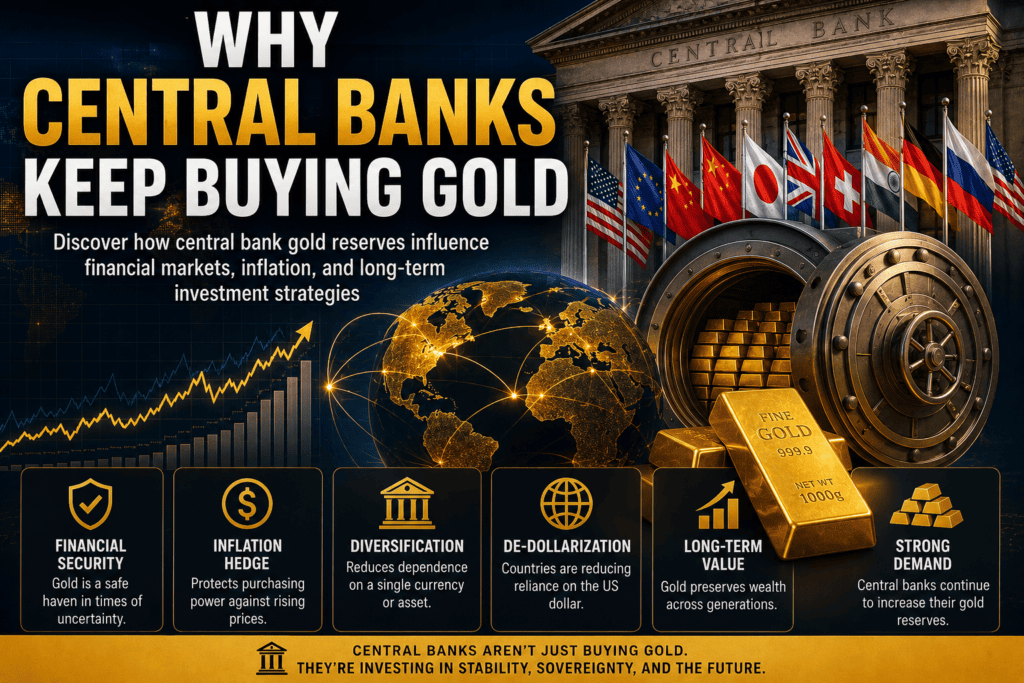
Why Central Banks Keep Buying Gold has become one of the most frequently discussed questions among investors, economists, and financial analysts. Every year, central banks around the world purchase large quantities of gold, often making headlines and prompting individual investors to wonder whether they should follow the same strategy. Consequently, understanding the reasons behind these purchases can provide valuable insight into global financial markets and long-term wealth preservation.
Unlike individual investors, central banks are not attempting to maximize short-term profits. Instead, they manage national reserves designed to support monetary stability, strengthen confidence in their currencies, and improve resilience during periods of economic uncertainty. As a result, their investment decisions often reflect long-term strategic objectives rather than temporary market movements.
Gold has maintained an important role in the international financial system for centuries. Although modern currencies are no longer directly backed by gold, many central banks continue to increase their reserves. Meanwhile, changing geopolitical conditions, inflation concerns, and evolving global trade relationships have renewed interest in the precious metal.
In this guide, you’ll learn why central banks continue accumulating gold, how reserve management works, which economic factors influence purchasing decisions, and what long-term investors can realistically learn from these institutional strategies without assuming that gold is appropriate for every portfolio.
Key Takeaways
- Central banks purchase gold primarily for reserve diversification.
- Gold remains an important component of many national reserve portfolios.
- Inflation, currency risk, and geopolitical uncertainty influence reserve management.
- Gold purchases do not guarantee rising gold prices.
- Diversification remains a key principle for institutional investors.
- Central bank activity may influence long-term market sentiment.
- Individual investors should evaluate gold within broader financial goals.
- Understanding reserve management provides valuable macroeconomic insight.
What Are Central Bank Gold Reserves?
Central bank gold reserves consist of physical gold owned by national monetary authorities.
These reserves form part of a country’s broader foreign exchange holdings, which may also include:
- U.S. dollars
- Euros
- Government bonds
- Foreign currencies
- International reserve assets
Because reserve portfolios serve multiple economic purposes, central banks typically maintain diversified holdings rather than relying on a single asset.
Gold represents one component within that broader strategy.
Why Gold Still Matters Today
Some investors assume gold became irrelevant after the end of the traditional gold standard.
However, central bank behavior suggests otherwise.
Many monetary authorities continue increasing their gold holdings despite operating within modern fiat currency systems.
Several characteristics explain why gold remains attractive:
- Limited supply
- Global recognition
- Long history as a reserve asset
- High liquidity
- No direct credit risk
- Broad international acceptance
Although these features contribute to gold’s importance, they do not eliminate price volatility.
Diversification Is One of the Primary Reasons
Diversification plays a central role in reserve management.
Just as individual investors diversify investment portfolios, central banks diversify national reserves.
Holding multiple asset types may reduce concentration risk while improving overall financial resilience.
Consequently, gold often complements other reserve assets rather than replacing them.
This balanced approach reflects long-term risk management instead of short-term speculation.
Gold Helps Reduce Currency Concentration
Most international trade relies heavily on major reserve currencies.
However, excessive dependence on one currency may expose reserve portfolios to additional risks.
Gold provides an asset that is not issued by any single government.
Therefore, some central banks view gold as a useful diversification tool alongside foreign currencies and sovereign bonds.
That strategy may improve portfolio flexibility under changing economic conditions.
Geopolitical Uncertainty Influences Reserve Decisions
Periods of geopolitical uncertainty often encourage governments to review reserve management strategies.
International tensions, economic sanctions, changing trade relationships, and financial market volatility may all influence long-term planning.
Although each country’s objectives differ, many central banks evaluate whether their reserve portfolios remain appropriately diversified.
Gold frequently becomes part of those discussions because of its long history as an internationally recognized reserve asset.
Inflation Can Affect Reserve Management
Inflation influences purchasing power over time.
Consequently, central banks continuously evaluate how different reserve assets may perform under changing economic conditions.
Gold has historically been considered one possible tool for preserving long-term value.
Nevertheless, monetary authorities rarely rely exclusively on precious metals.
Instead, reserve management typically balances multiple objectives simultaneously.
Gold Purchases Do Not Always Predict Higher Prices
Many investors mistakenly assume that central bank purchases automatically lead to rising gold prices.
Reality is more complex.
Gold prices reflect numerous economic forces, including:
- Interest rates
- Inflation expectations
- Currency movements
- Investor demand
- Jewelry consumption
- Industrial demand
- Mining production
Consequently, central bank buying represents only one factor affecting the global gold market.
Looking Beyond Headlines
News reports frequently highlight large central bank gold purchases.
Experienced investors, however, recognize that these transactions usually reflect long-term reserve management rather than short-term market forecasts.
Instead of reacting to individual headlines, they evaluate broader economic trends, monetary policy, inflation, currency markets, and portfolio diversification.
That disciplined perspective often provides more meaningful insight than focusing on daily news alone.
In the next section, we’ll examine how central banks decide when to purchase gold, explore the economic indicators they monitor, and discuss what long-term investors can realistically learn from institutional reserve management strategies.
How Central Banks Decide When to Buy Gold
Central banks do not purchase gold in the same way individual investors buy stocks or ETFs.
Instead, reserve managers typically follow long-term strategic plans designed to strengthen the stability of national reserve portfolios. Consequently, gold purchases often occur gradually over months or even years rather than as a response to short-term price movements.
Several factors influence these decisions, including:
- Reserve diversification goals
- Currency exposure
- Inflation expectations
- Economic resilience
- Liquidity requirements
- Long-term monetary policy objectives
Because each country’s financial situation is unique, reserve allocation strategies differ from one central bank to another.
Reserve Diversification Is a Continuous Process
Reserve management is not a one-time event.
Instead, central banks regularly evaluate whether their holdings remain consistent with changing economic conditions.
For example, shifts in foreign exchange reserves, international trade patterns, or financial market volatility may encourage portfolio adjustments.
Rather than replacing one reserve asset with another, many institutions gradually rebalance their holdings over time.
This disciplined approach helps reduce concentration risk while maintaining flexibility.
The Relationship Between Gold and the U.S. Dollar
Gold and the U.S. dollar often receive attention together because both play important roles in the international financial system.
The dollar remains the world’s primary reserve currency.
Meanwhile, gold continues serving as a globally recognized reserve asset.
Although investors sometimes describe the relationship as inverse, reality is more nuanced.
Interest rates, inflation, global growth, and investor confidence all influence both markets simultaneously.
Consequently, reserve managers evaluate multiple economic indicators before making allocation decisions.
Why Emerging Economies Often Increase Gold Reserves
Several emerging-market central banks have expanded their gold reserves during the past decade.
Although every country has unique economic objectives, common motivations may include:
- Diversifying reserve assets
- Reducing concentration risk
- Strengthening long-term financial resilience
- Supporting confidence in reserve portfolios
However, reserve strategies vary considerably.
Therefore, investors should avoid assuming that every central bank follows the same approach.
Central Banks Focus on Stability, Not Speculation
Unlike many market participants, central banks generally prioritize financial stability over investment returns.
Reserve assets support monetary policy, international payments, and confidence in the financial system.
Consequently, investment decisions emphasize preservation, liquidity, and diversification rather than maximizing short-term gains.
Understanding this distinction helps investors interpret central bank activity more accurately.
Gold Compared With Other Reserve Assets
Central banks typically manage diversified reserve portfolios.
Each asset contributes different characteristics.
| Reserve Asset | Primary Purpose | Key Consideration |
|---|---|---|
| Gold | Diversification and long-term reserve asset | Price volatility |
| U.S. Treasury Securities | Liquidity and income | Interest-rate sensitivity |
| Foreign Currencies | International payments | Exchange-rate fluctuations |
| IMF Reserve Assets | International reserve support | Institutional framework |
This combination allows reserve managers to balance multiple financial objectives.
What Individual Investors Can Learn
Individual investors should not automatically copy central bank portfolios.
Nevertheless, institutional reserve management offers several valuable lessons.
These include:
- Think long term.
- Diversify across multiple asset classes.
- Avoid emotional investing.
- Focus on risk management.
- Review portfolio allocations regularly.
Although personal financial goals differ from national reserve management, these principles remain broadly applicable.
Gold Is Only One Part of a Diversified Portfolio
Some investors mistakenly believe that buying gold alone provides complete financial protection.
In reality, successful portfolios typically combine several investment categories.
Examples include:
- Broad-market ETFs
- Dividend-paying stocks
- Treasury securities
- REITs
- International equities
- Cash reserves
- Precious metals
Diversification helps reduce dependence on the performance of any single investment.
Looking Beyond Short-Term Market Noise
Daily financial headlines frequently focus on central bank purchases.
However, experienced investors usually concentrate on broader economic trends.
Instead of reacting to individual announcements, they analyze inflation, monetary policy, economic growth, currency markets, and corporate fundamentals.
This disciplined process often supports more consistent long-term investment decisions.
In the final section, we’ll examine common investing mistakes, practical portfolio strategies, frequently asked questions, and the key lessons investors should remember when evaluating central bank gold purchases.
Expert Insights: What Central Bank Gold Buying Really Means
When headlines report that central banks are buying large amounts of gold, many investors immediately assume prices will continue rising.
However, experienced investors usually interpret these purchases differently.
Central banks are not attempting to outperform the stock market or generate short-term profits. Instead, they manage national reserve portfolios designed to support financial stability over decades rather than months.
Consequently, their investment decisions should be viewed as long-term reserve management rather than market timing.
Understanding this distinction helps investors avoid emotional reactions while making more informed financial decisions.
Common Mistakes Investors Should Avoid
Gold has played an important role in the global financial system for centuries.
Even so, investors frequently misunderstand how central bank purchases affect the market.
Avoiding these common mistakes may improve long-term investment outcomes.
Mistake 1: Assuming Central Banks Predict Gold Prices
Many investors believe central banks purchase gold because they expect immediate price appreciation.
In reality, reserve management focuses primarily on diversification, liquidity, and financial resilience.
Therefore, gold purchases should not be interpreted as short-term price forecasts.
Mistake 2: Copying Institutional Portfolios
Central banks manage national reserves, not retirement accounts.
Their investment objectives differ significantly from those of individual investors.
Consequently, personal portfolios should reflect individual financial goals, time horizons, and risk tolerance.
Mistake 3: Ignoring Portfolio Diversification
Gold can contribute to diversification.
Nevertheless, concentrating too much capital in a single asset increases overall investment risk.
Successful investors typically combine multiple asset classes rather than relying exclusively on precious metals.
Mistake 4: Forgetting That Gold Can Be Volatile
Although gold has historically served as a store of value, its market price still fluctuates.
Interest rates, inflation expectations, currency movements, and investor sentiment all influence performance.
As a result, investors should maintain realistic expectations regarding future returns.
Action Plan for Investors
If you’re considering adding gold to your investment portfolio, the following framework may help guide your research.
Step 1: Define Your Investment Objectives
Determine whether your primary goal is:
- Long-term wealth preservation
- Inflation protection
- Portfolio diversification
- Retirement planning
Clear objectives should guide every investment decision.
Step 2: Evaluate Your Current Portfolio
Review your existing asset allocation.
Consider whether your portfolio already includes sufficient diversification across:
- Stocks
- Bonds
- REITs
- Cash
- International investments
- Precious metals
Balanced portfolios often provide greater resilience during changing market conditions.
Step 3: Understand Different Gold Investment Options
Investors have several ways to gain exposure to gold.
These include:
- Physical bullion
- Gold ETFs
- Gold mining companies
- Precious metals mutual funds
Each approach offers different advantages, costs, and risk characteristics.
Step 4: Continue Monitoring Economic Indicators
Rather than focusing only on gold prices, monitor broader economic conditions such as:
- Inflation
- Interest rates
- Central bank policy
- Currency markets
- Global economic growth
- Government debt levels
These indicators frequently provide better long-term context than daily price fluctuations.
Step 5: Keep Learning
Financial markets continuously evolve.
Therefore, investors who regularly improve their knowledge often make more informed long-term decisions.
Reading financial reports, following reputable economic research, and reviewing portfolio performance periodically can strengthen investment discipline.
Frequently Asked Questions
Why do central banks own gold?
Central banks hold gold as part of diversified reserve portfolios designed to support monetary stability, improve financial resilience, and reduce concentration risk.
Does central bank buying always increase gold prices?
No.
Although institutional demand may influence the market, gold prices also depend on interest rates, inflation, currency movements, mining production, and private investor demand.
Why is gold considered a reserve asset?
Gold has been internationally recognized for centuries, maintains global liquidity, and carries no direct credit risk from any single government or corporation.
Should individual investors copy central bank strategies?
Not necessarily.
Central banks manage national reserves with objectives that differ significantly from personal investment portfolios.
Individual investors should make decisions based on their own financial goals and risk tolerance.
Is gold a good hedge against inflation?
Gold has historically been viewed as one potential inflation hedge.
However, its performance varies across different economic environments, and no investment consistently protects against every type of inflation.
How much gold should a diversified portfolio contain?
There is no universal percentage.
Appropriate allocations depend on financial objectives, investment horizon, and personal risk tolerance.
Many investors review their asset allocation with a qualified financial professional.
What is the biggest lesson investors can learn from central banks?
Long-term thinking, diversification, disciplined portfolio management, and careful risk assessment often matter more than attempting to predict short-term market movements.
Final Thoughts
Why Central Banks Keep Buying Gold is a question that reveals far more than simple commodity demand.
It highlights how major financial institutions manage uncertainty, diversify reserves, and strengthen long-term economic resilience.
Although central bank purchases attract considerable attention, successful investing requires a broader perspective.
Instead of reacting to individual headlines, investors should evaluate economic fundamentals, portfolio diversification, inflation, interest rates, and long-term financial objectives.
By adopting a disciplined approach similar to the principles used in institutional reserve management, investors may improve their ability to navigate changing market environments while maintaining realistic expectations about future investment performance.
Internal Linking Opportunities
Strengthen your website’s SEO by linking this article to related content using anchor texts such as:
- Gold vs. Bitcoin During Geopolitical Crises
- How Geopolitical Risk Could Drive Gold Prices Higher
- The Best Gold Mining Stocks to Watch During Global Tensions
- What Investors Should Watch During International Conflicts
- Building a Diversified Investment Portfolio
- Dividend Stocks for Long-Term Investors
- REIT Investing Guide
- Passive Income Strategies
- Inflation and Investing Explained
- Dollar-Cost Averaging Strategy
External Authority Sources
Readers who want to learn more about gold reserves and reserve management can consult these trusted organizations:
- U.S. Securities and Exchange Commission (SEC): https://www.sec.gov
- Federal Reserve: https://www.federalreserve.gov
- World Gold Council: https://www.gold.org
- International Monetary Fund (IMF): https://www.imf.org
- Morningstar: https://www.morningstar.com
Final Call to Action
Central bank gold purchases offer valuable insights into how the world’s largest financial institutions approach long-term risk management.
Rather than trying to imitate every institutional decision, focus on building a diversified portfolio that aligns with your financial goals, risk tolerance, and investment horizon.
Over time, disciplined investing, continuous learning, and thoughtful portfolio management have historically proven more valuable than reacting to short-term market headlines.