
What Investors Should Watch During International Conflicts. Learn how wars, geopolitical tensions, inflation, and global markets can influence investment decisions.
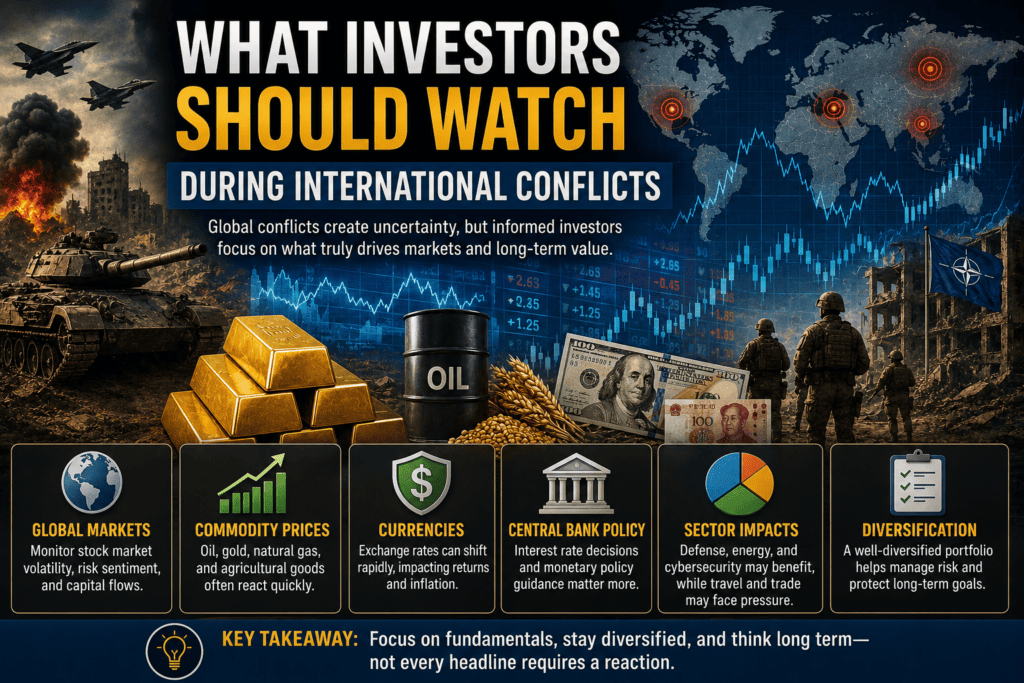
What Investors Should Watch During International Conflicts is one of the most important questions long-term investors can ask during periods of global uncertainty. When headlines report military conflicts, diplomatic disputes, economic sanctions, or rising geopolitical tensions, financial markets often react quickly. Consequently, many investors feel pressure to adjust their portfolios before fully understanding what is actually driving market movements.
Although international conflicts can influence stock prices, commodity markets, currencies, and investor sentiment, the relationship is rarely straightforward. Some industries may experience stronger demand, while others face temporary disruptions. At the same time, broader economic factors such as inflation, interest rates, central bank policy, and consumer confidence frequently play an equally important role.
Fortunately, history shows that disciplined investors often perform better when they focus on long-term fundamentals rather than emotional reactions. Instead of attempting to predict every geopolitical event, successful investors usually monitor a combination of economic indicators, corporate earnings, and portfolio diversification.
In this guide, you’ll learn which financial indicators deserve the most attention during international conflicts, how different asset classes have historically responded to periods of uncertainty, and what practical steps investors can take to make informed decisions without relying on fear or speculation.
Key Takeaways
- International conflicts can influence multiple financial markets simultaneously.
- Commodity prices often react quickly to geopolitical developments.
- Inflation and interest rates remain critical indicators to monitor.
- Diversification helps reduce portfolio risk during uncertain periods.
- Gold, energy, and defense-related industries may respond differently depending on the situation.
- Market volatility does not always indicate long-term economic weakness.
- Emotional investing often leads to poor financial decisions.
- Long-term fundamentals remain more important than daily headlines.
Why International Conflicts Affect Financial Markets
Financial markets constantly process new information.
When international conflicts emerge, investors begin reassessing economic expectations, corporate earnings, inflation forecasts, and overall market risk.
Consequently, stock prices may fluctuate significantly even before measurable economic effects appear.
However, not every conflict produces the same market reaction.
The size of the affected region, global trade relationships, commodity production, and government responses all influence investor behavior.
Understanding these variables helps investors interpret market movements more objectively.
The First Indicator: Energy Prices
Energy markets often respond rapidly to geopolitical developments.
Conflicts involving major oil- or natural gas-producing regions may disrupt production, transportation, or international trade.
As a result, crude oil and natural gas prices sometimes increase.
Higher energy costs can influence:
- Transportation expenses
- Manufacturing costs
- Consumer prices
- Corporate profit margins
- Inflation expectations
Because energy affects nearly every sector of the economy, investors frequently monitor commodity markets before making broader portfolio decisions.
Inflation Should Never Be Ignored
International conflicts sometimes contribute to inflationary pressure.
Supply chain disruptions, higher transportation costs, and rising commodity prices may increase business expenses.
Eventually, companies may pass part of those costs on to consumers.
Consequently, inflation becomes an important indicator for investors.
Nevertheless, inflation rarely depends on geopolitical events alone.
Monetary policy, labor markets, consumer demand, and economic growth also influence price levels.
Interest Rates Influence Nearly Every Asset Class
Central banks often adjust monetary policy in response to changing economic conditions.
Therefore, investors should monitor interest-rate expectations alongside geopolitical developments.
Higher interest rates may affect:
- Stock valuations
- Bond prices
- Mortgage costs
- Corporate borrowing
- Consumer spending
- Real estate markets
Although conflicts sometimes receive the most media attention, central bank decisions often have longer-lasting effects on financial markets.
Currency Markets Provide Important Clues
Foreign exchange markets frequently react before stock markets fully adjust.
Changes in investor confidence, interest-rate expectations, and global capital flows may strengthen or weaken major currencies.
The U.S. dollar, for example, often attracts increased attention during periods of global uncertainty.
However, currency movements depend on numerous economic variables beyond geopolitical events.
Consequently, investors should analyze foreign exchange trends within a broader macroeconomic context.
Commodity Markets Extend Beyond Oil
While oil often receives the most attention, other commodities may also experience increased volatility.
These include:
- Gold
- Silver
- Copper
- Natural gas
- Wheat
- Corn
- Industrial metals
Supply disruptions, transportation challenges, and changing global demand can all influence commodity prices.
Therefore, investors benefit from monitoring multiple commodity markets rather than focusing exclusively on energy.
Corporate Earnings Still Matter
During periods of uncertainty, many investors concentrate exclusively on headlines.
Experienced investors, however, continue analyzing corporate fundamentals.
Important financial indicators include:
- Revenue growth
- Earnings per share
- Free cash flow
- Profit margins
- Debt levels
- Management guidance
Companies with strong balance sheets often demonstrate greater resilience during volatile market conditions.
Looking Beyond Daily Headlines
Financial news changes every hour.
Nevertheless, successful investing rarely depends on reacting immediately to breaking events.
Instead, disciplined investors evaluate long-term economic trends, company fundamentals, valuation, and portfolio diversification before making investment decisions.
That thoughtful approach often proves more effective than attempting to predict short-term market movements.
In the next section, we’ll examine the asset classes, industries, and financial indicators that investors frequently monitor during periods of international conflict, while also discussing the opportunities and risks associated with each.
Asset Classes That Investors Often Monitor During International Conflicts
International conflicts rarely affect every investment in the same way.
Instead, different asset classes often respond according to changing economic expectations, inflation forecasts, and investor sentiment.
Consequently, understanding how each asset class behaves may help investors build more resilient portfolios.
Rather than assuming one investment will outperform in every situation, experienced investors evaluate several possibilities before making allocation decisions.
Stocks
Equities frequently experience increased volatility during periods of geopolitical uncertainty.
However, not every industry reacts identically.
Some businesses depend heavily on global trade, while others generate more stable domestic revenue.
Consequently, investors often compare sectors rather than focusing only on the overall market.
Strong companies with healthy balance sheets, diversified revenue streams, and consistent cash flow frequently demonstrate greater resilience over long investment horizons.
Bonds
Government bonds often attract investor attention during uncertain economic periods.
Many investors consider high-quality sovereign bonds an important component of diversified portfolios.
Nevertheless, bond prices remain heavily influenced by interest rates.
Therefore, investors should evaluate both monetary policy and inflation expectations before increasing fixed-income exposure.
Gold
Gold has historically been viewed as a store of value during periods of financial uncertainty.
Although gold prices sometimes rise when geopolitical tensions increase, performance varies depending on broader macroeconomic conditions.
Interest rates, inflation expectations, currency movements, and central bank purchases all influence the precious metals market.
Consequently, investors should evaluate gold within the context of an overall portfolio strategy rather than viewing it as a guaranteed hedge.
Energy Markets
Oil and natural gas frequently respond to geopolitical developments.
Supply disruptions, transportation risks, production changes, and export restrictions may influence energy prices.
Higher energy costs can affect businesses across multiple industries.
For that reason, investors often monitor both commodity markets and corporate earnings reports when evaluating the broader economic impact.
Currency Markets
International conflicts may influence foreign exchange markets through changes in investor confidence and global capital flows.
The U.S. dollar often receives considerable attention because of its role in international finance.
Even so, exchange rates also respond to inflation, interest rates, economic growth, and central bank policy.
Accordingly, currency movements should always be interpreted within a broader economic framework.
Industries That May Experience Different Market Conditions
Some industries are more sensitive to geopolitical developments than others.
The following comparison illustrates how different sectors may respond under changing economic conditions.
| Industry | Possible Economic Influence | Key Consideration |
|---|---|---|
| Energy | Commodity price changes | Supply disruptions |
| Precious Metals | Changing investor demand | Inflation expectations |
| Aerospace & Defense | Government procurement | Long-term contracts |
| Cybersecurity | Increased digital security investment | Technological competition |
| Utilities | Stable domestic demand | Interest-rate sensitivity |
| Consumer Staples | Essential products | Consumer spending trends |
Each industry faces unique opportunities and risks.
Therefore, investors should evaluate individual businesses rather than relying on broad assumptions.
Why Corporate Fundamentals Still Matter
Periods of market uncertainty often shift investor attention toward headlines.
However, long-term investment performance usually depends on company fundamentals.
Important financial indicators include:
- Revenue growth
- Earnings consistency
- Operating margins
- Free cash flow
- Return on invested capital
- Debt management
- Competitive advantages
Companies demonstrating strong financial discipline often prove more resilient during challenging economic periods.
Diversification Helps Reduce Portfolio Risk
Even experienced investors rarely concentrate their portfolios in one sector.
Instead, diversification spreads risk across multiple asset classes.
A balanced portfolio may include:
- Broad-market ETFs
- Dividend-paying companies
- Treasury securities
- REITs
- Precious metals
- International equities
- Cash reserves
Although diversification cannot eliminate losses, it may reduce the impact of unexpected market events.
Separate Headlines From Long-Term Trends
News cycles often create dramatic short-term market movements.
Nevertheless, many successful investors distinguish temporary events from long-term economic trends.
Instead of reacting emotionally to every headline, they evaluate economic data, corporate earnings, interest rates, inflation, and portfolio allocation.
This disciplined approach has historically supported more consistent long-term decision-making.
In the final section, we’ll examine common investing mistakes, practical portfolio strategies, frequently asked questions, and the most important lessons investors should remember when navigating periods of international conflict.
Expert Insights: Stay Focused on Fundamentals, Not Fear
Periods of international conflict often create uncertainty in financial markets.
However, experienced investors rarely build long-term portfolios around headlines alone.
Instead, they focus on business quality, economic fundamentals, portfolio diversification, and disciplined risk management. Consequently, they are less likely to make emotional decisions during volatile market conditions.
Although geopolitical events can influence markets, history suggests that successful long-term investing depends more on consistency than on accurately predicting every global development.
Rather than trying to forecast the next conflict, investors should concentrate on building resilient portfolios that can perform across different economic environments.
Common Mistakes Investors Should Avoid
International conflicts often trigger emotional reactions.
Fortunately, recognizing common mistakes can improve long-term investment outcomes.
Mistake 1: Reacting to Every Headline
Breaking news attracts attention.
Nevertheless, markets frequently price in new information long before individual investors react.
Instead of making immediate portfolio changes, review broader economic conditions first.
Mistake 2: Ignoring Portfolio Diversification
Some investors shift too much of their capital toward a single asset during periods of uncertainty.
However, concentrating investments in one sector may increase overall portfolio risk.
Diversification remains one of the most effective long-term risk-management strategies.
Mistake 3: Overlooking Economic Indicators
Conflicts represent only one part of the economic picture.
Interest rates, inflation, employment, corporate earnings, and monetary policy often influence markets just as much.
Consequently, investors should monitor several indicators simultaneously.
Mistake #4: Forgetting Long-Term Goals
Short-term volatility can distract investors from their financial objectives.
Nevertheless, retirement planning, wealth accumulation, and long-term portfolio growth generally require patience rather than frequent trading.
Keeping long-term goals in focus often leads to better decision-making.
Practical Action Plan
If you’re investing during periods of international uncertainty, this framework may help guide your decisions.
Step 1: Review Your Financial Goals
Ask yourself:
- Are you investing for retirement?
- Building long-term wealth?
- Seeking dividend income?
- Preserving capital?
Your answers should influence your investment strategy.
Step 2: Evaluate Your Portfolio Allocation
Review whether your investments remain appropriately diversified across:
- Stocks
- Bonds
- REITs
- Precious metals
- Cash
- International assets
Balanced portfolios often demonstrate greater resilience over time.
Step 3: Monitor Key Economic Indicators
Rather than following every headline, focus on data such as:
- Inflation
- Interest rates
- Corporate earnings
- Energy prices
- Currency markets
- GDP growth
- Employment trends
These indicators frequently provide more useful information than daily news cycles.
Step 4: Continue Investing Systematically
Many long-term investors maintain disciplined investment schedules regardless of short-term market volatility.
Consistent investing may reduce the temptation to make emotional decisions.
Step 5: Continue Expanding Your Knowledge
Financial markets evolve continuously.
Accordingly, investors should remain informed about:
- Global economics
- Monetary policy
- Portfolio management
- Asset allocation
- Risk management
- Behavioral finance
Continuous learning strengthens long-term investment decision-making.
Frequently Asked Questions
How do international conflicts affect the stock market?
International conflicts can increase market volatility by influencing investor sentiment, commodity prices, inflation expectations, and corporate earnings. However, each event affects markets differently depending on its economic impact.
Should investors sell stocks during geopolitical crises?
Not necessarily.
Many successful long-term investors avoid making emotional decisions based solely on current events.
Instead, they review their financial goals and overall portfolio strategy before making changes.
Why do commodity prices often rise during conflicts?
Supply disruptions, transportation challenges, and uncertainty regarding future production may increase commodity prices.
Nevertheless, demand, economic growth, and monetary policy also influence commodity markets.
Does gold always perform well during international conflicts?
No.
Although gold has historically attracted increased investor interest during some periods of uncertainty, its performance depends on several economic factors, including inflation, interest rates, and currency movements.
Which industries tend to receive increased investor attention?
Energy, precious metals, cybersecurity, aerospace, utilities, and defense-related industries often receive additional attention during periods of heightened geopolitical uncertainty.
However, individual company performance varies considerably.
Why is diversification important during uncertain times?
Diversification spreads investments across multiple asset classes.
Consequently, poor performance in one area may be partially offset by stronger performance elsewhere.
What is the most important lesson investors should remember?
Long-term investment success depends more on discipline, diversification, financial education, and consistent decision-making than on reacting to every geopolitical headline.
Final Thoughts
What Investors Should Watch During International Conflicts highlights an important reality: financial markets respond to far more than geopolitical events alone.
Although international conflicts can influence commodity prices, inflation, currencies, and investor sentiment, long-term investment outcomes generally depend on diversified portfolios, disciplined research, and strong financial fundamentals.
Rather than attempting to predict every global development, successful investors typically build portfolios capable of adapting to changing economic environments.
By focusing on education, patience, and sound portfolio management, investors place themselves in a stronger position to navigate uncertainty while pursuing long-term financial goals.
Internal Linking Opportunities
Strengthen your website’s SEO by linking this article to related content using anchor texts such as:
- How Wars Have Historically Affected the U.S. Stock Market
- How Geopolitical Risk Could Drive Gold Prices Higher
- Gold vs. Bitcoin During Geopolitical Crises
- The U.S.–China Trade War Isn’t Over: What Investors Need to Know
- Stocks That Could Benefit From Rising Military Spending
- Building a Diversified Investment Portfolio
- Dividend Stocks for Long-Term Investors
- REIT Investing Guide
- Passive Income Strategies
- Long-Term Investing for Beginners
External Authority Sources
Readers interested in learning more about investing during uncertain economic conditions can consult these trusted organizations:
- U.S. Securities and Exchange Commission (SEC): https://www.sec.gov
- Federal Reserve: https://www.federalreserve.gov
- International Monetary Fund (IMF): https://www.imf.org
- Morningstar: https://www.morningstar.com
- CFA Institute: https://www.cfainstitute.org
Final Call to Action
Global events will continue shaping financial markets for years to come.
Instead of allowing uncertainty to dictate your investment decisions, focus on building a diversified portfolio, strengthening your financial knowledge, and maintaining a disciplined long-term strategy.
Although markets will always experience periods of volatility, informed investors who remain patient and committed to their financial plans are often better prepared to navigate changing economic conditions with confidence.