
How Geopolitical Risk Could Drive Gold Prices Higher. Discover how wars, inflation, and global uncertainty may influence gold prices and investor behavior.
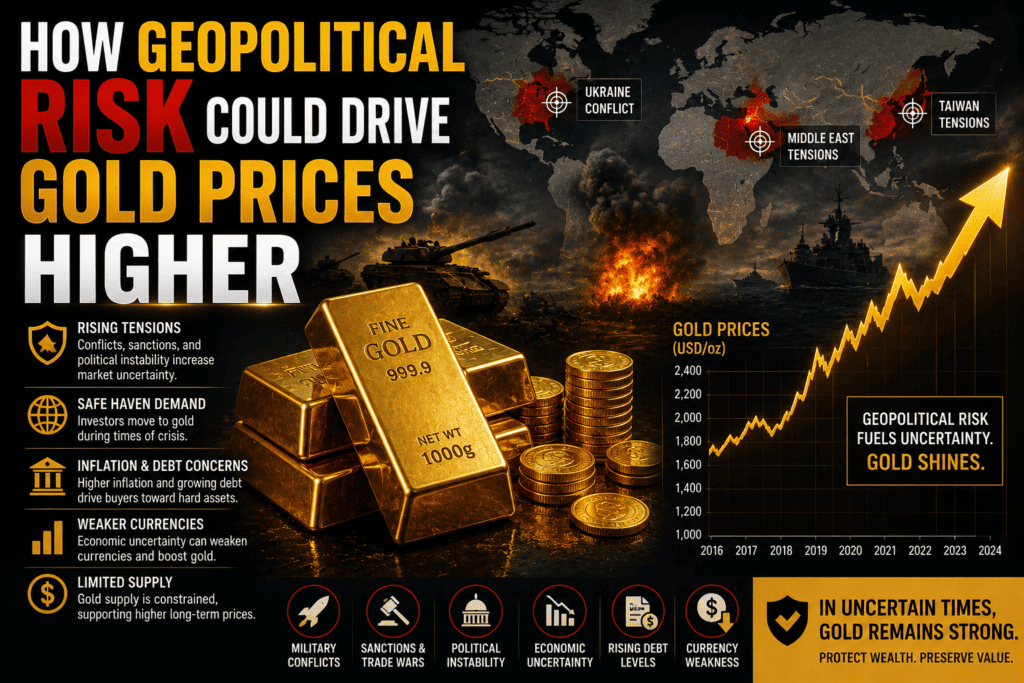
How Geopolitical Risk Could Drive Gold Prices Higher is a question that frequently resurfaces whenever financial markets face uncertainty. Wars, regional conflicts, trade disputes, sanctions, inflation concerns, and political instability often increase investor anxiety. Consequently, many investors begin looking for assets that have historically helped preserve wealth during challenging economic periods.
Gold has served as a store of value for thousands of years. Throughout history, governments, central banks, and private investors have turned to the precious metal during periods of financial stress. Although no investment performs well under every circumstance, gold has often attracted increased demand when confidence in other financial assets weakens.
Today’s global economy is highly interconnected. As a result, geopolitical events can influence commodity markets, currency values, inflation expectations, and central bank policies within a relatively short period. These interconnected forces help explain why movements in gold prices often extend beyond the immediate impact of a single geopolitical event.
In this guide, we’ll examine how geopolitical risk may influence gold prices, explore the economic mechanisms behind investor demand, and discuss the factors that long-term investors should monitor before adding gold or gold-related investments to a diversified portfolio. More importantly, you’ll learn why understanding market fundamentals is more valuable than reacting emotionally to breaking news.
Key Takeaways
- Geopolitical uncertainty often increases investor interest in gold.
- Gold has historically been viewed as a potential store of value.
- Inflation expectations can influence precious metal prices.
- Central bank activity plays an important role in the gold market.
- Currency movements frequently affect gold prices.
- Diversification remains essential for long-term investing.
- Gold does not guarantee positive returns during every crisis.
- Investors should evaluate multiple economic indicators before making decisions.
What Is Geopolitical Risk?
Geopolitical risk refers to uncertainty created by political, economic, or military events that may influence global markets.
These events can include:
- Military conflicts
- International sanctions
- Trade disputes
- Political instability
- Diplomatic tensions
- Energy supply disruptions
- Changes in government policy
Because financial markets dislike uncertainty, geopolitical developments often influence investor sentiment long before their full economic effects become visible.
Why Investors Often Turn to Gold
Gold has maintained its reputation as a valuable asset for centuries.
Unlike corporate stocks, gold does not depend on company earnings.
Likewise, it cannot be created through monetary policy in the same way that fiat currencies can.
Consequently, many investors consider gold a potential hedge against certain economic risks.
Some of its most frequently cited characteristics include:
- Limited natural supply
- Global recognition
- High liquidity
- Long historical track record
- Broad institutional ownership
- Portfolio diversification benefits
Although these features make gold attractive to many investors, they do not eliminate investment risk.
Why Gold Prices Don’t Rise After Every Crisis
One common misconception is that geopolitical events automatically cause gold prices to increase.
Reality is more complex.
Gold responds to multiple economic forces simultaneously.
For example, investors also monitor:
- Interest rates
- Inflation expectations
- U.S. dollar strength
- Central bank purchases
- Bond yields
- Market liquidity
Consequently, gold prices may remain stable—or even decline—during certain geopolitical events if other economic factors exert stronger influence.
Understanding these relationships helps investors avoid oversimplified conclusions.
The Connection Between Gold and Inflation
Inflation reduces the purchasing power of money over time.
As consumer prices rise, many investors search for assets that may help preserve long-term wealth.
Gold has often been viewed as one possible inflation hedge.
However, historical performance has varied across different inflationary periods.
Therefore, investors should evaluate inflation alongside broader economic conditions rather than relying on gold alone.
Central Banks Play an Important Role
Central banks remain among the world’s largest holders of gold.
Many institutions periodically adjust their reserves based on long-term monetary objectives.
Consequently, central bank purchases or sales can influence overall market demand.
Investors often monitor:
- Reserve accumulation
- Monetary policy
- Currency diversification
- Foreign exchange reserves
Because these institutions manage significant capital, their decisions frequently receive close attention from financial markets.
Why the U.S. Dollar Matters
Gold is generally priced in U.S. dollars.
As a result, movements in the dollar often influence gold prices.
When the dollar strengthens significantly, gold sometimes becomes more expensive for international buyers.
Conversely, a weaker dollar may support increased demand under certain market conditions.
Even so, currency movements represent only one factor affecting precious metal prices.
Looking Beyond Market Headlines
Financial news often emphasizes dramatic geopolitical events.
Nevertheless, experienced investors usually analyze broader economic trends before adjusting their portfolios.
Instead of reacting impulsively, they examine inflation, interest rates, central bank policy, currency markets, and overall portfolio diversification.
That disciplined approach generally produces more consistent long-term investment decisions.
In the next section, we’ll explore the historical relationship between geopolitical uncertainty and gold prices, examine the factors that have driven previous rallies, and discuss how investors can evaluate opportunities without relying on speculation.
How Gold Has Historically Responded to Geopolitical Events
Gold has earned its reputation over centuries rather than years.
Throughout history, investors have frequently increased their exposure to gold during periods of heightened uncertainty. Wars, financial crises, sovereign debt concerns, and inflationary episodes have often contributed to stronger demand for the precious metal.
However, gold has not reacted the same way in every event.
Sometimes prices have risen sharply.
In other situations, gold has remained relatively stable or even declined after an initial rally.
Consequently, investors should avoid assuming that every geopolitical development will automatically produce higher gold prices.
Instead, historical performance demonstrates that gold responds to a combination of economic and psychological factors.
Why Investor Psychology Matters
Financial markets are influenced by both economic fundamentals and human behavior.
When uncertainty increases, many investors seek stability rather than maximum returns.
As a result, demand for traditionally defensive assets often rises.
Gold frequently benefits from this shift in sentiment because it has long been viewed as a store of value.
Nevertheless, market psychology can change rapidly.
Once uncertainty begins to decline, investors sometimes rotate back toward growth-oriented assets.
Therefore, gold prices may adjust even if geopolitical risks remain present.
Inflation Expectations Can Influence Gold Demand
Inflation and geopolitical uncertainty often reinforce one another.
For example, conflicts may disrupt energy supplies, transportation networks, or international trade.
Consequently, businesses may experience higher production costs.
If those costs are passed on to consumers, inflation may accelerate.
Under these conditions, some investors increase their allocation to gold in an effort to preserve purchasing power.
Even so, inflation alone does not determine gold prices.
Interest rates and monetary policy remain equally important variables.
The Role of Interest Rates
Gold does not generate dividends or interest income.
Because of this characteristic, interest rates play an important role in investor decision-making.
When interest rates rise significantly, income-producing assets such as bonds may become more attractive.
Conversely, lower interest rates sometimes increase investor interest in gold.
Therefore, evaluating central bank policy helps investors better understand the broader environment influencing precious metals.
Energy Markets and Gold
Energy prices frequently respond to geopolitical developments.
Higher oil and natural gas prices can contribute to broader inflationary pressures.
Consequently, some investors increase exposure to gold when energy markets become more volatile.
Although the relationship is not perfectly consistent, both markets often respond to similar macroeconomic forces.
Understanding these connections provides additional context when analyzing precious metals.
Gold Compared With Other Defensive Assets
Investors have several options when seeking portfolio protection during uncertain periods.
Each asset offers different characteristics.
| Asset | Potential Strength | Primary Consideration |
|---|---|---|
| Gold | Long history as a store of value | No income generation |
| U.S. Treasury Bonds | Government backing | Sensitive to interest rates |
| Cash | High liquidity | Inflation risk |
| Gold Mining Stocks | Potential leverage to gold prices | Operational business risk |
| Bitcoin | Digital scarcity | Higher volatility |
Rather than searching for one perfect solution, many investors combine multiple defensive assets.
Physical Gold vs. Gold ETFs
Modern investors can access gold in several ways.
Physical ownership remains one option.
Alternatively, many investors purchase gold exchange-traded funds (ETFs) that track the price of the metal.
Physical gold offers direct ownership.
Meanwhile, ETFs generally provide greater liquidity and convenience.
Because each approach has unique advantages, investors should evaluate costs, storage considerations, and overall portfolio objectives before making a decision.
Why Diversification Remains Essential
Gold can contribute to portfolio diversification.
Nevertheless, concentrating too heavily in any single asset increases investment risk.
Experienced investors often combine gold with:
- Broad-market ETFs
- Dividend-paying stocks
- REITs
- High-quality bonds
- International equities
- Cash reserves
This balanced approach reduces dependence on one market outcome while improving long-term portfolio resilience.
Looking Beyond Short-Term Price Movements
Daily fluctuations in gold prices often attract considerable media attention.
However, successful long-term investors usually focus on broader economic trends rather than short-term volatility.
Instead of reacting to every headline, they evaluate inflation expectations, monetary policy, currency markets, and overall portfolio allocation.
That disciplined process generally produces more consistent investment decisions over time.
In the final section, we’ll examine common investing mistakes, practical portfolio strategies, frequently asked questions, and the most important lessons investors should remember when evaluating gold during periods of geopolitical uncertainty.
Expert Insights: Should Gold Be Part of Every Portfolio?
One of the most common questions investors ask is whether everyone should own gold.
The answer depends on individual financial goals rather than market headlines.
Gold has historically served as a portfolio diversifier and a potential store of value during periods of economic uncertainty. Nevertheless, it should not be viewed as a replacement for a diversified investment strategy.
Experienced investors generally evaluate gold as one component of a broader financial plan that may also include stocks, bonds, REITs, cash reserves, and other asset classes.
Instead of asking whether gold is “good” or “bad,” a more useful question is:
“Does gold improve the overall balance of my portfolio?”
That perspective often leads to better long-term investment decisions.
Common Mistakes Investors Make
Periods of geopolitical uncertainty often encourage emotional decision-making.
Fortunately, understanding the most common mistakes can help investors remain disciplined.
Mistake 1: Buying Gold Only After Prices Surge
When gold experiences a strong rally, many investors feel pressure to buy immediately.
However, purchasing an asset solely because it recently increased in price may expose investors to unnecessary risk.
Instead, evaluate long-term objectives before making allocation decisions.
Mistake 2: Ignoring Interest Rates
Many investors focus exclusively on geopolitical headlines.
Nevertheless, interest rates remain one of the most important drivers of gold prices.
Consequently, monitoring central bank policy provides valuable context when evaluating precious metals.
Mistake 3: Treating Gold as a Guaranteed Investment
Gold has preserved wealth across many historical periods.
Even so, no investment guarantees positive returns.
Gold prices sometimes remain flat or decline for extended periods.
Therefore, realistic expectations are essential.
Mistake 4: Neglecting Diversification
Some investors allocate excessive portions of their portfolios to one defensive asset.
Although gold can contribute to risk management, diversification across multiple asset classes generally produces more balanced long-term results.
Action Plan for Long-Term Investors
If you’re considering adding gold to your investment portfolio, this framework may help guide your decisions.
Step 1: Define Your Investment Goals
Begin by identifying your primary objective.
Are you seeking:
- Inflation protection?
- Portfolio diversification?
- Long-term wealth preservation?
- Reduced volatility?
Your goals should determine the role gold plays within your portfolio.
Step 2: Evaluate Your Risk Tolerance
Every investor responds differently to market volatility.
Some investors prefer stable assets.
Others accept greater short-term fluctuations in pursuit of higher long-term growth.
Understanding your personal risk tolerance helps determine an appropriate allocation.
Step 3: Choose the Right Type of Gold Exposure
Several investment options exist.
These include:
- Physical gold
- Gold ETFs
- Gold mining stocks
- Precious metals mutual funds
Each alternative offers unique advantages and disadvantages.
Therefore, investors should compare liquidity, costs, convenience, and portfolio objectives before investing.
Step 4: Maintain Diversification
Gold should complement—not replace—a diversified portfolio.
Many investors combine precious metals with:
- Broad-market ETFs
- Dividend stocks
- Bonds
- REITs
- Cash reserves
This balanced allocation helps reduce overall portfolio risk.
Step 5: Continue Monitoring Economic Conditions
Financial markets evolve continuously.
Accordingly, investors should remain informed about:
- Inflation
- Interest rates
- Central bank activity
- Currency markets
- Global economic growth
- Geopolitical developments
Continuous learning supports better investment decisions over time.
Frequently Asked Questions
Why does geopolitical risk sometimes increase gold prices?
Periods of uncertainty may increase investor demand for assets perceived as stores of value.
However, gold prices also depend on interest rates, inflation expectations, central bank activity, and currency movements.
Is gold always a safe-haven asset?
Gold has historically been viewed as a traditional safe-haven investment.
Nevertheless, no asset performs well under every market condition.
Future returns can never be guaranteed.
Does inflation always push gold higher?
Not necessarily.
Although inflation sometimes supports gold prices, interest rates, monetary policy, and investor sentiment also influence market performance.
Should beginners invest in physical gold or ETFs?
Many beginners choose gold ETFs because they provide liquidity and eliminate storage concerns.
Others prefer physical ownership.
The appropriate choice depends on individual preferences and financial objectives.
Can gold protect a portfolio during recessions?
Gold has historically provided diversification benefits during certain economic downturns.
However, its performance varies depending on broader financial conditions.
Are gold mining stocks the same as owning gold?
No.
Gold mining companies are operating businesses.
Consequently, their share prices depend on operational performance in addition to gold prices.
What is the biggest lesson investors should remember?
Long-term investing depends more on diversification, discipline, and realistic expectations than on reacting to short-term geopolitical headlines.
Final Thoughts
How Geopolitical Risk Could Drive Gold Prices Higher demonstrates that global events can influence investor behavior, inflation expectations, and financial markets.
Although gold has historically attracted increased attention during periods of uncertainty, its price reflects a combination of economic, monetary, and psychological factors.
Rather than assuming geopolitical risk automatically guarantees higher gold prices, investors should evaluate the broader economic environment while maintaining diversified portfolios.
Successful investing is rarely about predicting the next crisis.
Instead, it involves preparing thoughtfully for multiple possible outcomes.
By combining disciplined research, diversification, and long-term planning, investors can build portfolios that remain resilient across changing market conditions.
Internal Linking Opportunities
Strengthen your website’s SEO by linking this article to related content using anchor texts such as:
- Gold vs. Bitcoin During Geopolitical Crises
- The Best Gold Mining Stocks to Watch During Global Tensions
- How Wars Have Historically Affected the U.S. Stock Market
- Building a Diversified Investment Portfolio
- Dividend Stocks for Long-Term Investors
- REIT Investing Guide
- Passive Income Strategies
- Inflation and Investing Explained
- Dollar-Cost Averaging Strategy
- Warren Buffett’s Long-Term Investment Philosophy
External Authority Sources
Readers interested in learning more about gold and global markets can consult the following trusted organizations:
- U.S. Securities and Exchange Commission (SEC): https://www.sec.gov
- Federal Reserve: https://www.federalreserve.gov
- World Gold Council: https://www.gold.org
- Morningstar: https://www.morningstar.com
- CFA Institute: https://www.cfainstitute.org
Final Call to Action
Geopolitical uncertainty will always be part of investing.
Rather than reacting emotionally to every headline, focus on building a diversified portfolio, strengthening your financial knowledge, and maintaining a disciplined long-term strategy.
Although no investment eliminates risk completely, thoughtful planning and consistent decision-making can help you navigate changing markets with greater confidence while pursuing your long-term financial goals.